Ana Megawati
The Spring/Summer collections at London Fashion Week delivered an unexpected masterclass in heritage rehabilitation and avant-garde craftsmanship, anchored by the high-profile joint comeback of designer Christopher Kane and legacy leather goods house Mulberry. Featuring provocative spicy leather mini-dresses, sculptural footwear detailed with miniature axes, and a deeply personal exploration of British identity, the showcase signaled a watershed moment for the British fashion ecosystem. Fifteen years ago, Kane and Mulberry occupied the absolute apex of the London style hierarchy. Kane was celebrated as a visionary prodigy capable of locating high-fashion elegance in unconventional sources—most famously transforming rubberised lace into mini-dresses inspired by "Princess Margaret on acid" and printing illustrations from the 1972 classic The Joy of Sex onto fluid slip dresses. Simultaneously, Mulberry reigned supreme as Britain’s homegrown "It-bag" manufacturer, commanding global waitlists for signature silhouettes like the Bayswater and the Alexa.
Yet, the intervening decade and a half tested the resilience of both entities. The COVID-19 pandemic severely destabilised independent luxury brands, leading Kane to place his eponymous label into administration in 2023. Mulberry faced its own existential hurdles after misjudging consumer price hikes, subsequently fighting off an aggressive corporate takeover bid as annual profits plummeted. However, a strategic executive restructuring, a renewed commitment to domestic British craftsmanship, and an emphasis on traditional manufacturing techniques have catalysed a robust commercial revival for Mulberry, evidenced by a 23 percent surge in sales during the first quarter of the year. The appointment of Christopher Kane as creative director marks a definitive return of ambitious artistic direction for the brand, offering a high-profile platform to harness Kane’s unique tailoring vision.
An Unlikely Alliance Rooted in Leather
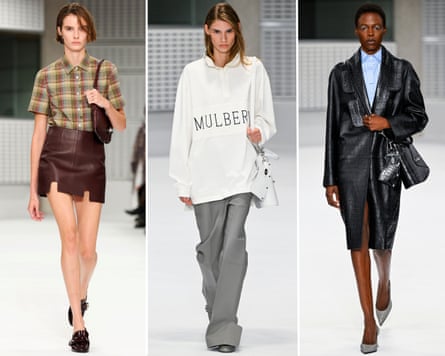
On paper, the partnership between Christopher Kane and Mulberry reads as a paradox of design philosophies. Mulberry’s brand equity is anchored in its historic workshops in Somerset, synonymous with understated, utilitarian luxury and heritage leather goods. In contrast, Kane’s aesthetic identity was forged on the gritty, urban streets of Glasgow, characterized by transgressive party dressing and subverted motifs. Their common denominator, however, is leather. The collaborative runway presentation featured sharp leather sheath dresses and minimalist, impeccably tailored car coats alongside heeled loafers integrated with Mulberry’s iconic postman’s lock.
True to his methodical design process—which historically draws from isolated visual motifs such as Frankenstein, gorillas, or the reproductive anatomies of plants—Kane utilised the castellated leather flaps of Mulberry’s Bayswater bags to shape notched necklines and garment hems. The resulting collection successfully bridged the gap between avant-garde conceptualism and commercial viability, pairing full-throttle statement fashion with market-ready luxury accessories.
Exploring British Identity Beyond the Capital

Titled "Town, City, Country," Kane’s collection drew heavily from his formative years in Scotland. The palette was a direct tribute to the bleak, post-industrial landscapes of his youth, juxtaposing concrete grays with coalminer orange, while soft plaid checks injected a rustic counterpoint into the urban silhouettes. Backstage, Kane articulated a broader philosophical shift for the brand: "I want Mulberry to be about a Britishness that’s not London-centric."
This decentralization of style mirrored a broader thematic currents across London Fashion Week, which benefited from a revitalised schedule, robust buyer attendance, and renewed institutional confidence. Designers across the capital looked far beyond traditional London reference points to construct their narratives, drawing inspiration from diverse historical, artistic, and geographic sources.
Broader Runway Highlights and Creative Inspirations
The overarching mood of the fashion week was defined by an intellectual approach to garment construction, where designers looked to historical anomalies, fine art, and performance disciplines to inform their collections.
Simone Rocha found her conceptual starting point in a real-world news story regarding an unknown Caravaggio painting discovered inside a Dublin drawing room. This narrative prompted Rocha to explore the concept of "beautiful things in unobvious places," translating the theme into a series of striking dresses featuring intricate silk roses trailing delicately from hemlines or partially obscured beneath layers of structured tulle.
Erdem turned his focus toward Barbette, the avant-garde 1920s Parisian trapeze artist whose breathtaking circus acts routinely concluded with the dramatic revelation that the performer was a Texas-born man. Erdem’s collection paid homage to this theatrical duality through leotard-tight dresses enveloped in crystalline spiderwebs and paired with high-collared circus master coats.
Edeline Lee collaborated directly with artists from the Royal Ballet, showcasing her dance-inspired collection inside a utilitarian north London school sports hall. The presentation featured precisely-waisted, full-skirted dresses juxtaposed with slouchy, rehearsal-ready knitwear.
Meanwhile, Emilia Wickstead reflected on her identity as an "old-school girl" with an affinity for classic silhouettes and vintage tailoring, often soundtracked by jazz music. Eager to subvert traditional presentation formats, Wickstead noted that she is rapidly "outgrowing the space" of her typical London boutique runway. For this season, she produced a cinematic fashion film paired with physical spatial screenings, enabling an immersive set design of interwoven pastel rooms that would have been financially and physically impossible within the confines of a traditional boutique catwalk. Her collection was directly inspired by American abstract expressionist Lee Krasner, translating the artist’s aesthetic into painted daisy silk dresses, aprons of fine tweed shedding colorful threads like flecks of oil paint, and tailored artist shirts.
Economic Implications and Industry Analysis
The successful execution of London Fashion Week’s spring showcase highlights a critical period of stabilization and strategic reinvention for the British fashion sector. Following years of post-pandemic financial distress, regulatory shifts resulting from Brexit, and escalating operational costs, the industry has demonstrated remarkable resilience through strategic consolidation and creative realignment.
The partnership between Kane and Mulberry serves as a prime case study in contemporary luxury resuscitation. By pairing an endangered design visionary with a heritage brand seeking modern relevance, parent companies are discovering viable pathways to mitigate risk while capturing consumer imagination. Analysts note that heritage brands can no longer rely solely on historical prestige; they require disruptive creative leadership to maintain relevance among younger, highly discerning demographics.
Furthermore, the commercial uptick reported by Mulberry—bolstered by a 23% increase in early-year sales—indicates that consumers are responding favorably to localized craftsmanship, transparent supply chains, and localized design narratives. By grounding collections in tangible British heritage rather than generic global trends, labels are successfully protecting their market share against macroeconomic headwinds.
As London Fashion Week draws to a close, the overarching sentiment is one of cautious optimism. The dual triumph of established prodigies and institutional mainstays proves that British fashion retains its unmatched capacity for reinvention, narrative depth, and commercial pragmatism.