Ana Megawati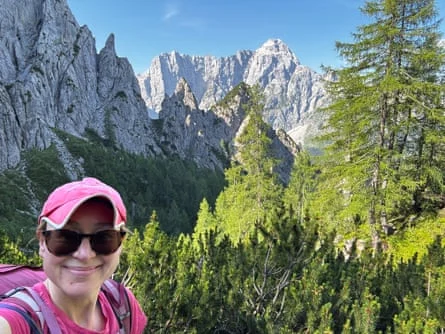
The concept of the European nation-state has historically been defined by rigid lines drawn across maps, enforced by customs posts, border guards, and infrastructure designed to separate populations. Yet, in the high-altitude reaches of the Eastern Alps, where Austria, Italy, and Slovenia converge, these geopolitical barriers have increasingly given way to fluid recreational landscapes. At the center of this transformation is the Alpe Adria Trail, a 750-kilometer long-distance hiking route that stretches from the foothills of Austria’s highest peak, the Grossglockner, down to the Adriatic coast.
While the full traverse represents an expedition demanding weeks of endurance, a more accessible 135-kilometer moderate-grade loop has captured the imagination of international travelers. Designed as a collaborative venture between Austrian, Italian, and Slovenian regional tourism authorities, this circuit offers a multicultural alpine taster. It allows hikers to cross multiple international frontiers in a single day without encountering physical checkpoints, highlighting the frictionless movement enabled by the Schengen Agreement and a shared regional commitment to cross-border cooperation.
Main Facts and Route Overview
The 135-kilometer tri-country loop is engineered for intermediate hikers, typically completed in a seven-to-eight-day itinerary with daily stages ranging from 15 to 24 kilometers. The route traverses the distinct cultural and ecological zones of Carinthia in Austria, Friuli-Venezia Giulia in Italy, and the Upper Carniola region in Slovenia.

Unlike the notoriously congested Tour du Mont Blanc in the Western Alps—which struggles with over-tourism and severe environmental degradation—the Alpe Adria loop presents a quieter, less saturated alternative. The trail navigates a diverse terrain of pine forests, glacial lakes, limestone ridges, and high-altitude pastures known locally as Alm. Along the way, travelers transition effortlessly between German, Italian, and Slovenian linguistic and culinary traditions, experiencing a micro-cosmos of Central European diversity.
Chronological Journey Through Three Nations
Departure and the Austrian Ascent
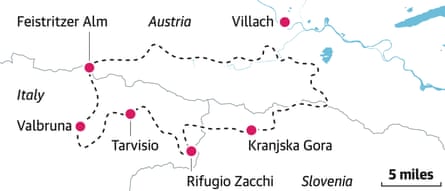
The journey traditionally commences in Carinthia, near the Austrian village of Feistritz. Following historical trade routes and paths used by generations of farmers and pilgrims, the trail climbs away from valley settlements past centuries-old rural architecture, such as 15th-century parish churches whose bells continue to regulate rural life.
From the tree line, the route ascends onto high-altitude pastures like the Feistritzer Alm. Here, formal state borders are demarcated with understated Prussian-font signage bearing the legend Achtung! Staatsgrenze!. In practice, however, these markers function merely as geographical curiosities rather than administrative hurdles. Hikers, mountain bikers, and grazing livestock move across the frontier unimpeded, while patrons at mountain huts such as Schutzhütte Oisternig consume local provisions regardless of which side of the national demarcation line they happen to be seated on.
The Italian Valleys and Alpinist Heritage
Crossing into Italy brings hikers into the deep-green foothills of the Julian Alps and the rugged range of the Jôf Fuart. Valleys such as Valbruna offer accommodation steeped in regional history, including establishments honoring Julius Kugy. Born in 1858 in Gorizia—then part of the Austro-Hungarian Empire, now in Italy—Kugy is widely regarded as the foundational figure of Julian Alpine exploration. His literary works, preserved in regional libraries, framed the mountains not as military obstacles or economic hazards, but as philosophical sanctuaries capable of engendering profound human fulfillment.
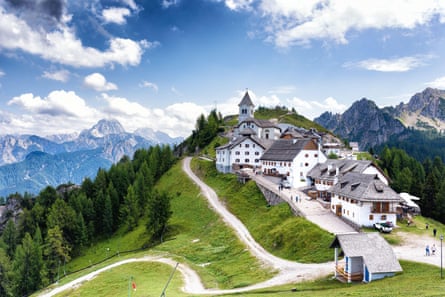
Further along the Italian section, the trail passes the Sanctuary of Monte Lussari, a ridge-top hamlet established following a reported Marian apparition in 1360. Serving historically as a site of Catholic pilgrimage, Monte Lussari exemplifies the syncretism of the region, where Slavic, Germanic, and Romance cultural influences have long overlapped.
Descending toward Tarvisio and the arresting blue-green glacial waters of the Fusine lakes, the itinerary demands physical resilience. The climb to Rifugio Zacchi at 1,380 meters tests endurance before rewarding hikers with local culinary specialties such as frico, a traditional Friulian dish made from Montasio cheese and potatoes, paired with venison ragù.
Slovenia and the Karavanke Ridge
The final phases of the loop lead into Slovenia via the Sava Valley and the alpine hub of Kranjska Gora. From there, the route turns north to conquer the highest point of the circuit: the 1,842-meter Schwarzkogel in the Karavanke Alps.
As hikers ascend the ridge, sweeping vistas open up: south toward Slovenia’s jagged interior peaks and north toward the electric-blue lakes of Austrian Carinthia. Along the watershed ridge, squat white boundary stones trace the international frontier with casual informality. Descending these slopes completes a continuous circuit that underscores the geographical continuity of the mountain range despite centuries of shifting political sovereignty.
Supporting Data and Tourism Metrics
The development of the Alpe Adria Trail and its regional loops reflects broader European trends in sustainable, slow-adventure tourism. According to regional tourism boards in Carinthia and Friuli-Venezia Giulia, long-distance walking routes have experienced steady year-on-year growth in visitor numbers, driven by demand for outdoor recreation that minimizes carbon footprints.
- Total Trail Length (Full Route): Approximately 750 kilometers (466 miles).
- Tri-Country Loop Length: 135 kilometers (84 miles).
- Recommended Duration: 7 to 8 days.
- Daily Stage Distances: 15 to 24 kilometers (9 to 15 miles).
- Maximum Elevation: 1,842 meters (Schwarzkogel).
- Logistical Accessibility: Supported by international rail connections, including European sleeper services (Nightjet) linking major hubs like Amsterdam and Vienna to Salzburg and Villach.
Official Responses and Stakeholder Perspectives
Regional tourism authorities and conservationists have praised the tri-country initiative for distributing economic benefits to rural communities that historically relied solely on declining agricultural or heavy industrial sectors.
"The Alpe Adria project demonstrates that borders do not need to be barriers to economic and cultural vitality," noted a representative from a regional tourism development agency in Carinthia. "By uniting three countries under a single trail network, we provide visitors with a holistic experience of the Eastern Alps while supporting small-scale hoteliers, mountain hut wardens, and local artisans."
Local alpine clubs emphasize the safety and infrastructural cooperation required to maintain multi-jurisdictional trails. Search and rescue coordination, path maintenance, and environmental protection standards are harmonized across Austrian, Italian, and Slovenian authorities to ensure uniform safety protocols for international visitors.
Broader Impact and Economic Implications
The success of cross-border itineraries like the Alpe Adria loop points to a wider shift in European regional development. By capitalizing on historical infrastructure—such as ancient mule tracks, pilgrimage routes, and forestry paths—local governments can promote high-value, low-impact tourism without the need for extensive new construction.
Furthermore, the integration of international rail travel with self-guided hiking packages aligns with European Union sustainability targets. Many travelers access the trailheads via low-emission rail networks, reducing the reliance on private motor vehicles in sensitive alpine valleys.
Ultimately, the Alpe Adria trek transcends its function as a recreational pathway. It serves as a living laboratory for European integration, demonstrating how shared natural heritage can bind neighboring nations closer together through mutual appreciation, environmental stewardship, and shared economic enterprise.