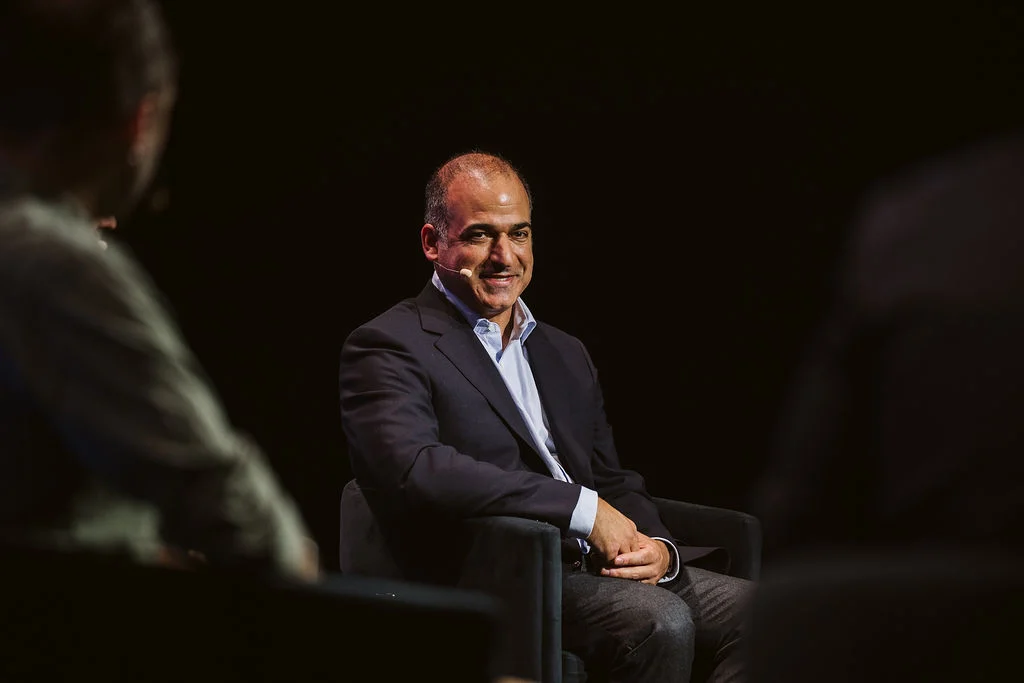
Prabowo Widodo
Signal President Meredith Whittaker, a prominent voice in digital privacy and AI ethics, has issued a forceful caution regarding the pervasive integration of advanced chatbots like ChatGPT and Claude into daily life, unequivocally stating that these systems are "not your friends," "not conscious beings," and "not sentient interlocutors." Her remarks, made during a comprehensive interview with Bloomberg published on June 20, 2026, underscore a growing alarm among privacy advocates about the potential for artificial intelligence to erode personal autonomy and data security. Whittaker’s commentary comes at a critical juncture, as AI technologies rapidly evolve from niche tools to ubiquitous assistants, prompting an urgent re-evaluation of their role and the trust users place in them.
Whittaker’s Core Argument: Dispelling the Myth of Sentient AI
Whittaker’s primary concern revolves around the dangerous anthropomorphism of large language models (LLMs). She argues that by imbuing these statistical prediction engines with human-like qualities – such as consciousness, sentience, or even friendship – users risk a fundamental misunderstanding of their underlying mechanisms and, consequently, their inherent limitations and privacy implications. These AI models, while capable of generating remarkably coherent and contextually relevant text, operate by identifying patterns and probabilities within vast datasets, not by understanding or feeling. They simulate conversation; they do not engage in it from a place of genuine comprehension or personal experience.
The impulse to humanize AI stems from several factors, including sophisticated conversational interfaces, clever marketing, and the human brain’s natural tendency to seek connection and attribute agency. However, Whittaker warns that this tendency creates a false sense of security, encouraging users to share intimate details or rely on AI for critical decision-making without fully grasping the data collection, processing, and potential vulnerabilities involved. As co-founder of the AI Now Institute and a long-time advocate for ethical technology, Whittaker has consistently highlighted the power dynamics embedded in technological systems, and her current position at Signal, a leading end-to-end encrypted messaging service, further amplifies her commitment to user privacy and digital autonomy. Her caution is not merely theoretical; it is rooted in years of observing how technological advancements, when deployed without sufficient ethical guardrails, can inadvertently undermine fundamental rights.
The Personal Cost of Convenience: Data Pervasiveness
A significant portion of Whittaker’s critique targeted the burgeoning trend of AI systems assuming increasingly agentic roles in users’ lives, often framed as ultimate convenience. She specifically addressed a prediction made by Microsoft AI CEO Mustafa Suleyman in a 2025 interview, suggesting that users could delegate their entire Christmas shopping to Microsoft Copilot. Whittaker meticulously dismantled this seemingly innocuous scenario, illustrating the profound privacy sacrifices such an arrangement would entail.
To facilitate Christmas shopping, Copilot, or any similar "personal AI agent," would require what Whittaker termed "very pervasive access across multiple applications and services." This access would necessarily extend to highly sensitive personal data: a user’s credit card information for purchases, browser history to understand preferences and track potential gifts, access to private communication channels like Signal to "eavesdrop on the family group chat to determine who wants what," the ability to message siblings on the user’s behalf, knowledge of home addresses for shipping, and calendar access to manage delivery schedules or holiday events.
Whittaker unequivocally stated that, "In the context of Signal, it would constitute a kind of a backdoor." This analogy is particularly potent given Signal’s foundational commitment to end-to-end encryption, which ensures that only the sender and intended recipient can read messages, not even Signal itself. If an AI assistant, operating on behalf of a user, were granted the permission to access and interpret these encrypted communications, it would fundamentally bypass the very privacy protections Signal is designed to provide. While technically the user would be granting permission, the implications for data aggregation and potential exploitation are immense. Such a system would effectively centralize an unprecedented volume of personal data, creating a single point of failure and an irresistible target for malicious actors or data brokers. The convenience offered by such an AI comes at the potentially catastrophic cost of digital sovereignty.
Signal’s Stance: A Beacon for Secure Communication
Signal, under Whittaker’s leadership, remains steadfast in its mission to provide privacy-preserving communication tools. The platform’s architecture is designed to minimize data collection, and all communications are end-to-end encrypted by default, meaning that Signal cannot access the content of messages, calls, or media exchanged between users. This commitment places Signal in direct opposition to business models that rely on extensive data harvesting and profiling, which are often integral to the functionality and profitability of many AI services.
Whittaker’s concerns are therefore not just academic; they reflect the core ethos of Signal. The idea of an external AI system siphoning information from a Signal chat, even with a user’s supposed consent, represents a direct threat to the privacy guarantees Signal offers. It highlights the critical distinction between user-controlled data and data that, once shared with an AI, becomes part of a broader, less transparent ecosystem. This distinction is crucial for users to understand as they navigate a digital world increasingly populated by AI assistants.
The Broader AI Landscape: Rapid Growth and Emerging Risks
Whittaker’s warning is set against a backdrop of unprecedented acceleration in AI development and deployment. The public launch of OpenAI’s ChatGPT in late 2022 marked a pivotal moment, introducing sophisticated conversational AI to a mainstream audience and catalyzing a global race among tech giants to integrate similar capabilities across their product suites. Companies like Anthropic, with its focus on "constitutional AI" and safety-aligned models like Claude, have also emerged as significant players, aiming to address some of the ethical concerns from the outset. However, the fundamental data-hungry nature of these models remains a constant.

The global AI market, projected to reach well over a trillion dollars in the coming years, is driven by innovation across various sectors, from healthcare to finance to personal productivity. While the potential benefits are vast – from accelerating scientific discovery to streamlining mundane tasks – the rapid pace of development has outstripped public understanding and, in many cases, regulatory oversight. This creates a fertile ground for privacy erosion, as new functionalities are rolled out before their long-term societal impacts are fully comprehended.
One key risk lies in the training data itself. LLMs are trained on colossal datasets scraped from the internet, often containing copyrighted material, personal information, and potentially biased or harmful content. While developers implement measures to filter and fine-tune models, the sheer scale makes complete oversight challenging. Furthermore, user interactions with these models often become additional training data, creating a continuous feedback loop that raises questions about data ownership, consent, and the potential for inadvertently exposing sensitive information. The more users engage with AI, the more data these systems collect and process, creating ever-more detailed digital profiles that can be exploited for targeted advertising, surveillance, or even manipulation.
Regulatory Scrutiny and Industry Response
Governments and international bodies worldwide are grappling with how to regulate this rapidly evolving technology. The European Union has taken a leading role with its proposed AI Act, which categorizes AI systems by risk level and imposes stringent requirements on high-risk applications. In the United States, executive orders and legislative proposals are beginning to shape a framework for AI governance, focusing on safety, security, and privacy. However, the challenge lies in crafting regulations that are robust enough to protect citizens without stifling innovation in a highly competitive global landscape.
The tech industry, while pushing the boundaries of AI capabilities, has also begun to acknowledge the need for ethical considerations. Many major AI developers have published guidelines for responsible AI development, emphasizing principles like fairness, accountability, and transparency. Companies often highlight their efforts to anonymize data, implement robust security measures, and provide users with controls over their interactions. However, critics like Whittaker often point out the gap between stated principles and actual practices, particularly when those practices conflict with profit motives or the drive for market dominance. The tension between providing seamless, intelligent services and protecting user privacy remains a central conflict in the AI era.
The Paradox of AI: Innovation vs. Intrusions
Whittaker’s comments highlight a profound paradox at the heart of the AI revolution: the very innovations that promise to enhance convenience and productivity often demand unprecedented levels of personal data access, potentially leading to intrusions into private life. The allure of an AI assistant that can manage our schedules, handle our finances, and even anticipate our needs is powerful. Yet, realizing this vision requires constructing systems with a comprehensive, almost omniscient, view of our digital existence.
The dilemma for individuals is stark: embrace the efficiency and ease offered by these advanced AI tools, or prioritize digital privacy and autonomy, potentially at the cost of convenience. This is not a simple choice, as AI is increasingly integrated into essential services and platforms. Whittaker’s stance encourages a critical, discerning approach, urging users to understand what they are consenting to and to question the implications of surrendering control over their digital lives to algorithmic systems. It’s a call for informed consent that goes beyond merely clicking "agree" on terms of service.
Looking Ahead: Shaping the Future of AI Ethics and Privacy
Meredith Whittaker’s forthright statements serve as a crucial reminder that the rapid ascent of artificial intelligence demands ongoing vigilance and critical engagement from all stakeholders. Her warning against anthropomorphizing chatbots is a call for intellectual honesty about the nature of these machines, while her critique of pervasive data access underscores the concrete privacy risks inherent in the pursuit of ultimate convenience. As AI systems become more sophisticated and integrated into the fabric of daily life, the questions she raises will only become more pressing.
The future of AI ethics and privacy will hinge on a collaborative effort involving technologists, policymakers, and the public. Developers bear the responsibility of designing systems with privacy by design, implementing robust security measures, and being transparent about data collection and usage. Regulators must create adaptable frameworks that protect fundamental rights without stifling beneficial innovation. And critically, users must cultivate digital literacy, understanding both the immense power and the inherent limitations and risks of AI. Ultimately, Whittaker’s message is an urgent plea to shape an AI future where technological advancement genuinely serves humanity, rather than inadvertently undermining its privacy and autonomy.