Jono Maryono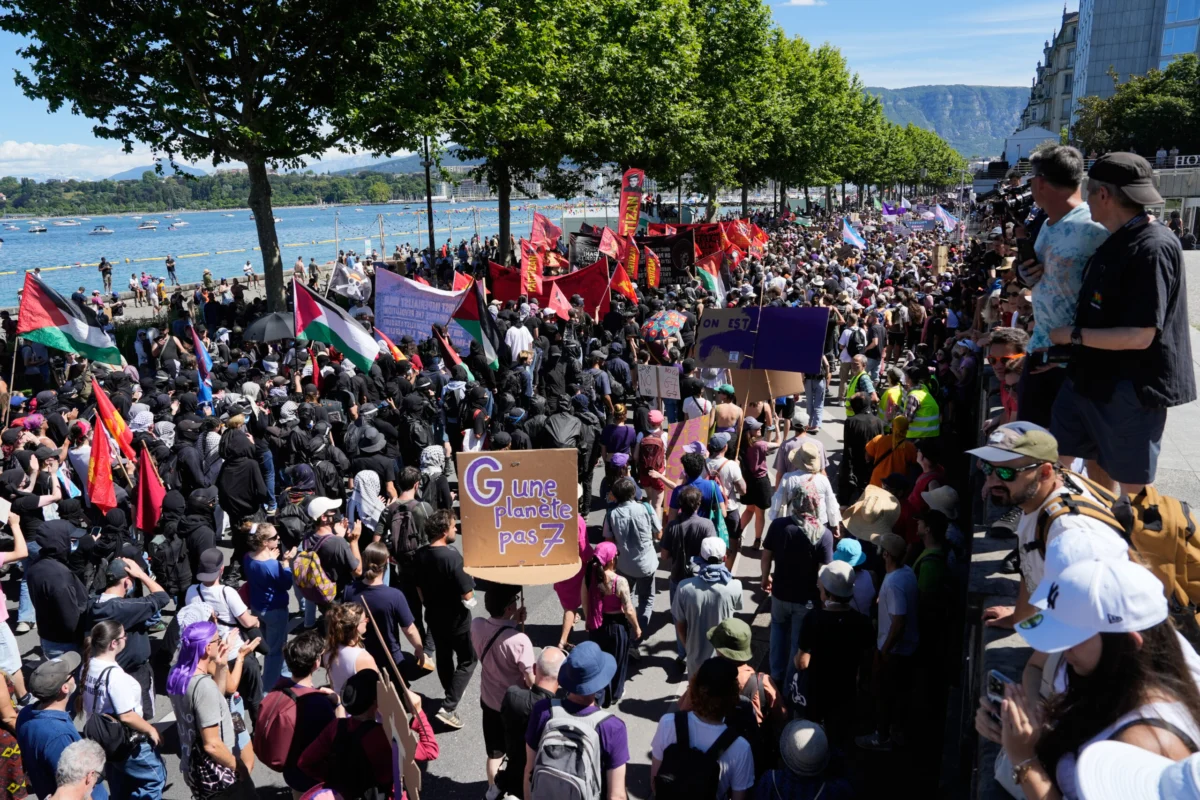
Thousands of protesters converged on Geneva, Switzerland, on Sunday, June 14, 2026, to voice their strong opposition to the policies and leadership of the Group of Seven (G7) nations, just as the bloc’s leaders prepared to convene for their annual summit in the nearby French resort town of Evian-les-Bains from June 15-17. The demonstration, organized by the broad “No-G7” coalition, brought together a diverse array of civil society groups, including advocates for Palestinian rights, feminist organizations, environmental activists, and labor unions, signaling widespread discontent with the G7 agenda.
The coalition, reportedly comprising over 60 associations and groups, articulated deep-seated concerns regarding the direction of global governance under the current G7 leadership. Francoise Nyffeler, a spokesperson for the “No-G7” coalition, articulated the protesters’ anxieties, stating, “We are very afraid of the policy and the politics of Mr. Trump and also of the other leaders of the G7, because they are fighting, making war all over the place. The planet is in danger, and we are very scared about it and we want to protest and say that the people of the world are against their policies.” This sentiment underscores a palpable fear of escalating global conflicts and environmental degradation, which demonstrators attribute, at least in part, to the decisions made by the world’s most industrialized democracies.
The security measures implemented by Swiss and French authorities for the three-day summit were extensive. Thousands of police officers were deployed to ensure the safety of the attending world leaders, including United States President Donald Trump, and to maintain order. Authorities took proactive steps to mitigate potential disruptions, including blocking off key roads, prohibiting unauthorized gatherings in designated areas, and pledging financial support for local businesses anticipated to be affected by the summit’s security cordon and potential unrest. This precautionary approach was informed by past experiences, such as the disruptions that occurred in Geneva during a previous G7 summit held in Evian in 2003, which led to significant damage to property. Consequently, numerous businesses and shops in the region boarded up their storefronts as a protective measure.
Shifting Global Power Dynamics and G7 Relevance
The protests highlight a growing skepticism regarding the continued relevance and representative nature of the G7 in the 21st century. The G7, comprising the United States, Canada, Japan, France, Germany, Italy, and the United Kingdom, historically represented the core of global economic power. However, the economic landscape has evolved significantly. While the G7 countries once accounted for approximately 70 percent of global Gross Domestic Product (GDP), this figure has diminished to around 40 percent. Simultaneously, their representation of the global population remains relatively small, at about one-tenth.
This shift in economic influence is mirrored by the rise of other global blocs. The BRICS nations, for instance, have seen a substantial expansion, doubling their membership from five to eleven countries. This expansion, which includes major economies like India, Russia, and China, signifies a growing multipolar world order where economic and political power is increasingly distributed. The G7’s diminished share of global GDP and the ascendance of other economic groupings raise pertinent questions about the bloc’s capacity to effectively address global challenges and represent the interests of a broader international community.
Core Grievances of the Protesters
Al Jazeera’s correspondent Natacha Butler, reporting from Geneva, observed that demonstrators broadly condemned the G7 as an entity that perpetuates economic inequality, labeling it as a forum where “the rich getting richer and the poor getting poorer.” The central argument presented by the protesters was that the G7, as a club of wealthy nations, does not adequately represent the global population. Their policies and decisions, according to the demonstrators, have detrimental impacts worldwide, exacerbating issues related to climate change, perpetuating inequalities in equal rights, and contributing to persistent poverty.
The concerns articulated by the “No-G7” coalition extend to a range of critical global issues. Specific points of contention highlighted by activists and observers include:

- Economic Inequality: Critics argue that G7 policies, often driven by neoliberal economic frameworks, tend to favor multinational corporations and wealthy nations, thereby widening the gap between the rich and the poor both within and between countries. The focus on free trade agreements and austerity measures, they contend, often comes at the expense of social welfare programs and worker protections.
- Climate Change Inaction: Despite growing scientific consensus and the visible impacts of climate change, many activists accuse G7 nations of insufficient action and commitment to ambitious climate targets. Concerns are frequently raised about the continued reliance on fossil fuels, the inadequacy of financial commitments to developing nations for climate adaptation and mitigation, and the perceived hypocrisy of advocating for climate action while maintaining high per capita carbon emissions.
- Global Conflict and Interventionism: The presence of President Trump, whose administration has been characterized by a more assertive and often confrontational foreign policy, amplified concerns about global stability. Protesters voiced fears of increased geopolitical tensions, the perpetuation of proxy wars, and the negative humanitarian consequences of military interventions. The ongoing US-Israeli war on Iran, which was a significant point of global concern at the time, was also cited as a policy that generated immense suffering and instability.
- Human Rights and Social Justice: Various groups within the “No-G7” coalition raised specific human rights concerns. Palestinian rights advocates, for example, protested the perceived lack of accountability for Israeli actions in occupied territories and the continued US support for Israel. Feminist activists highlighted ongoing struggles for gender equality and the disproportionate impact of global economic policies on women.
A History of Protest and Growing Dissent
The G7 summit has historically been a focal point for anti-globalization and anti-establishment protests. However, the scale and diversity of the demonstrations in Geneva this year underscore a deepening and broadening dissatisfaction with the current global order. The convergence of these disparate groups, united by a shared critique of G7 policies, indicates a growing momentum for alternative models of global governance.
The lead-up to the Sunday march saw a series of preparatory actions aimed at drawing attention to the protesters’ cause. On Saturday, June 14, a flotilla of approximately 20 boats sailed on Lake Geneva, near Evian, displaying banners critical of the G7 and in solidarity with Palestinian rights. This symbolic act aimed to visually represent the broad reach of the protest movement and its diverse concerns. The preceding Friday evening also saw the detention of around 20 protesters, according to Swiss media reports, highlighting the heightened security environment and the potential for friction between authorities and demonstrators.
The G7 Agenda and Anticipated Discussions
The official G7 summit, scheduled to commence on Monday, June 15, was expected to address a range of pressing global issues. While the specific agenda items were not fully public at the time of the protests, past summits and current geopolitical realities suggest that discussions would likely revolve around:
- Global Economic Stability: Strategies to address inflation, supply chain disruptions, and potential recessionary pressures in the global economy.
- International Trade and Tariffs: Navigating trade disputes, particularly those involving the United States and its major trading partners, and the future of global trade agreements.
- Climate Change and Energy Security: Efforts to accelerate the transition to renewable energy, meet climate targets, and ensure energy security in the face of geopolitical challenges.
- Geopolitical Conflicts and Security: Addressing ongoing conflicts, including the US-Israeli war on Iran, and coordinating responses to international security threats.
- Global Health and Pandemic Preparedness: Lessons learned from recent pandemics and strategies for future health security.
- Technological Advancement and Regulation: The implications of artificial intelligence, cybersecurity, and digital governance.
However, the presence of President Trump at the summit was a significant factor that fueled anxieties among protesters and observers alike. His administration’s policies on trade, international agreements, and climate action had already generated considerable controversy and strained relations with some traditional allies. His approach to diplomacy, often characterized by bilateral deals and a skepticism of multilateral institutions, presented a stark contrast to the collaborative spirit that G7 summits are intended to foster.
Analysis of Implications
The protests in Geneva serve as a potent reminder of the growing chasm between the established global powers and a significant segment of the world’s population. The “No-G7” coalition’s message, amplified by the sheer number of participants, indicates that the policies enacted by these leading industrialized nations are increasingly perceived as detrimental to the well-being of a large portion of humanity and the planet.
The diminishing economic clout of the G7 relative to emerging economies further erodes its claim to singular global leadership. As more nations join blocs like BRICS, the G7’s ability to unilaterally shape global policy may be further constrained. This evolving power dynamic necessitates a reevaluation of global governance structures to ensure greater inclusivity and representation.
The demonstration also underscores the complex intersection of various global challenges. Economic inequality, environmental degradation, and geopolitical instability are not isolated issues but are deeply intertwined. The protesters’ demand for a more equitable and sustainable world reflects a growing recognition that these challenges require comprehensive and systemic solutions, rather than incremental adjustments within existing frameworks.
The G7 leaders, while meeting behind closed doors in Evian-les-Bains, could not ignore the voices of dissent emanating from Geneva. The protests highlight the urgent need for the G7 to address the legitimate concerns of civil society and to demonstrate a tangible commitment to policies that promote global justice, environmental sustainability, and lasting peace. Failure to do so risks further alienating large segments of the global population and undermining the very legitimacy of the institutions that have long governed international affairs. The coming days and the official communiqués from the summit will reveal whether the G7 leaders are prepared to acknowledge and respond to the profound challenges articulated by the thousands who gathered in Geneva.