Danny Garick
The culinary landscape has undergone a significant transformation over the last decade, shifting from a focus purely on ingredient quality to an all-encompassing appreciation for the multisensory experience of a meal. While the palate remains the primary judge of food, the aesthetic presentation of dishes has become a critical component of professional catering and, increasingly, domestic hosting. Industry analysts note that the global ceramic tableware market is projected to reach unprecedented valuations by 2030, driven by a growing consumer interest in "tablescaping"—the practice of artfully arranging a dining table to enhance the social and visual aspects of eating.
The Science of Sensory Perception
Psychological studies in the field of gastrophysics suggest that the vessel from which food is consumed can alter the perception of flavor. Researchers have observed that the weight, color, and texture of a plate influence how the brain processes the taste of the contents. For instance, a dish served on a heavy, hand-painted stoneware platter is often perceived as higher quality than the same dish served on lightweight, mass-produced plastic. This phenomenon is rooted in expectation bias; when the environment suggests a higher-end experience, the consumer’s sensory receptors are primed to find the food more satisfying.
The integration of artisanal serveware into the home kitchen represents a democratization of fine dining. Where restaurants once held the monopoly on high-end plating, the current market allows homeowners to curate tables that rival professional establishments. This trend is not merely about ornamentation; it is about the functional utility of specialized vessels. A roast chicken, when presented on a scallop-edged platter, is not only more visually striking but is also easier to carve and distribute, bridging the gap between utilitarian kitchenware and art.
A Chronology of Tableware Trends
The history of serveware reflects broader societal shifts in wealth and leisure. In the mid-20th century, the post-war boom popularized standardized, minimalist porcelain, prioritizing durability and ease of cleaning. By the 1980s and 90s, the focus shifted toward decorative, pattern-heavy designs, often influenced by European ceramic traditions.
However, the 2010s marked a pivot toward "organic modernism." The rise of social media platforms dedicated to visual lifestyle content accelerated the demand for unique, handcrafted pieces. Since 2018, there has been a documented resurgence in the popularity of exposed-clay rims, matte finishes, and asymmetrical forms. This trend reflects a move away from the "perfectly uniform" industrial aesthetic toward items that highlight the human element of production—the thumbprint of the potter, the slight irregularities of the kiln, and the natural variations in glaze.

Categorizing the Modern Collection
To understand the current market, one must categorize the diverse array of available platters, each serving a distinct purpose in both aesthetic and functional capacities.
1. The Minimalist Aesthetic
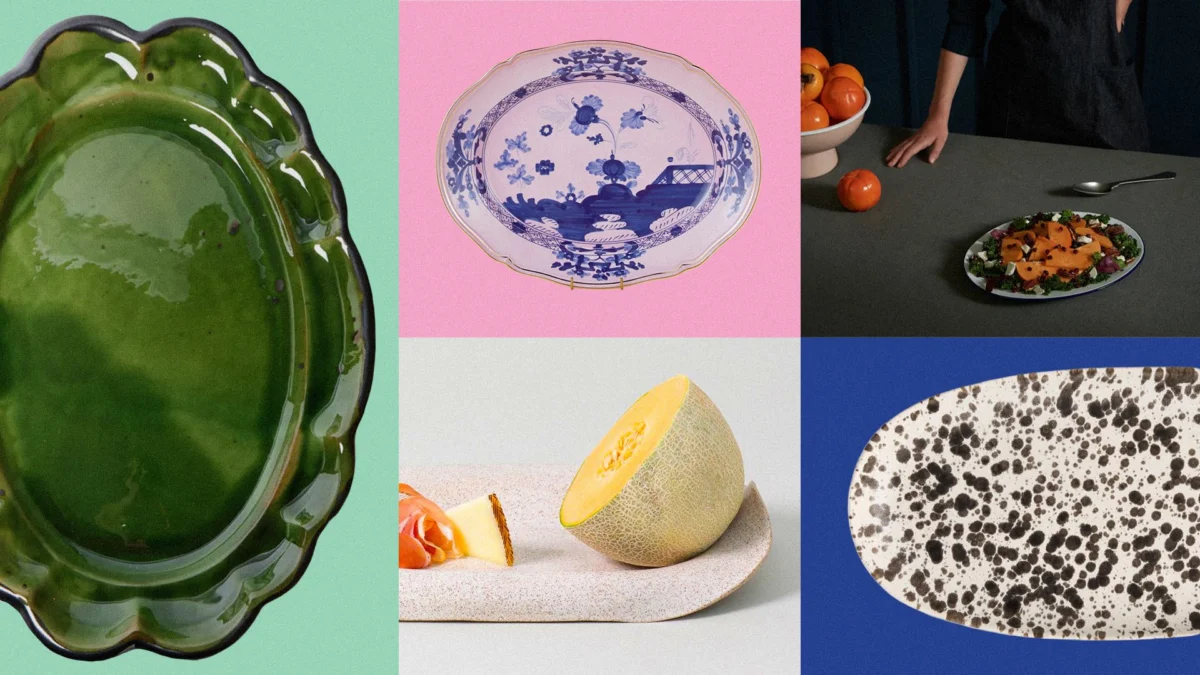
Minimalism remains a dominant force in interior design, and this extends to the dinner table. Monochrome platters, particularly those in matte black or bone white, offer a neutral canvas that allows the colors of the food to take center stage. High-end brands like Jono Pandolfi have become industry benchmarks by utilizing signature exposed clay rims. These pieces are favored by chefs because they provide a clean, structural frame for the food, emphasizing the freshness of ingredients over the busyness of the serving dish.
2. Intricate Craftsmanship and Heritage Designs
Hand-painted stoneware offers a narrative quality to the dining experience. Historically, such pieces were reserved for heirloom status, but modern manufacturing has made them more accessible. Brands like Ginori 1735 continue to maintain the legacy of Italian porcelain, providing a link to centuries-old artistic traditions. Conversely, graphic, bold designs—such as the checkered patterns popularized by contemporary design houses—cater to a younger demographic that views the dinner table as an extension of personal fashion and interior design style.
3. Decorative Edges and Textural Interest
The "zhuzh" factor—a colloquial term used in the design industry for adding a final, elevated touch—often manifests in the form of decorative edges. Ruffles, scalloping, and beading serve a dual purpose. When the platter is fully loaded with food, the center is obscured, but the edges remain visible. This ensures that the aesthetic investment is not lost once the meal is served. These details provide a tactile dimension to the meal, inviting guests to notice the craftsmanship inherent in the table setting.
4. Organic and Free-form Shapes
The shift toward asymmetry represents a rejection of the rigid, circular norms of the 20th century. Abstract, free-form platters are particularly suited for "grazing" or communal dining, a style of eating that has gained momentum as a way to foster social interaction. Asymmetrical shapes allow for a more natural distribution of crackers, cheeses, and charcuterie, creating a more dynamic and less formal visual flow on the table.
Economic and Practical Implications
The decision to invest in high-quality serveware carries both economic and practical considerations. While an artisanal platter from a studio such as Softedge or a specialist manufacturer like Mud Australia may cost significantly more than a big-box retail equivalent, industry experts point to the longevity of these products. Quality stoneware, when properly cared for, can last for generations, effectively lowering the cost-per-use over time.

However, there is a necessary distinction between indoor and outdoor usage. The "shatterproof" market for outdoor dining has evolved to address the risks of ceramic breakage. Materials like high-grade melamine and enamelware have seen significant technological improvements. Modern enamelware, such as that produced by Falcon Enamelware, has transitioned from a strictly utilitarian item to a stylish choice for outdoor entertaining. Crucially, the move toward dishwasher-safe enamelware has solved one of the primary historical drawbacks of the material, making it a viable, high-performance alternative for hosts who want the elegance of a platter without the fragility of glass or ceramic.
Official Responses and Industry Outlook
Retail representatives indicate that the "holiday hosting" period remains the most critical time for the tableware industry. Data from major home goods retailers shows a 25% increase in searches for "centerpiece-worthy" serving vessels in the fourth quarter of each year. This surge is not merely incidental; it aligns with the cultural emphasis on family gatherings and the traditional hosting of elaborate holiday meals.
"The platter is the anchor of the table," says one industry lead consultant. "It is the focal point where the labor of the kitchen meets the social environment of the dining room. When a host invests in a piece that tells a story—whether through its shape, its history, or its artisanal origins—it elevates the status of the entire event."
Broader Impact on Home Dining
The implications of this trend extend beyond simple home decor. By prioritizing the vessel, hosts are signaling a commitment to the "slow dining" movement. In an age of fast-paced consumption and digital distraction, the deliberate choice of a beautiful serving platter encourages guests to slow down, admire the presentation, and engage in meaningful conversation.
Furthermore, the rise of independent pottery studios has supported a micro-economy of artisans. Consumers are increasingly willing to pay a premium for pieces that are sourced locally or from known makers, reflecting a broader consumer trend toward ethical and sustainable consumption. By bypassing mass-market, disposable plastic options in favor of durable, sustainable, and aesthetically pleasing serveware, the modern consumer is contributing to a more circular and craft-focused economy.
As we look toward the future, the integration of technology and art in the kitchen will likely continue to blur the lines between professional and domestic spaces. Whether through the minimalist lines of a modern tray or the intricate, hand-painted details of a traditional Italian ceramic, the serving platter remains an essential, albeit often overlooked, element of the culinary arts. It is a bridge between the chef’s intention and the guest’s enjoyment, ensuring that the act of eating remains an experience rather than a necessity. The continued investment in these pieces suggests that, for the modern host, the table is not just a place to set food—it is a stage, and the platter is the most vital prop in the performance.