Ana Megawati

David Jones has endured two world wars, the Great Depression, a succession of severe economic recessions, and the fickle shifts of consumer fashion tastes across nearly two centuries. Yet, the nation’s beloved retail institution is currently facing a modern crisis defined by incremental financial strain, leaving its long-term future beyond the upcoming Christmas trading period deeply uncertain. While the pressures facing traditional brick-and-mortar retail are global in scale—impacting storied flagships from London to New York—the potential fading of David Jones strikes a particularly emotional chord with the Australian public. As executives and financial stakeholders deliberate over the structural viability of the historic chain, the unfolding situation highlights a pivotal turning point for high-street retail across the country.
A Rich History of Retail Innovation
Founded nearly two decades before Confederation, David Jones holds the distinction of being the world’s oldest continuously operating department store still trading under its original name. Surpassing contemporaries such as London’s Selfridges and New York’s Saks Fifth Avenue, the enterprise—affectionately known to generations of shoppers simply as "DJs"—began as a modest establishment in Sydney before systematically expanding its footprint. Throughout the 1950s, the company embarked on an aggressive acquisition strategy, absorbing independent regional department stores across various Australian states to cement its status as a truly national retailer. Decades later, in 2016, the brand crossed the Tasman Sea to launch its first international storefront in Wellington, New Zealand, attempting to scale its distinct upscale shopping experience for international audiences.
Beyond its commercial expansion, David Jones wove itself into the social fabric of Australian civic life. The grand Elizabeth Street store in Sydney, inaugurated in 1927, quickly evolved into a cultural anchor. In July 1969, crowds gathered before its display windows and internal televisions to witness humanity’s first steps on the moon. Annual rituals—ranging from lavish spring floral exhibitions to whimsical, narrative-driven Christmas window displays—became cherished milestones that routinely coaxed families and children out long past their usual bedtimes. The institution’s prestige even attracted royalty; Queen Elizabeth II walked its polished floors, and a historic state dinner was hosted within the building’s Great Restaurant during the 1954 Royal Tour. For decades, the store served as the ultimate urban destination, drawing shoppers "into town" from the expanding suburban fringes long before localized satellite shopping centres decentralised metropolitan commerce.

Chronology of an Australian Institution
The operational history of David Jones can be tracked through key milestones that mirrored the modernization of Australian society:
- 1838: David Jones establishes the company in Sydney, promising the public "the best and exclusive goods."
- 1927: The iconic Elizabeth Street flagship store opens in Sydney, setting a new architectural and commercial standard for Australian retail.
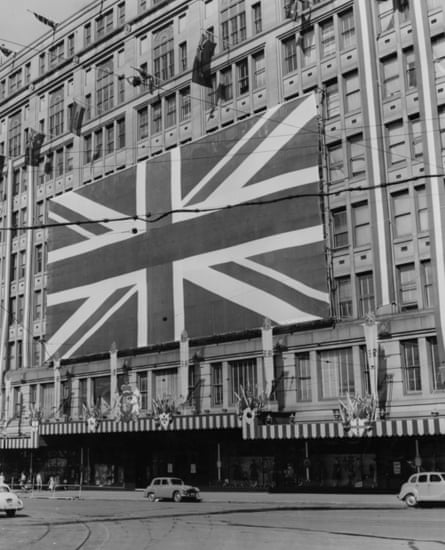
- 1954: The store hosts a state dinner during the Royal Tour of Queen Elizabeth II, featuring a monumental 100-foot by 50-foot Union Jack displayed across its facade.
- 1960s: The introduction of the distinct black-and-white houndstooth check pattern, which rapidly becomes synonymous with the brand’s identity, packaging, and advertising.
- 2016: David Jones expands internationally for the first time, opening a flagship department store in Wellington, New Zealand.
- 2019: Designer Toni Maticevski returns to David Jones after a 15-year tenure with rival Myer, signaling a definitive strategic divergence toward the luxury market.
- 2026: The ongoing strategic review places the future of the department store chain under critical evaluation ahead of the pivotal Christmas trading period.
Generations of Cultural Rites of Passage
For ordinary Australians, the department store was far more than a house of commerce; it was the backdrop for defining personal milestones. Generations navigated its labyrinthine departments for everything from Butterick dressmaking patterns in the bustling haberdashery sections to avant-garde Alessi kitchenware chosen from wedding registry lists, or thick down doonas purchased ahead of the winter months.
The retailer also managed important domestic rites of passage. Teenage girls were routinely escorted by their mothers to be professionally fitted for their first undergarments by veteran, matronly experts, while young men were frequently steered toward the menswear departments for their inaugural tailored suits. Shopping excursions regularly concluded with lunch or high tea at the in-store cafeteria, while weekend outings with friends frequently found a final stop at the food hall’s champagne bar. Furthermore, the brand’s visual identity—the ubiquitous black-and-white houndstooth check introduced in the 1960s—adorned shopping bags, credit cards, and high-fashion runways alike, cementing its aesthetic footprint across the nation’s cultural memory.
The Evolution of Australian Fashion and the "Store Wars"
From its inception, David Jones aligned its merchandising with the prevailing currents of British and French couture. Following the conclusion of the Second World War, the retailer elevated its fashion credentials through ambitious overseas buyers who forged direct channels to Parisian fashion houses. In 1947, designer Pierre Balmain visited the Sydney flagship to showcase his latest runway collections. The company subsequently secured exclusive licensing agreements to manufacture local, line-for-line reproductions of original designs by icons such as Yves Saint Laurent and Christian Dior, bringing high-end European fashion within reach of Australian consumers.
This foundational dedication to design eventually yielded a powerful platform for domestic talent. Australian luminaries including Carla Zampatti, Akira Isogawa, Collette Dinnigan, and Zimmermann leveraged the retail giant’s runway shows to launch and sustain their labels. Throughout the late 2000s, the Australian retail landscape was dominated by the high-stakes "store wars" between David Jones and its primary rival, Myer, as both enterprises vied aggressively to secure exclusive representation of the country’s most sought-after design talent.
Industry analysts point to pivotal moments, such as designer Toni Maticevski’s high-profile return to David Jones in 2019 following a 15-year alignment with Myer, as a clear fork in the road. While Myer consolidated its positioning within the broad middle-market tier, David Jones systematically doubled down on an upscale, luxury-centric retail model.
Economic Pressures and Modern Realities

Despite its storied heritage, David Jones has faced a compounding series of headwinds over the past two decades. The rapid ascendance of e-commerce—to which traditional department stores were often slow to adapt—fundamentally altered consumer purchasing habits. This digital disruption was further compounded by the proliferation of fast-fashion and ultra-fast-fashion competitors offering immediate trend replication at a fraction of the cost.
When combined with broader macroeconomic pressures, including the COVID-19 pandemic, supply chain volatility, and sustained cost-of-living constraints that have squeezed discretionary household spending, legacy retailers have found themselves forced to operate with heightened agility. Industry observers note that maintaining vast footprints of prime CBD real estate has transitioned from a historical brand advantage into a heavy financial liability amid shifting consumer foot traffic.
Broader Economic and Urban Implications
The potential restructuring or contraction of David Jones carries implications that extend far beyond corporate balance sheets, striking directly at the identity of Australia’s metropolitan centres. Urban planners and retail economists have long argued that major capital city hubs require strong anchor tenants to drive foot traffic, support surrounding hospitality networks, and maintain the vibrancy of central business districts.
The potential loss or significant downsizing of David Jones threatens to leave a structural void in the heart of cities like Sydney, Melbourne, and Brisbane. As stakeholders deliberate the future of the enterprise ahead of the critical Christmas retail window, the overarching question remains whether the historic brand can successfully reinvent its operational model to survive an era that has already claimed numerous global retail titans. For millions of Australians, a city centre without the familiar presence of David Jones remains an unthinkable departure from tradition.