Layla Zulfa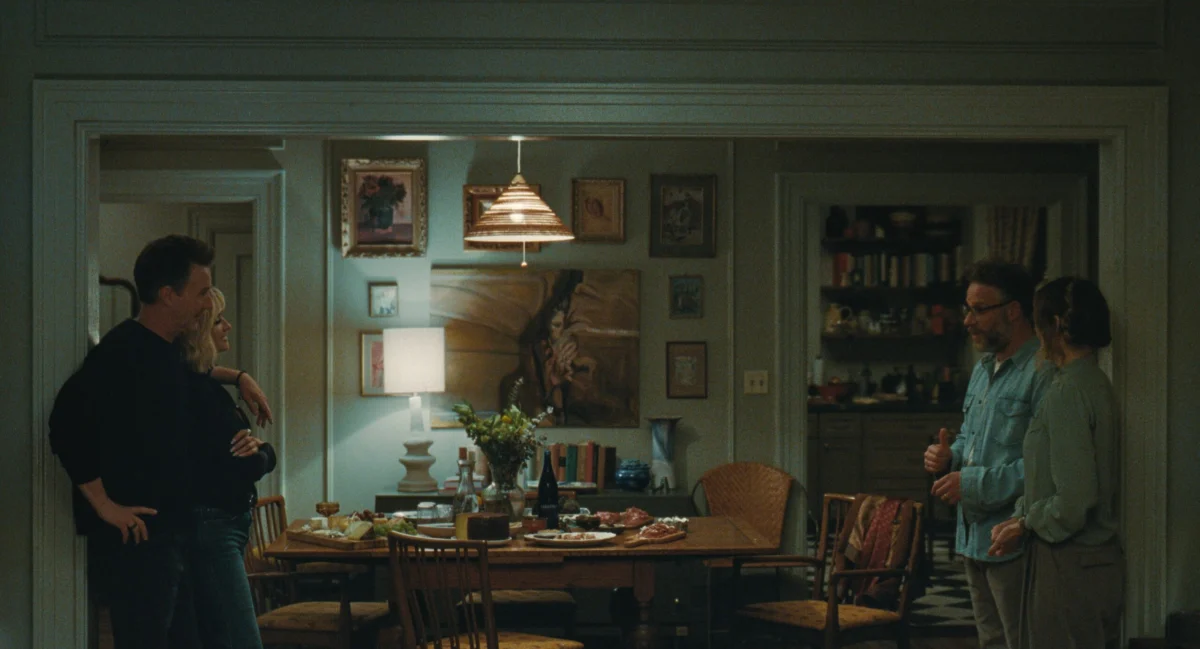
The upcoming cinematic release of The Invite marks a significant stylistic pivot for director Olivia Wilde, who has chosen to anchor her latest narrative within the claustrophobic and meticulously curated confines of a single San Francisco apartment. In collaboration with veteran production designer Jade Healy, Wilde has constructed a physical environment that functions not merely as a backdrop, but as a silent, primary character that externalizes the deteriorating marriage of the film’s protagonists, Angela (played by Wilde) and Joe (played by Seth Rogen). This chamber drama, produced by A24, utilizes its setting to explore themes of pretense, creative stagnation, and the psychological weight of domestic history, a strategy that places the film within a long tradition of location-restricted masterpieces.
The Architecture of a Fractured Union
The narrative of The Invite centers on a dinner party hosted by Angela and Joe for their neighbors, Hawk (Edward Norton) and Pína (Penélope Cruz). While the film begins with brief glimpses of Joe’s external life—including his professional struggles and a commute on a folding bicycle—the vast majority of the action occurs within the couple’s home. To achieve the necessary depth and texture, Wilde and Healy eschewed existing locations in favor of a custom-built set at Sunset Las Palmas Studios in Los Angeles.

The decision to build from scratch was driven by the need for absolute control over the "labyrinthian" layout of the apartment. While Healy conducted extensive scouting of authentic pre-war units in San Francisco to capture the city’s unique architectural vernacular, the final design deliberately rejected the modern trend of open-plan living. According to Healy, the script originally suggested a renovated, open-concept kitchen and living area, but the creative team realized that such a layout would undermine the film’s tension. Instead, they opted for a series of interconnected rooms, hallways, and private nooks that emphasize the couple’s sense of being trapped. This structural choice reflects the emotional boundaries and "frames within frames" that Wilde sought to capture through her direction, creating a visual metaphor for the psychological distance between the characters.
Influences and Artistic Lineage
In developing the aesthetic for The Invite, Wilde and Healy looked toward seminal films that utilized single-location settings to dissect interpersonal dynamics. Wilde cited Mike Nichols’ 1966 adaptation of Who’s Afraid of Virginia Woolf? as the production’s "North Star," alongside Woody Allen’s Hannah and Her Sisters and Michael Haneke’s Amour. These films are noted for their use of "lived-in" spaces that suggest a history of conflict and shared experience through layers of texture and decor.
To simulate this sense of history, the production team integrated "mismatched" architectural details, such as varying moldings and doorknobs, which suggest that the apartment was formed by merging two separate units—a common occurrence in older San Francisco buildings. This architectural "scarring" mirrors the patchwork nature of Angela and Joe’s relationship. Furthermore, the auditory experience of the apartment was enhanced in the sound mix by adding the creaks of aging wood floors, ensuring that the environment felt as physically present as the actors themselves.
.jpg)
The Psychology of Decor: Thrifting for Identity
The interior design of the apartment serves as a direct reflection of Angela’s character and her desperate attempts to maintain the appearance of a successful, cultured life. Wilde describes Angela’s aesthetic as "warm, maximalist, and classic," but with an underlying current of insecurity. To reflect the couple’s realistic financial standing, Healy populated the set with a mix of estate sale finds, vintage store acquisitions, and Facebook Marketplace discoveries.
A central plot point involves a vibrant vintage rug that Angela unfurls just moments before her guests arrive, claiming it is a long-held heirloom. The rug, which captivates the attention of Edward Norton’s character, Hawk, was specifically chosen to be an "antique statement piece" that feels believable within a cozy, unpretentious home while simultaneously representing the void Angela feels in her life. This reliance on secondhand designer items—such as a Barbara Barry reeded base sofa found at a thrift shop—highlights Angela’s obsession with "placeholders" and her constant search for the "perfect" item to fill the gaps in her environment and, by extension, her marriage.
Color Palettes and Symbolic Stagnation
The film’s color story is equally calculated to convey the emotional temperature of the household. Healy utilized a palette of bluish-greens and muted grays, specifically selecting Farrow & Ball shades such as "Blue Gray" and "Vale Mist." These tones are intended to evoke a sense of coldness and "drowning," suggesting that the characters are submerged under the weight of their unresolved issues.

This theme of being "underwater" is most pronounced in Joe’s study, which is painted in the darker "Oval Room Blue." Joe, a former musician currently mired in a creative rut, is depicted as being further submerged than his wife, isolated in a room that reflects his professional and personal paralysis. The contrast between these public-facing rooms and the couple’s private quarters provides a stark look at the reality of their situation. The bedroom, featuring an unadorned IKEA bed and a literal crack in the wall, stands in sharp contrast to the curated maximalism of the living room. Because the bedroom is a space hidden from the view of their neighbors, it remains neglected—a physical representation of the "fracture" in their intimacy that Angela refuses to address.
Technical Execution and Collaborative Synergy
The production of The Invite faced logistical challenges typical of ambitious soundstage builds. One notable instance involved a bathroom renovation scene where the intended tiles failed to arrive on schedule. To maintain the production timeline, the design team was forced to innovate, using painted tileboard to mimic the look of the missing materials. This "faux" renovation ironically mirrored the film’s themes of artifice and the performance of domestic perfection.
The integration of the set with the characters extended to the wardrobe, designed by Arianne Phillips. Wilde noted that her character’s clothing was often color-matched to the paint on the walls, literally causing Angela to blend into the apartment she has worked so hard to curate. This visual choice reinforces the idea that Angela’s identity has become inextricably linked to the physical space she inhabits, losing herself in the "layers upon layers" she uses to conceal the cracks in her life.

Broader Context: The Resurgence of the Chamber Piece
The Invite arrives at a time when the "chamber drama"—a film focused on a small cast in a limited location—is seeing a resurgence in independent and prestige cinema. From the success of The Whale to the critical acclaim of Mass, filmmakers are increasingly returning to these high-stakes, dialogue-driven narratives that prioritize performance and production design over spectacle.
Industry analysts suggest that the single-location format, while often born out of budgetary necessity, offers a unique opportunity for "prestige" branding, allowing directors to showcase their ability to maintain tension through mise-en-scène. In the case of The Invite, the San Francisco apartment acts as a pressure cooker, where the physical boundaries of the set force the characters into confrontations they might otherwise avoid.
Conclusion and Implications
By treating the apartment as a narrative engine, Wilde and Healy have created a film that challenges the audience to look beyond the surface of domestic bliss. The meticulous attention to detail—from the specific Farrow & Ball paint codes to the "creak" of the floorboards—ensures that the setting of The Invite is as much a part of the storytelling as the script itself.

As the film moves toward its release, it stands as a testament to the power of production design in shaping cinematic psychology. For Wilde, the apartment is not just a house; it is a manifestation of effort, a display of contribution, and a desperate attempt to manufacture history where the present is failing. The Invite promises to be a visceral exploration of how the spaces we inhabit can both define us and, eventually, confine us.