Ana Megawati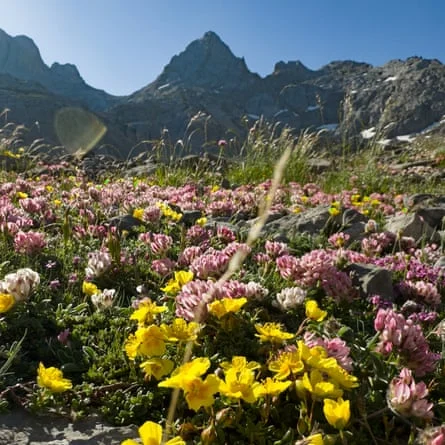
The Picos de Europa, a dramatic limestone mountain range in northern Spain, continues to captivate adventurers with its unparalleled blend of rugged landscapes, unique biodiversity, and rich cultural heritage. Recent expeditions into this formidable region highlight its contrasting natural beauty and the enduring spirit of those who call its heights home, even amidst a European heatwave that underscores the changing climate. From glacial depressions teeming with life to an extraordinary mountain refuge forged from a World War II aircraft carrier gun turret, the Picos offers a tapestry of experiences, challenging perceptions of Spain’s diverse topography.
A Realm of Contrasts: Alpine Life Amidst Summer Heat
High within the first glacial depression of the Picos de Europa, the juxtaposition of extreme conditions becomes immediately apparent. Despite a prevailing European heatwave, hikers encounter snow patches that persist in sheltered hollows. A vivid scene unfolds as a spider, disturbed by a human presence, scuttles across frozen crystals, a stark reminder of the unique microclimates within these mountains. Just a short distance away, the mountainside bursts into a riot of color, with tiny Alpine flowers providing a vibrant habitat for bees and crickets, thriving against a backdrop of jagged, imposing peaks. The diverse ecosystem supports iconic wildlife, including pairs of Cantabrian chamois (Rupicapra pyrenaica parva), a unique subspecies endemic to the region, which observe intruders from crags before agilely scaling almost vertical rock faces. This rich biodiversity, including rare flora and fauna, is a hallmark of the Picos de Europa National Park, established in 1918 as Spain’s first national park and later designated a UNESCO Biosphere Reserve, emphasizing its global ecological significance.
Cabin Verónica: A Relic Reborn on the Peaks
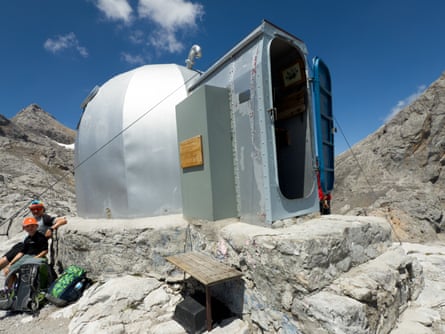
The arduous ascent through the Picos leads to an unexpected architectural marvel: Cabin Verónica. Perched at an elevation of 2,325 meters (7,628 feet) in the Macizo Central (Central Massif), this diminutive yet iconic mountain refuge is crafted from the gleaming aluminium dome of a gun turret salvaged from the USS Palau, a World War II escort aircraft carrier. The incredible feat of transporting this substantial piece of naval history to its current lofty position occurred in 1961, when it was painstakingly cut from the decommissioned vessel at a Bilbao breakers’ yard and dragged up the formidable mountain slopes by mules.

For the past eight years, the refuge has been the summer domain of its custodian, Jorge, who has meticulously transformed it into a self-sufficient haven. He has integrated solar power and water tanks, making the most of the sun-drenched peaks and meltwater. Jorge’s deep connection to the mountains is evident in his contentment: "Why would I need cities and crowds when I have this?" he reportedly stated, making coffee in the hut’s tiny kitchen. The panoramas from Cabin Verónica are truly spectacular, offering sweeping views of the valleys below. It is a prime vantage point for spotting wildlife, including the majestic bearded vulture (Gypaetus barbatus), a species successfully reintroduced to the Picos in 2005 as part of a critical conservation program to restore its population in Europe. The hut, capable of sleeping a maximum of six individuals, is a popular, albeit exclusive, stop for climbers and solo walkers seeking both solitude and adventure. Its unique history and breathtaking setting make it a powerful symbol of human ingenuity and resilience in harmony with nature.
The Oceanic Gateway: A Journey Across the Bay of Biscay
The journey to the Picos de Europa often begins with an equally remarkable passage across the Bay of Biscay, connecting the United Kingdom to northern Spain. The ferry route from Portsmouth to Bilbao, along with its sister route to Santander, traverses an oceanic canyon extending to depths of 4,000 meters. This deep-water environment is a crucial habitat and migratory corridor for a diverse array of marine mammals, making cetacean sightings a common and celebrated occurrence.
A typical crossing can offer profound moments of connection with the natural world. One traveler recounted being alone on deck at 5 AM, enveloped by a dense, cold fog that obscured the waves below. The sensation was one of profound isolation, akin to being adrift in the outer reaches of the cosmos. This ethereal calm was dramatically broken when the mist momentarily lifted, revealing three dolphins bursting from the swell, a powerful reminder of life’s vibrancy on planet Earth. Onboard experts, such as Andre, a seasoned observer, frequently document sightings of various whale species, including orcas and the elusive Cuvier’s beaked whale, highlighting the ecological richness of this oceanic corridor. The choice of ferry travel also carries a significant environmental benefit; as a foot passenger, the carbon footprint is less than 10% of that produced by air travel, according to the Direct Ferries carbon calculator, aligning with growing calls for sustainable tourism practices.
The Picos’ Enduring Legacy: History, Biodiversity, and a Hidden World
Beyond its dramatic peaks, the Picos de Europa boasts a multifaceted history and an extraordinary natural heritage. Historically, these mountains served as a bastion of resistance, first against Roman rule and later against the Moorish invasion, embodying a spirit of independence and resilience. This isolation has also fostered unique evolutionary pathways, resulting in a biodiversity found nowhere else. The Cantabrian chamois, as mentioned, is a distinct subspecies, and the rugged terrain provides refuge for other iconic species like Cantabrian brown bears and Iberian wolves, whose populations are slowly recovering thanks to dedicated conservation efforts.
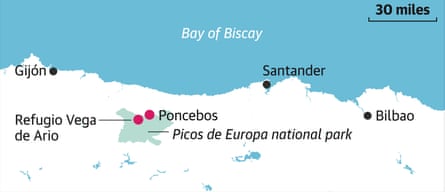
Beneath the soaring peaks lies another remarkable secret: an extensive underworld network of rivers and giant caverns, some plunging almost a mile deep. This karst landscape, formed by the dissolution of soluble bedrock, is a paradise for speleologists and a testament to the immense geological forces at play. The Picos are globally recognized for their deep cave systems, attracting scientific expeditions from around the world.
Life in the Refuges: Sustenance and Community on the Trails
The Picos de Europa hiking experience is intrinsically linked to its network of mountain huts, or refugios, which provide essential shelter, food, and camaraderie to trekkers. The journey typically begins with an ascent to refuges like Vegarredonda, situated at 1,410 meters. Most of these huts operate off-grid, relying on mules to transport supplies, a testament to the challenging logistics of mountain life. Hikers can anticipate hearty conversations, generous food portions, and simple, shared accommodations, often referred to light-heartedly as "snoremitories." The communal sleeping arrangements, though sometimes noisy, foster a unique sense of shared adventure. Thoughtful preparation, such as bringing earplugs, can ensure a restful night before another day of challenging trekking.
The Taste of Tradition: Artisan Cheese and Enduring Legacies
A significant element of the Picos experience is its culinary heritage, particularly the traditional cheese-making practices. One morning, a hiking group discovered a handwritten sign advertising homemade cheese near the stone cabins by Lake Ercina. This led them to Maria, an elderly woman continuing a generations-old tradition. Seated on a rustic milking stool in a small, stone-walled workshop, dressed in a practical nylon housecoat, Maria shared her story. Her grandfather built the cabin in 1944 when she was three years old. She reminisced about a time when entire communities would migrate to the high pastures for summer with their animals, a practice that has dwindled over the decades, leaving her as one of the last practitioners.
The walls of her workshop are adorned with ancestral drinking horns and wooden platters, while shelves proudly display wheels of her artisanal cheese. Picos cheese is distinctive for its blend of milk from sheep, cows, and goats, a technique passed down through generations. The results are exceptionally flavorful, representing a vital part of the region’s cultural identity and economy. Maria expressed concern that this tradition might die out, but found hope in her son’s interest, suggesting a potential continuation of this cherished legacy. This encounter highlights the fragile balance between preserving traditional livelihoods and the pressures of modernization and changing demographics in remote mountain communities.
Navigating the High Paths: Flora, Fauna, and the Shadow of Climate Change
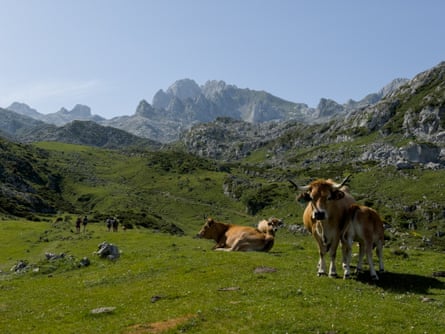
Continuing the trek, the paths wind through side valleys, ascending steadily past boulders that cradle miniature gardens of saxifrage and stonecrop in their hollows. The keen-eyed observer might spot a wallcreeper, one of the rarer bird species that inhabit these high altitudes, flitting across the rock faces. Chamois, ever-present, pose gracefully on distant ridges, always in proximity to the dwindling snow patches. Their world, however, is increasingly threatened. Spain’s intensifying heatwaves are encroaching higher into the mountains, causing snowlines to retreat and altering delicate alpine ecosystems. This environmental shift poses a significant challenge to species adapted to colder climates, including the chamois, whose habitat is shrinking. The observed impacts of climate change underscore the urgency of sustainable practices in tourism and broader environmental conservation efforts.
Subterranean Marvels and Climactic Peaks
The Picos de Europa is not only a vertical world but also a hidden, subterranean one. One night, hikers found themselves at Refugio Vega de Ario, known for its excellent cuisine, sharing the space with the Oxford University caving team. For over 60 years, multiple generations of speleologists from Oxford have been meticulously exploring and mapping some of the most extensive cave systems in the world within the Picos. The team shared exciting news of being on the brink of connecting two massive cave networks, a monumental achievement in speleology that promises to reveal even more about this complex underground world. The prospect of such a discovery, though requiring "stairs" for casual visitors, speaks to the ongoing scientific exploration and the hidden depths of these mountains.
The journey culminates in a dramatic reveal, perfectly orchestrated by nature. After crossing Poncebos, a village known for its scenic gorge walk along the Rio Cares and one of the few places in the Picos accessible by car, the path ascends again through flower-strewn meadows and past abandoned farmhouses, eventually leading into the clouds. Then, with perfect timing, the mists part to unveil the undisputed monarch of these mountains: the Picu Urriellu, a soaring 2,529-meter (8,297-foot) pinnacle of rock. Beneath this majestic monolith lies another of Europe’s most spectacular mountain huts, the Vega de Urriellu.
Picu Urriellu: The "Orange Peak" and a Climber’s Paradise
The Refugio Vega de Urriellu is one of the most popular huts in the Picos, accommodating 96 individuals, with many more camping nearby. Despite its capacity, the atmosphere remains friendly and sociable, a hub for the climbing community. Guides like Bruno and Cristina enthusiastically point out their favorite climbing routes on the formidable rock face. Around the hut, small groups of climbers huddle, discussing strategies for tackling the various ascents. The south face is a favored route for guided expeditions, while the west face, a 750-meter (2,460-foot) vertical wall, presents a monumental challenge for experienced climbers.
As the sun begins its descent, a transformative spectacle unfolds. The rock face of Picu Urriellu glows with an intense orange hue, giving rise to its cherished Spanish name, Naranjo de Bulnes – the Bulnes orange. This ephemeral display of color, casting long shadows across the rugged landscape, is a powerful and unforgettable conclusion to a journey through the Picos. While the allure of the deep caves remains for some, the call of the climbing routes, described as excellent by local guides, is a strong temptation.
As dusk deepens, the world below the hut becomes shrouded in cloud, creating an ethereal landscape. Perched on a boulder, an observer might become aware of a silent presence. A Cantabrian chamois, its delicate curving horns silhouetted against the twilight like twin question marks, stands poised on a ledge above. This fleeting encounter, as the last orange glow fades from Urriellu’s summit, encapsulates the wild, untamed spirit of the Picos de Europa, a place where nature’s grandeur and life’s quiet persistence converge in breathtaking harmony.
Logistical Information for Aspiring Trekkers
Organized expeditions, such as the eight-day traverse of the Picos offered by KE Adventure Travel, provide comprehensive packages starting from £1,295, including all meals, accommodation, and experienced guides. For sustainable travel, Brittany Ferries offers routes from Portsmouth to Bilbao and Santander, and from Plymouth to Santander, with sailings up to twice weekly. Foot passenger fares, for example, start from £128 in August, offering an environmentally conscious alternative to air travel while providing a unique opportunity for marine wildlife observation in the Bay of Biscay. These options facilitate access to one of Spain’s most magnificent and ecologically significant mountain ranges.