Layla Zulfa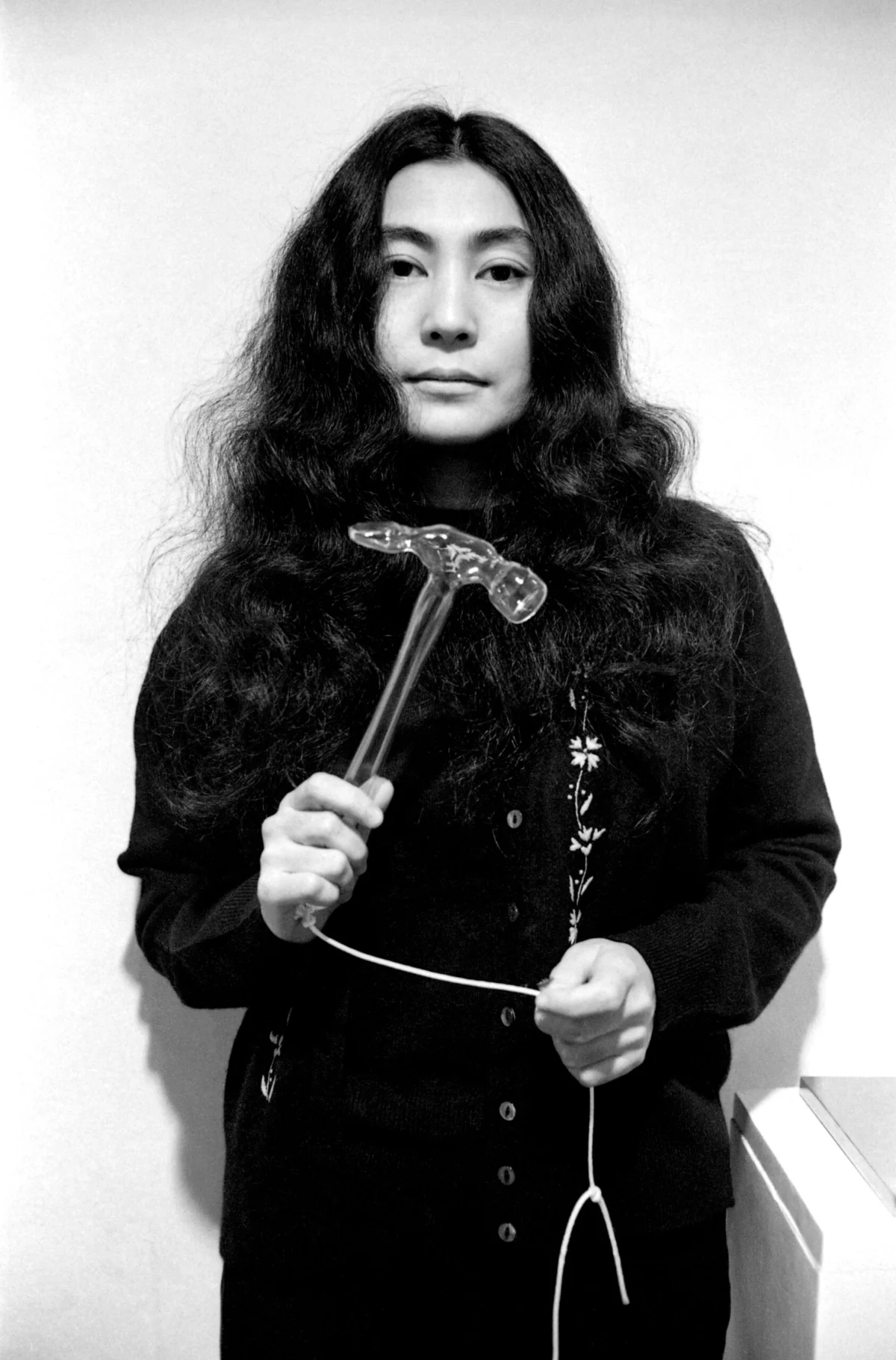
The nine-word imperative "Light a match and watch till it goes out" constitutes one of Yoko Ono’s earliest mature artworks, a piece titled Lighting Piece and dated "1955 autumn." Typed on plain paper, this "Instruction" helped ignite a creative practice that would span seven decades, revolving around a singular, radical premise: the viewer must step into the role of an essential participant to complete the work of art. This foundational concept predates the celebrated movements of several male contemporaries and has recently become the focus of a major institutional reevaluation.
Currently on display at The Broad in Los Angeles, the traveling retrospective Yoko Ono: Music of the Mind serves as a comprehensive exploration of the 91-year-old artist’s lifelong themes of collectivity, connectivity, and peace. As the final stop for this exhibition, which originated at the Tate Modern in London, the show aims to peel back the layers of pop-culture notoriety to reveal the rigorous intellectual and formal contributions Ono made to the avant-garde. For more than half a century, Ono’s status as a global icon and her marriage to John Lennon frequently overshadowed her professional output. However, the chronological display at The Broad emphasizes that Ono was a formidable force in the art world long before her 1966 meeting with the Beatles frontman.
The Foundations of Conceptualism and Fluxus
Long before Sol LeWitt moved toward designing paintings for others to execute, or Tino Sehgal developed "constructed situations," Ono was pioneering the idea that the object is secondary to the concept. By the late 1950s and early 1960s, she had become a central figure in Fluxus, an international network of artists, composers, and designers who sought to blur the boundaries between art and life.

Ono’s work during this period was characterized by "Instruction Paintings," which shifted the authority from the artist’s hand to the viewer’s mind. At The Broad, Sarah Loyer, curator and exhibitions manager, notes that the exhibition is structured to allow the public to encounter Ono’s early radicalism in its original context. "You don’t encounter John Lennon until about halfway through the show," Loyer observes. "She did a lot in the decade-plus before they met."
One of the most striking examples of this early period is Painting to be Stepped On (1960). A piece of canvas spread on the floor like a common rug, the work invites a "deviant" interaction with art. By asking visitors to physically tread upon the medium, Ono challenged the traditional sanctity of the museum object. This piece, along with others that invite the audience to hammer nails into a canvas or shake hands through a hole in a curtain, established a new paradigm for audience engagement.
A Chronology of Innovation
To understand the breadth of Ono’s influence, one must look at the timeline of her career, which bridges the gap between traditional Japanese aesthetics and Western avant-garde movements.
- 1933: Born in Tokyo to an aristocratic family.
- 1945: Evacuated to the Japanese countryside during the U.S. firebombing of Tokyo. This period of starvation and trauma is cited by scholars as the genesis of her focus on imagination as a tool for survival.
- 1955: Creates Lighting Piece, establishing the "Instruction" format.
- 1960–1961: Hosts a series of influential loft performances at her Chambers Street apartment in New York, featuring artists like John Cage and Marcel Duchamp.
- 1964: Publishes Grapefruit, a seminal book of instruction pieces, and performs Cut Piece for the first time in Kyoto.
- 1966: Holds a solo exhibition at Indica Gallery in London, where she meets John Lennon.
- 1969: Conducts the "Bed-In for Peace" in Amsterdam and Montreal, utilizing celebrity as a medium for social activism.
- 1980: Following the murder of John Lennon, Ono continues to produce work that addresses grief, violence, and the fragility of life.
- 2001: Creates Helmets (Pieces of Sky), an installation using military surplus to deliver a message of collective healing.
- 2024: Music of the Mind opens at The Broad, cementing her status as a foundational figure in art history.
Performance Art and the Feminist Lens
Ono’s 1964 work Cut Piece remains one of the most significant performances in the history of feminist art. In the piece, Ono sat motionless on a stage, inviting audience members to take a pair of scissors and cut away pieces of her clothing. The work is a study in vulnerability, power dynamics, and the "male gaze."

Film footage of a New York rendition of Cut Piece shows the varying degrees of audience aggression. While some participants delicately snipped small fragments of fabric, others acted with visible glee, eventually leaving Ono to shield her body with her arms. Curator Sarah Loyer explains that the audience is not a passive observer in Ono’s work. They are implicated in the outcome. The decisions they make—whether to be gentle or destructive—determine the final state of the performance. This work paved the way for future performance artists like Marina Abramović, who would further explore the limits of the artist’s body and audience responsibility.
The Intersection of Peace and Participation
Ono’s humanitarianism is a persistent thread throughout her oeuvre, often manifesting in works that use simple metaphors to address complex global conflicts. White Chess Set (1966) is a prime example. In this work, all the squares on the board and all the chess pieces are painted white. As the game progresses, players inevitably lose track of whose pieces are whose, rendering the traditional "conquest" of chess impossible. The work suggests that in the absence of perceived differences, conflict ceases to have a purpose.
In her later years, Ono’s work moved toward more communal, additive installations. Wish Trees, a series started in the 1990s, invites visitors to write their hopes on paper tags and tie them to the branches of living trees. Similarly, My Mommy Is Beautiful encourages participants to affix photographs or notes about their mothers to a gallery wall. While some critics have labeled these later works as overly sentimental, curators argue they represent a sophisticated understanding of collective memory. Loyer notes that the input from museum-goers is often more nuanced than expected, ranging from expressions of deep love to reflections on complicated or absent parental relationships.
Historical Trauma and the "Music of the Mind"
The title of the retrospective, Music of the Mind, is derived from Ono’s 1966 address To the Wesleyan People. In it, she wrote, "The only sound that exists to me is the sound of the mind. My works are only to induce music of the mind in people." This focus on the internal experience of art is deeply rooted in her childhood experiences during World War II.

During the 1945 bombing campaigns, Ono and her family were forced to forage for food and seek shelter in the countryside. She has frequently spoken about looking up at the sky during those times as a source of solace. This biographical context provides a darker, more resilient foundation for works that might otherwise seem whimsical. Helmets (Pieces of Sky), produced in 2001, features German military helmets suspended from the ceiling. Each helmet is filled with blue-and-white puzzle pieces depicting the sky. Visitors are invited to take a piece of the "sky" with them. The work functions as a metaphor for the collective responsibility to "repair the world"—a concept known in Jewish tradition as Tikkun Olam, but mirrored in Ono’s own philosophy of universal connectivity.
Institutional Re-evaluation and Legacy
For decades, the mainstream narrative surrounding Yoko Ono was dominated by the "Beatles mythos," which often cast her as a polarizing figure or a secondary character in Lennon’s life. However, the current retrospective at The Broad is part of a broader institutional shift to recognize the contributions of women in the Fluxus and Conceptual movements.
The exhibition’s data-driven approach to her career reveals a prolific output that influenced everything from punk rock to contemporary installation art. By presenting her work chronologically, the show forces a confrontation with the fact that Ono was an established avant-garde leader before her name became a household word. The presence of her work in major collections like the Museum of Modern Art (MoMA) and the Tate Modern signifies that the art world is finally moving past the tabloid headlines of the 1970s.
The Broad’s presentation of Music of the Mind suggests that Ono’s greatest contribution may not be a single object, but rather a shift in the definition of the artist. By delegating the completion of her work to the public, she democratized the creative process. As visitors navigate the galleries in Los Angeles, hammering nails, stepping on canvas, and tying wishes to trees, they are participating in a legacy that insists art is not something to be viewed in isolation, but something to be lived and enacted collectively. In an era defined by digital connectivity and social fragmentation, Ono’s call for "music of the mind" remains as relevant as it was when she first lit a match in 1955.