Layla Zulfa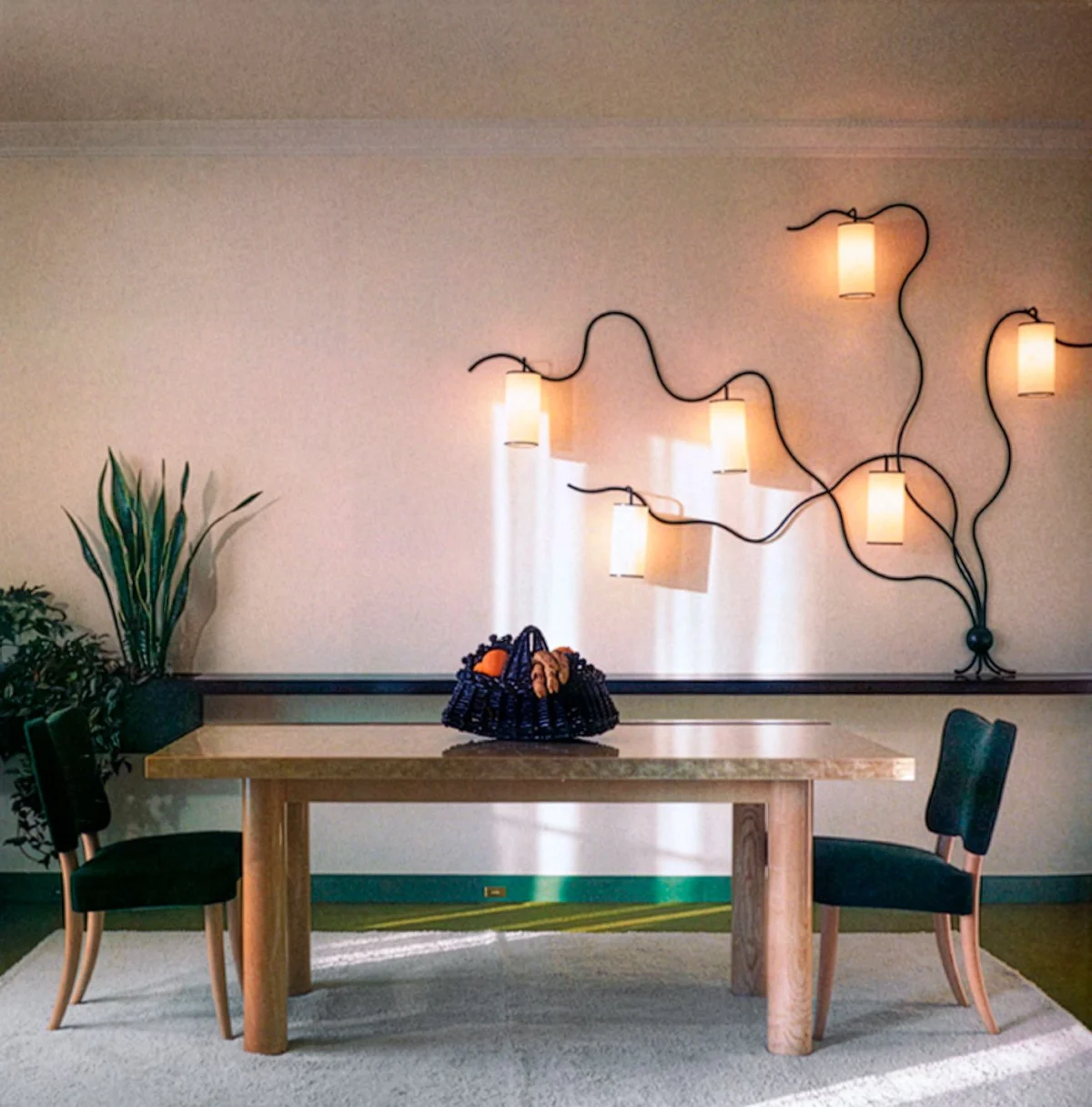
In the annals of mid-century interior design, few artifacts capture the intersection of industrial utility and organic whim as poignantly as the Liane lighting collection by French designer Jean Royère. The origin of this iconic series is rooted in a 1949 Nordic excursion that fundamentally altered the trajectory of Royère’s creative output. Following a comprehensive tour of Scandinavia, the designer authored a reflective report for the publication Le Décor d’Aujourd’hui, detailing his observations of the Swedish capital, Stockholm. It was here, amidst the vibrant, vine-entwined displays of Svenskt Tenn—the legendary emporium curated by Josef Frank—that Royère experienced a sensory epiphany. He noted with admiration the local custom of integrating botanical elements into domestic interiors, observing living spaces where ivy seemingly danced across mirrors and dining rooms where Virginia creeper cascaded over chandeliers. This atmospheric "jungle" aesthetic served as the primary catalyst for the subsequent development of his Liane series.
Chronology of an Icon: From Nordic Flora to Steel Forging
The transition from observation to physical manifestation occurred in the immediate aftermath of Royère’s 1949 trip. The name "Liane"—the French word for vine—served as an explicit nod to the botanical inspiration that birthed the concept. By the mid-1950s, Royère had refined his approach to hand-forged tubular steel, a material often associated with the rigid, utilitarian aesthetic of the Bauhaus movement. However, Royère’s interpretation diverged significantly from his German predecessors. While Bauhaus designers utilized steel for its structural efficiency and industrial honesty, Royère employed the material as a medium for sculptural fluidity.
The evolution of the design can be categorized into three distinct phases:
- The Experimental Phase (1930s): Early exploration of tubular steel that featured controlled, geometric wiggles.
- The Naturalistic Transition (Late 1940s–Early 1950s): The synthesis of his Scandinavian observations, resulting in the organic, vine-like curvature of the Liane form.
- The Mature Era (Mid-1950s–1960s): The standardization of the Liane aesthetic into a versatile array of wall sconces, chandeliers, and floor lamps, often finished in signature palettes of coral, blue, or black, with occasional applications of gold leaf.
Design Specifications and Materiality
The technical composition of the Liane fixtures was as deliberate as their aesthetic form. Royère utilized hand-forged steel to ensure that no two pieces were strictly identical, lending the collection a bespoke, handcrafted quality that belied its industrial roots. Each lamp featured a central block at the base from which the stems would originate, mimicking a bouquet of climbing ivy.

The shades were crafted from cellulose acetate, a revolutionary material of the era that offered durability and a unique translucency, finished with a color-matched paper trim that ensured visual cohesion. This meticulous attention to detail allowed the fixtures to function not merely as lighting sources, but as "wall drawings"—a term frequently used by historians to describe the way the fixtures interact with the surrounding architecture.
The Revival and Contemporary Market Dynamics
The brand, which had seen its influence wane in the decades following Royère’s death, underwent a significant resurgence in 2018. The revival was spearheaded by Vladimir Markovic, the great-nephew of Royère’s longtime business partner, Micha Djordjevic. This transition was not merely a commercial reboot but a scholarly effort to preserve the integrity of the Royère archives.
Jonathan Wray, the creative director under the current management, has been instrumental in maintaining the brand’s commitment to its original design ethos. According to Wray, the resurgence has faced significant challenges, most notably the proliferation of low-quality reproductions in the global furniture market. These imitations often sacrifice the structural nuance of the original hand-forging process for cheaper, mass-produced methods.
"It is never purely expressive," Wray notes regarding the design philosophy. "The decorative elements are always structural." This statement underscores the core tenet of Royère’s work: the fusion of art and function where the aesthetic flourish—the wiggle of the steel—is a direct result of its structural purpose.
Data and Market Analysis: The Value of Authenticity
In the current high-end interior design market, the distinction between authentic Royère pieces and contemporary imitations has become a focal point for collectors and galleries.

- Production Standards: Modern authorized pieces are manufactured using powder-coated steel to ensure longevity, paired with Japanese paper shades that honor the original aesthetic while meeting modern safety and material standards.
- Availability: Collectors can currently choose from a curated catalog of 35 verified Liane varietals.
- Bespoke Limitations: In a move to protect the artistic integrity of the designer’s legacy, the current management has largely curtailed bespoke modifications. By treating the pieces as finished works of art rather than customizable furniture, the brand maintains strict control over the historical narrative and quality assurance.
Broader Impact and Historical Context
The enduring success of the Liane lamp serves as a case study in the longevity of "organic modernism." By bridging the gap between the rigid, intellectual design language of the Bauhaus and the romantic, decorative impulses of the mid-century period, Royère successfully carved a niche that remains relevant in contemporary architecture.
The influence of the Liane collection extends beyond lighting; it represents a philosophy of "inhabited design." When Royère described the Swedish interiors of the 1940s, he was identifying a desire for the domestic space to be a living, breathing environment. His lamps do not sit passively on a wall; they interact with the space, creating shadows and shapes that change with the ambient light. This dynamism has made the Liane fixture a staple in high-end design projects, appearing in everything from Parisian apartments to luxury commercial installations.
Official Responses and Preservation Efforts
The Musées des Arts Décoratifs, which holds several of Royère’s original sketches and prototypes in its collection, continues to serve as the definitive record of his process. The sketches, particularly those from the mid-1950s, reveal a rigorous iterative process. Royère did not simply "draw" these designs; he engineered them through hundreds of variations, adjusting the curvature of the steel to ensure the weight distribution remained balanced without sacrificing the appearance of weightlessness.
The preservation of these archives has been essential in the legal and cultural battles against counterfeit producers. By providing a clear documentation trail, the museum and the Royère brand have been able to educate the market on the differences between a "Liane-style" product and an authentic Royère design.
Implications for Future Design
The trajectory of the Liane lamp suggests a shift in the way historical design is viewed by the modern consumer. There is a growing appreciation for the "hand of the designer"—the visible evidence of the creator’s labor—as a counterpoint to the sterile, digital-first aesthetic that dominated the early 21st century.

As we look forward, the legacy of Jean Royère acts as a reminder that industrial materials do not have to result in cold or impersonal objects. By injecting warmth, humor, and a sense of natural movement into the cold steel of the industrial age, Royère created a legacy that transcends time. The Liane lamp remains a testament to the idea that the most successful designs are those that blur the lines between the natural world and the built environment, creating a sense of life within the walls of our homes.
The continued relevance of these designs is not merely a product of nostalgia, but an acknowledgment of the fundamental human need for spaces that reflect the complexity and beauty of the natural world. Whether through the original vintage pieces surfacing at international auctions or the modern, authorized iterations, the Liane lamp persists as a vital element of the modern interior landscape, perpetually climbing the walls of contemporary design.