Layla Zulfa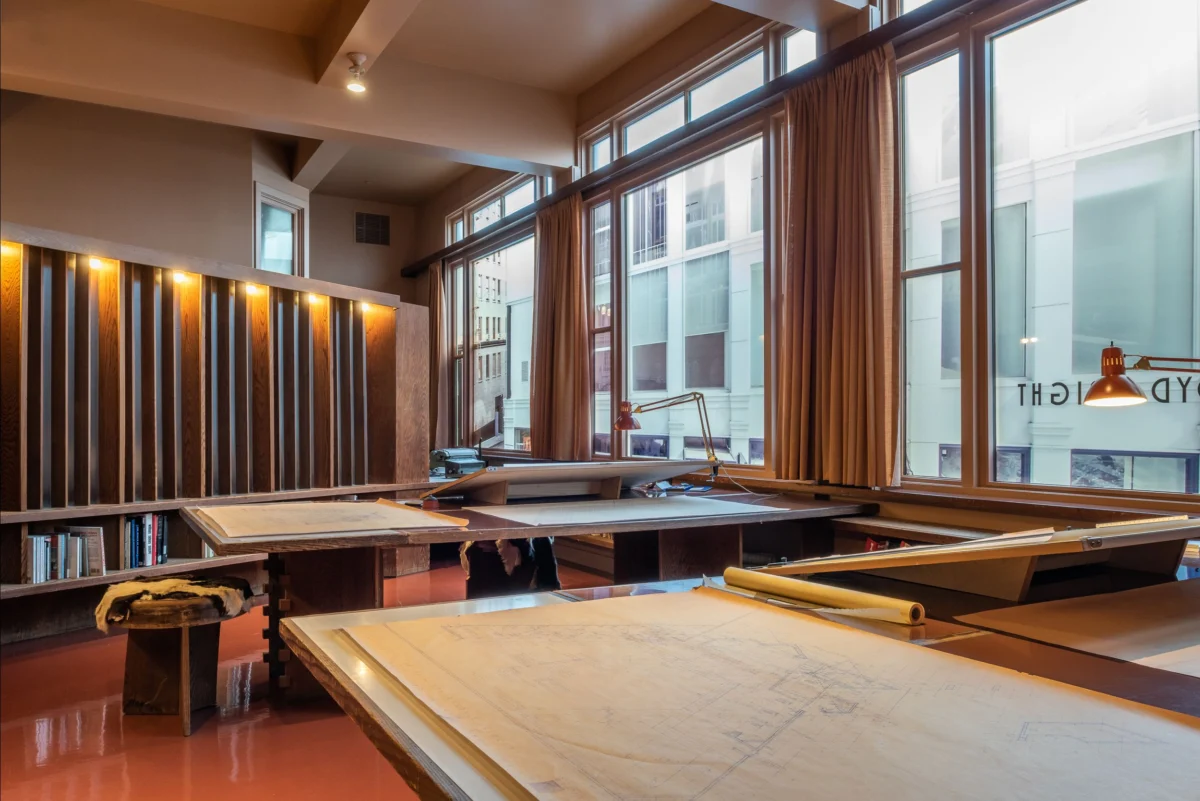
The Genesis of the San Francisco Field Office
In 1951, Frank Lloyd Wright was experiencing a late-career surge in commissions, particularly on the West Coast. Despite being in his 80s, Wright’s influence remained unparalleled, and his workload necessitated a formal presence in California to oversee projects such as the V.C. Morris Gift Shop and the expansive Marin County Civic Center. To facilitate this, Wright partnered with associate Aaron Green, an architect who had become a trusted collaborator and a proponent of Wright’s organic architecture philosophy.
The office was established on the second floor of an existing building at 170 Maiden Lane in San Francisco. True to his signature style, Wright did not merely occupy the space; he transformed it. Utilizing redwood plywood, he crafted an environment that emphasized warmth, geometric precision, and the "compression and release" technique that defined much of his residential and commercial work. Mark Schmitz, a member of the Board of Trustees for Taliesin Preservation and founder of the design firm Zebradog, notes that the office was designed to be largely self-supporting. It sat upon the original floor plate of the San Francisco building without requiring structural integration into the existing walls, a design choice that would later prove instrumental in its preservation and eventual relocation.
Throughout the 1950s, this office served as Wright’s primary workspace outside of his personal residences and studios at Taliesin in Wisconsin, Taliesin West in Arizona, and his home in Oak Park, Illinois. While it was a functional drafting room for apprentices and associates, it also served as a private sanctuary where Wright could meet with high-profile clients and refine his vision for the future of American urban and civic design.
.jpg)
A Chronology of Preservation and Relocation
The survival of the San Francisco Field Office is largely credited to the foresight of Aaron Green. Following Wright’s death in 1959, Green continued to operate out of the space for nearly 30 years, maintaining the integrity of the design. When the office finally closed its doors in 1988, Green recognized the "star power" and historical value of the interior. Rather than allowing the materials to be scrapped or renovated, he oversaw a meticulous dismantling process. Every board was tagged, every joint cataloged, and the entire office was crated for long-term storage.
The following timeline illustrates the office’s journey from a working studio to a museum artifact:
- 1951: The office is designed and installed at 170 Maiden Lane, San Francisco.
- 1951–1959: Wright utilizes the office for major California commissions.
- 1959–1988: Aaron Green maintains the office as a working architectural studio.
- 1988: The office is dismantled, cataloged, and placed into storage.
- 1990s: The office is briefly reconstructed and displayed behind glass at the Heinz Architectural Center at the Carnegie Museum in Pittsburgh, Pennsylvania.
- 2000s–2010s: The crated office is moved to a storage facility in Buffalo, New York, where it remains for approximately 30 years.
- 2020: The Hagen History Center acquires the office and transports it to Erie, Pennsylvania.
- 2021: The physical reconstruction of the office is completed within a new, dedicated facility.
- 2024: The immersive museum experience, including soundscapes and interactive digital elements, officially opens to the public.
Caleb Pifer, President and CEO of the Hagen History Center, has emphasized that the "spoiler" of this long history is the successful salvage of the artifact. The acquisition by the Erie-based center was driven by a desire to move beyond static displays and create a "living" history that visitors could enter and experience firsthand.
Architectural Philosophy and Immersive Design
The new museum at the Hagen History Center is not merely a display of furniture but a comprehensive exploration of Wright’s architectural doctrine. The 3,000-square-foot facility utilizes the original redwood plywood office as its centerpiece, but it surrounds the artifact with context designed to "humanize" the architect.
.jpg)
A central feature of the exhibit is the use of "compression and release." In Wright’s residential designs, this often involved a low-ceilinged entryway (compression) that opened into a soaring, light-filled living area (release), intended to evoke a sense of liberation and connection to nature. In the San Francisco Field Office, Wright adapted this concept to the professional environment. The entrance and peripheral areas provide the compression, while the drafting room—with its high ceilings and strategically placed windows—serves as the release. Pifer explains that while Wright’s homes often used windows to draw the eye toward the natural landscape, the office windows and ceiling heights are designed to focus attention on the drafting table, signaling that this is "where the action is happening."
To enhance the visitor experience, the Hagen History Center collaborated with Zebradog to create a multi-sensory environment. A meticulously designed soundscape plays throughout the tour, featuring the sounds of 1950s San Francisco street traffic, the ringing of period-appropriate telephones, and the muffled conversations of apprentices and clients. The intention is to create the illusion that the staff has simply stepped out for lunch, leaving the workspace frozen in a moment of peak productivity.
Furthermore, the museum employs modern technology to bridge the gap between the past and present. Upon entering, visitors are greeted by a high-definition video of an actor portraying Wright at his desk. Utilizing proximity sensors, the digital "Wright" looks up and addresses visitors as if they were prospective clients, discussing his theories on organic architecture and the relationship between structures and their natural surroundings. To maintain authenticity, the production team used filming equipment and techniques common in the 1950s to ensure the visual texture matched the era.
Educational Initiatives and Interactive Elements
The Hagen History Center has integrated several interactive stations intended to engage visitors of all ages in the principles of design. These include:

- Froebel Blocks: Wright famously credited his childhood play with Froebel blocks—a set of geometric wooden blocks designed by Friedrich Froebel, the inventor of kindergarten—as a foundational influence on his architectural style. Visitors can manipulate these blocks to understand the geometric patterns that underpin Wright’s work.
- Art Glass Design: Interactive displays allow guests to design their own personal "art glass" windows, reflecting the stained-glass patterns Wright used to dissolve the boundaries between interior and exterior spaces.
- Scale Comparison: The exhibit highlights the staggering range of Wright’s late-career output. On one end of the spectrum is a recreation of a doghouse Wright designed for a client’s son—the smallest structure of his career. On the other end is a detailed exploration of the Marin County Civic Center, his largest project. Notably, both of these projects were developed within the confines of the San Francisco Field Office.
Broader Impact and Regional Implications
The opening of the Frank Lloyd Wright Field Office Museum is expected to have a significant impact on Erie’s tourism and cultural standing. By housing a major architectural artifact that was previously hidden from public view, the Hagen History Center positions itself as a key destination for the "Wright Trail," a network of sites across the United States dedicated to the architect’s legacy.
From a preservation standpoint, the project demonstrates a successful model for the relocation of interior architectural environments. Unlike historic buildings, which are often tied to their specific geography, interior workspaces like the field office represent a "portable" history. The ability to reconstruct such a space with its original materials—rather than creating a replica—provides an authentic link to the past that is rare in museum settings.
The project also reflects a broader trend in the museum industry toward "experiential" history. By moving away from "behind-the-glass" exhibits and toward immersive environments, institutions like the Hagen History Center are finding new ways to make historical figures and their philosophies accessible to a contemporary audience.
The Frank Lloyd Wright Field Office Museum is now open to the public Tuesday through Saturday from 10 a.m. to 5 p.m., and Sundays from noon to 5 p.m. With an admission fee of $14, the center offers an affordable entry point for students, architectural enthusiasts, and tourists to engage with the work of a man who redefined the American landscape. As Caleb Pifer noted, the ultimate goal of the exhibition is for guests to walk away with a profound understanding of why Wright remains a central figure in the pantheon of global architecture. Through the preservation of his San Francisco workspace, his "organic" doctrine continues to find new life in the heart of Pennsylvania.