Layla Zulfa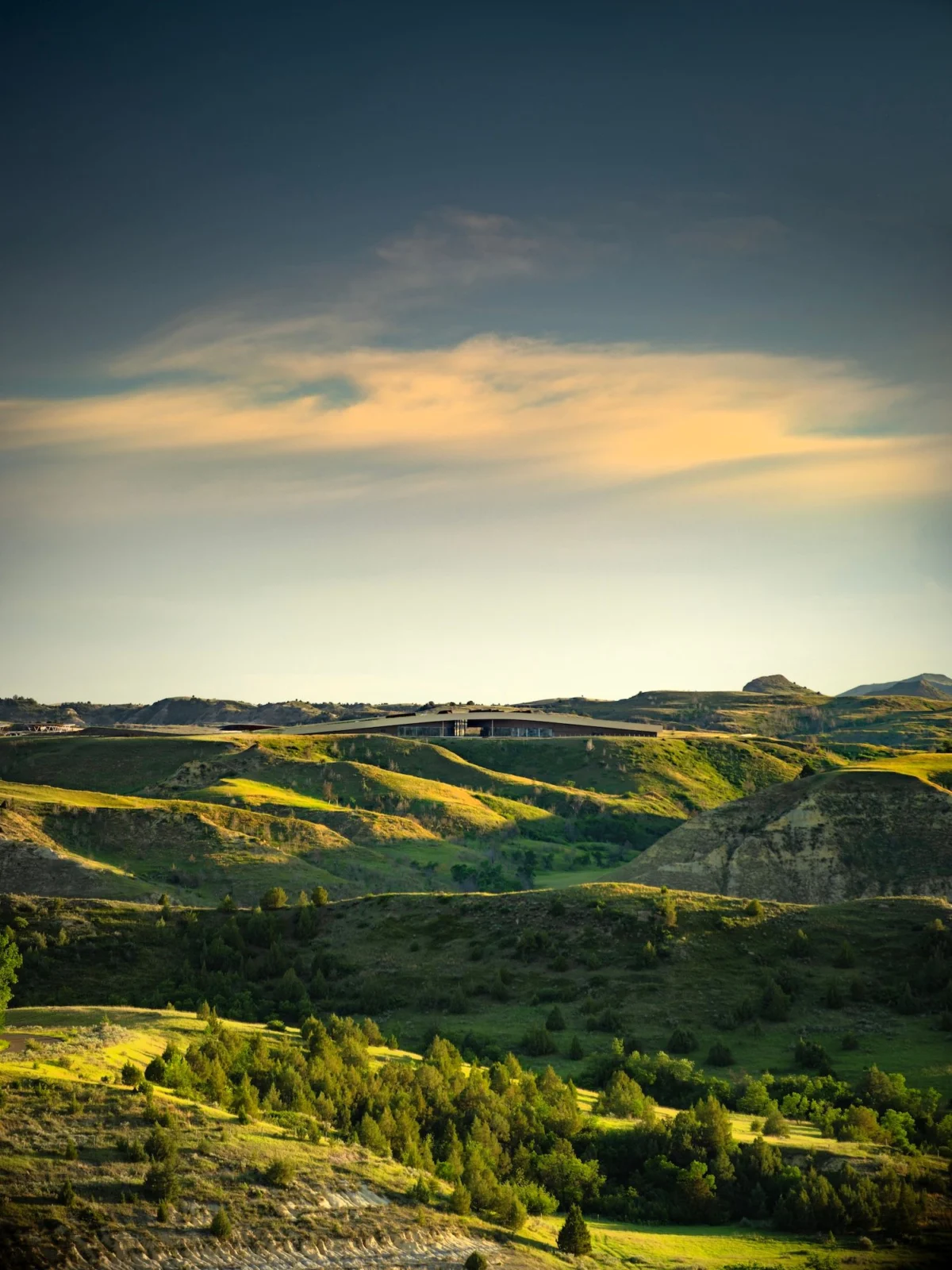
Rising from the rugged buttes of Medora, North Dakota, the Theodore Roosevelt Presidential Library stands as a testament to a leader whose identity was forged in the furnace of the American West. Scheduled to open on July 4, the 96,000-square-foot facility is far more than a repository for documents; it is a structural manifestation of the 26th president’s conservationist ethos. Designed by the internationally acclaimed architecture firm Snøhetta in collaboration with the local firm JLG Architects, the library is positioned to become a global benchmark for sustainable architecture and immersive historical education. Unlike traditional presidential monuments that project authority through neoclassical stone and verticality, this library is integrated into the topography, disappearing and reappearing as visitors navigate the landscape of the Badlands.
The project serves a dual purpose as a museum and a digital archive, but its most striking feature is its physical relationship with the land. The building’s curved, sloping roof—reaching a peak of 39 feet—doubles as a public hiking trail, allowing visitors to walk atop the institution while surveying the same vistas that once inspired Roosevelt. This design philosophy, according to Snøhetta partner and architect Craig Dykers, treats the building not as a separate entity delineated by property lines, but as an extension of the natural world. In an era where architectural sustainability is often a secondary consideration, the Theodore Roosevelt Presidential Library (TRPL) seeks to be a carbon sink, sequestering more carbon over its lifespan than was emitted during its construction.

The Crucible of the Badlands: A Chronology of Healing
To understand the location of the library is to understand the transformation of Theodore Roosevelt himself. The site is situated near the Little Missouri River, a region Roosevelt first visited in September 1883. At the age of 24, he arrived as an eastern aristocrat seeking to hunt bison before the species vanished from the plains. However, the landscape soon shifted from a playground to a sanctuary.
In February 1884, Roosevelt suffered a double tragedy that would have broken a lesser man: his mother, Mittie, and his wife, Alice Hathaway Lee, died on the same day in the same house. Seeking an escape from his grief, Roosevelt returned to the North Dakota Badlands to immerse himself in the grueling life of a rancher. He established the Elkhorn Ranch, which he often referred to as his "home ranch," and spent years raising cattle and living among the rugged frontiersmen.
This period was the catalyst for his conservationist ideology. Observing the overgrazing of the plains and the rapid disappearance of wildlife, Roosevelt realized that the American wilderness was a finite resource. When he ascended to the presidency in 1901 following the assassination of William McKinley, he brought this Western sensibility to the White House. During his tenure, he protected approximately 230 million acres of public land, established the U.S. Forest Service, and signed the Antiquities Act of 1906. The new library in Medora is built on this very ground, honoring the specific geography that transitioned Roosevelt from a grieving widower to a national visionary.

Architectural Innovation and the Working Landscape
The design of the library reflects the "strenuous life" Roosevelt famously advocated. Matthew McMahon, a director of landscape architecture at Snøhetta, notes that the face of the building is effectively the land itself. This is achieved through the use of mass timber for the primary structure and low-carbon concrete for the foundations. Perhaps most distinctive are the rammed earth walls. These walls are constructed using locally sourced sediment mixed with custom pigments and a minimal amount of cement binder. Beyond their aesthetic appeal—mimicking the stratified layers of the surrounding buttes—these walls provide high thermal mass, which helps regulate the building’s internal temperature against the extreme seasonal fluctuations of the North Dakota climate.
The integration of the building into the environment extends to the "Native Plant Project." In a massive volunteer effort, 400,000 native seedlings were collected and grown by North Dakota State University to restore the grasslands surrounding the museum. This is not merely a decorative garden but a "working landscape." The grounds will be managed through controlled burns and modified grazing by local livestock, simulating the historical impact that bison herds once had on the prairie ecosystem.
In 2021, the site’s resilience was tested when a wildfire swept through the area shortly after project planning had begun. Rather than a setback, the event served as a biological proof of concept. Michelle Delk, a partner and landscape architect at Snøhetta, observed that native plants began to reemerge within weeks of the fire. This natural regeneration reinforced the design team’s commitment to a project that supports, rather than replaces, the existing ecological cycles.

Sustainable Infrastructure and Energy Independence
The TRPL aims to operate with zero carbon emissions and zero waste, a feat made possible through a sophisticated array of renewable energy systems. Aaron Dorf, a director at Snøhetta, explains that the building is designed to be self-sufficient. The facility utilizes geothermal wells to leverage the earth’s constant temperature for heating and cooling. This is supplemented by radiant flooring and a low-energy HVAC system.
While the building generates 25% of its required renewable energy through on-site solar panels, the remaining 75% is sourced from off-site solar arrays. This comprehensive approach to energy ensures that the library does not place a burden on the local power grid. By partnering with the environmental design studio Atelier Ten, the architects have ensured that every aspect of the 96,000-square-foot structure—from its orientation to its material composition—minimizes its environmental footprint.
The Interior Experience: Education and Storytelling
Inside the library, the focus shifts to a narrative journey through Roosevelt’s life. The interior includes a 300-seat auditorium featuring a massive picture window behind the stage, framing the Badlands as a permanent backdrop for lectures and performances. The galleries, designed in collaboration with firms such as Local Projects and the Future of StoryTelling, utilize interactive and digital archives to bring Roosevelt’s voluminous writings and speeches to life.

Visitors will find:
- The Digital Archive: A comprehensive collection of Roosevelt’s letters, diary entries, and official documents, made accessible through high-tech interfaces.
- The Elkhorn Gallery: An exploration of Roosevelt’s time as a rancher, detailing the hardships and triumphs of life in the 1880s Badlands.
- The Conservation Hub: An educational space dedicated to the history of the U.S. Forest Service and the ongoing challenges of wildlife preservation.
- Classrooms and Cafés: Spaces designed to host local students and tourists, fostering a community-centric atmosphere.
Crucially, the library does not dictate a single way to experience its offerings. A large breezeway serves as the main entrance, but the site is accessible via hiking trails, mountain bike paths, and even horseback. A hitching post is provided for those arriving on horse, a nod to the traditional mode of transport during Roosevelt’s era. The one-mile undulating boardwalk that weaves through the grounds includes scenic overlooks and a suspended observation net, encouraging visitors to engage with the outdoors as much as the indoor exhibits.
Broader Implications and Economic Impact
The construction of the Theodore Roosevelt Presidential Library is a significant milestone for North Dakota and the national system of presidential monuments. Most presidential libraries are located in urban or suburban settings, often closer to the president’s birthplace or political stronghold. By placing this library in remote Medora, the organizers are betting on the power of "destination architecture" to drive tourism and economic growth in the region.

The project has received substantial support from both private donors and the state of North Dakota. The state legislature famously approved a $50 million endowment for the project, contingent on the foundation raising $100 million in private donations—a goal that was met with enthusiasm from philanthropists across the country. This public-private partnership underscores the perceived value of the library as a cultural and economic anchor for the northern plains.
Furthermore, the TRPL sets a new standard for how presidential legacies are preserved. In the past, such institutions were often criticized for being hagiographic or static. By creating a "living library" that focuses on active conservation and environmental science, the TRPL aligns Roosevelt’s historical significance with contemporary global concerns regarding climate change and land management.
A Century-Long Vision
The architects and planners behind the project frequently asked themselves how Roosevelt would view these modern challenges. "We often adopted this stance that he would have been thinking around at least a hundred years in the future, because he often was," says Aaron Dorf. This forward-thinking approach is evident in the library’s commitment to durability and ecological harmony.

As the sun sets over the Little Missouri River valley, the library’s silhouette blends into the buttes, a quiet observer of the land it seeks to protect. When it opens its doors on July 4, it will offer more than a history lesson; it will offer a blueprint for how humanity can build in conversation with nature. Theodore Roosevelt once said, "The nation behaves well if it treats the natural resources as assets which it must turn over to the next generation increased, and not impaired, in value." The Theodore Roosevelt Presidential Library is the physical embodiment of that promise, ensuring that the "strenuous life" and the beauty of the Badlands remain accessible for the next century and beyond.