Layla Zulfa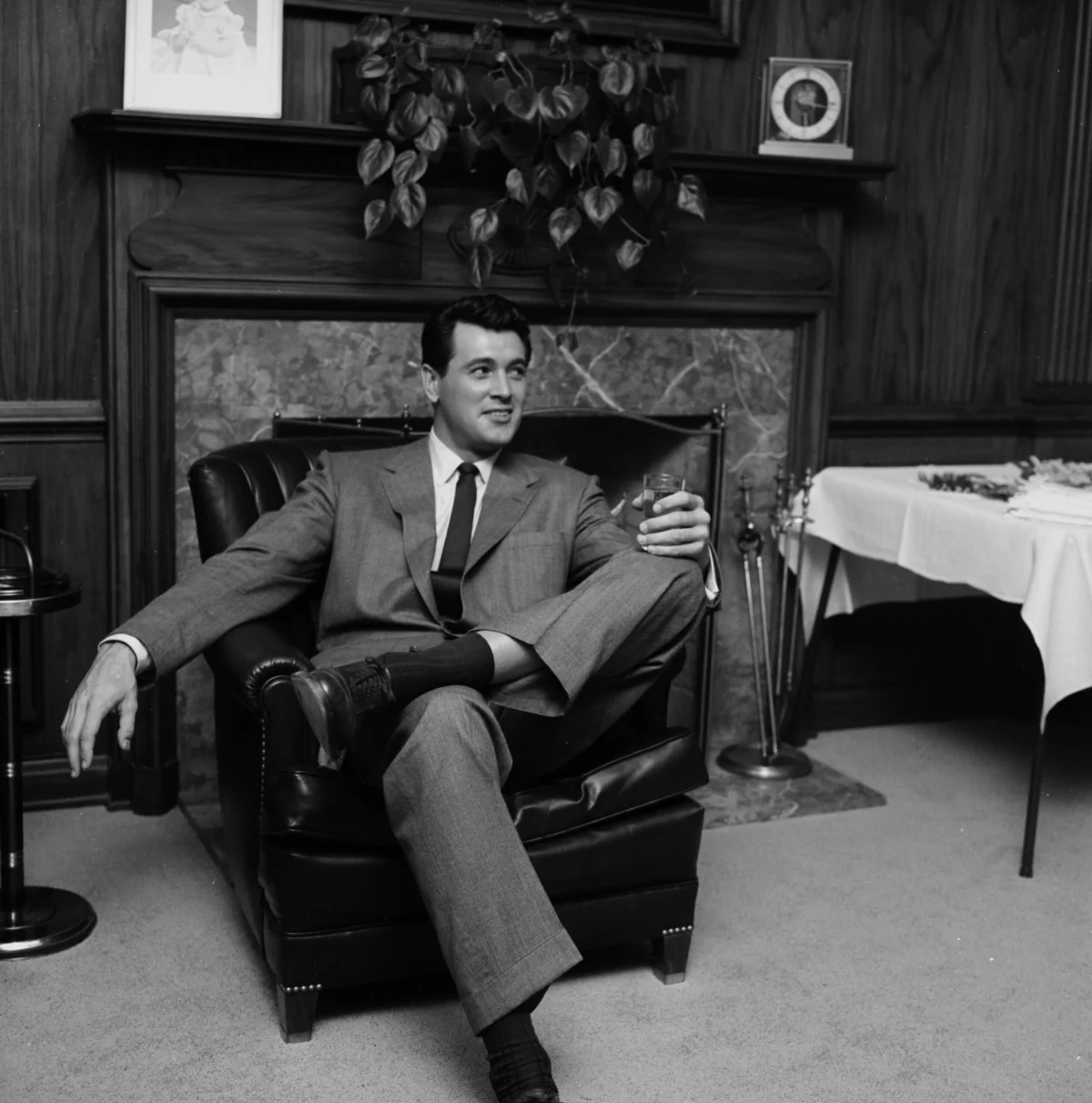
Though he remains an enduring icon of Hollywood’s Golden Age, synonymous with the polish and prestige of mid-century cinema, the trajectory of Rock Hudson’s life began far from the spotlights of Tinseltown. Born Roy Harold Scherer Jr. on November 17, 1925, in Winnetka, Illinois, Hudson’s early life was defined by the modest realities of the Great Depression. According to Sara Davidson’s definitive biography, Rock Hudson: His Story, the future star spent his formative years in a cramped, one-bedroom bungalow at 719 Center Street. This dwelling, shared by six adults and five children, offered little in the way of privacy or personal space—a stark contrast to the sprawling estates he would eventually cultivate as a global celebrity. This early scarcity likely informed his profound attachment to the homes he later acquired, which he viewed not merely as real estate, but as essential refuges from a public life that demanded constant performance.

From Humble Roots to Hollywood Stardom
As Hudson’s career ascended, marked by landmark performances in cinematic staples such as Giant, Pillow Talk, and All That Heaven Allows, the actor found himself increasingly scrutinized by the public eye. The pressure of maintaining a leading-man persona while navigating his private identity as a closeted gay man necessitated a sanctuary. By the 1950s, Hudson’s real estate choices reflected his desire to create a hermetic environment. As he famously articulated in his memoirs, his home was the only place where he could experience true autonomy. Outside his gates, every movement was documented and debated; inside, he could engage in the manual labor of home improvement, finding solace in the tangible act of tearing down walls and laying bricks—a grounded pursuit for a man whose professional life was built on artifice.
The Early Years of Cohabitation and Domestic Transitions
The chronology of Hudson’s domestic life offers a window into the evolution of his personal relationships and his burgeoning aesthetic sensibilities. In 1952, a period during which Hudson was establishing his foothold in the industry, he shared a home in Los Angeles with fellow actor Bob Preble. Their domestic arrangement spanned three years and four different residences, culminating in a home on Avenida del Sol. This property was notably forward-thinking, featuring futuristic glass fixtures and sweeping vistas of the valley and mountains.

Historical accounts suggest this period was marked by an exploration of identity. In retrospect, Preble characterized their time together as a period of experimental proximity that never fully solidified into a conventional partnership, ultimately concluding when Preble married actor Yvonne Rivero. This transition marked a recurring theme in Hudson’s life: the intersection of his private, personal desires with the heteronormative expectations of the 1950s film industry.
The Marriage to Phyllis Gates: A Study in Public Perception
In 1955, Hudson entered a high-profile marriage with Phyllis Gates, a secretary and interior designer. The union, which many historians and contemporary observers suggest was arranged to shield Hudson from the career-ending stigma of his homosexuality, was centered at 9151 Warbler Place. Hudson had acquired this two-bedroom ranch-style property near Sunset Boulevard in 1954. Because the acquisition had depleted his financial reserves, the home was initially furnished with simple redwood lawn chairs—a modest start for a burgeoning superstar.

Despite the complexities surrounding the marriage, Gates later maintained that her affection for Hudson was genuine. In testimonies provided years after their 1958 divorce, she recounted the charisma and stature that defined Hudson, noting that his public profile and undeniable magnetism made him an alluring partner. When the marriage dissolved, the settlement provided Gates with $250 in weekly alimony for a decade and the title to the Warbler Place residence, then valued at $35,000. This period represented a pivotal shift, as Hudson moved toward a more independent lifestyle, eventually relocating to a beach house in Malibu.
The Malibu Interlude and the Search for Solitude
Following his divorce, Hudson sought refuge in a coastal home in Malibu. Perched on stilts, the structure was frequently buffeted by high tides, creating an environment that was both dramatic and serene. During the production of the 1959 film Pillow Talk, this home served as his primary residence and a hub for his social circle, which included stuntmen and actors who shared his affinity for outdoor recreation. This era was defined by a rustic, active lifestyle—swimming, sailing, and scuba diving—that stood in stark contrast to the rigid constraints of the studio system. However, the Malibu tenure was brief, and by the summer of 1959, Hudson moved to Newport Beach, continuing his search for a space that offered both tranquility and a sense of permanence.

The Castle: An Architectural Sanctuary
The most significant chapter in Hudson’s residential history began in the early 1960s with 9402 Beverly Crest Drive. Initially leased from producer Sam Jaffe, the residence was a sprawling 3.5-acre estate characterized by its Spanish-style architecture, including a red-tile roof, stucco walls, and dark wooden beams. Hudson’s desire to own this property became a primary motivation during his contract negotiations with Universal Studios. In 1962, the studio leveraged the purchase of the house—for a price of $167,000—as an incentive to secure a long-term contract extension.
Upon obtaining the property, which he dubbed "The Castle," Hudson undertook a massive, years-long renovation. Guided by his research into Mexican colonial architecture, he transformed the home into a reflection of his eclectic tastes. He incorporated stone archways, hand-painted tiles, and ceilings fashioned from tree limbs. The interior was decorated with a mix of high-culture and exotic items, including zebra skins, African masks, and massive pewter candlesticks. The property also featured notable artistic installations, including sculptures by Mexican artist Victor Salmones and custom wood carvings that reflected the actor’s interest in mythology.

Lifestyle and Philosophical Underpinnings
The management of The Castle revealed much about Hudson’s philosophy regarding privacy and community. Despite his reputation as a guarded celebrity, he maintained a notably open-door policy. Associates such as George Nader noted that Hudson purposefully left doors unlocked, harboring a desire for spontaneous human connection and the excitement of the unknown. His staff, including his housekeeper, observed that Hudson remained deeply engaged with the outside world, frequently prioritizing fan mail and telephone calls over the isolation that his wealth afforded him.
This engagement extended to his passion for horticulture. Inheriting a professional gardener, Clarence Morimoto, Hudson dedicated significant time to the estate’s grounds. His garden was a functional and aesthetic pursuit, producing a bounty of orchids, roses, limes, and fresh vegetables. Hudson viewed gardening as a meditative practice, a place where he could process professional decisions and find relief from the performative exhaustion of his career. He often remarked that if his life had taken a different path, he would have pursued a career as a landscape architect.

The Final Years and Legacy
The Castle remained Hudson’s primary residence until his death on October 2, 1985, following complications from AIDS. The property became the setting for his memorial service, attended by 300 guests, including his long-time collaborator Elizabeth Taylor. At the time of his passing, the estate was appraised at $3 million, a testament to the appreciation of the Beverly Crest area and the extensive improvements Hudson had made.
The post-Hudson history of the estate serves as a barometer for the extreme escalation of the Los Angeles real estate market. In 1997, Microsoft co-founder Paul Allen acquired the property for $9 million. Allen held the estate until his death in 2018, and in 2021, his estate listed the residence for $55.5 million. This massive valuation underscores not only the prestige of the location but the enduring fascination with the properties associated with Hollywood’s Golden Age figures.

The story of Rock Hudson’s homes is more than a record of real estate transactions; it is an architectural biography of a man struggling to reconcile the public demands of stardom with the private need for a sanctuary. From the crowded bungalow in Chicago to the expansive, self-designed sanctuary of The Castle, Hudson’s homes were the stages upon which he navigated his identity, his passions, and the inevitable pressures of a life lived in the public gaze. The historical preservation of these sites offers a rare, grounded perspective on a career that, while defined by the screen, was lived in the quiet, cultivated spaces behind closed doors.