
 Jono Maryono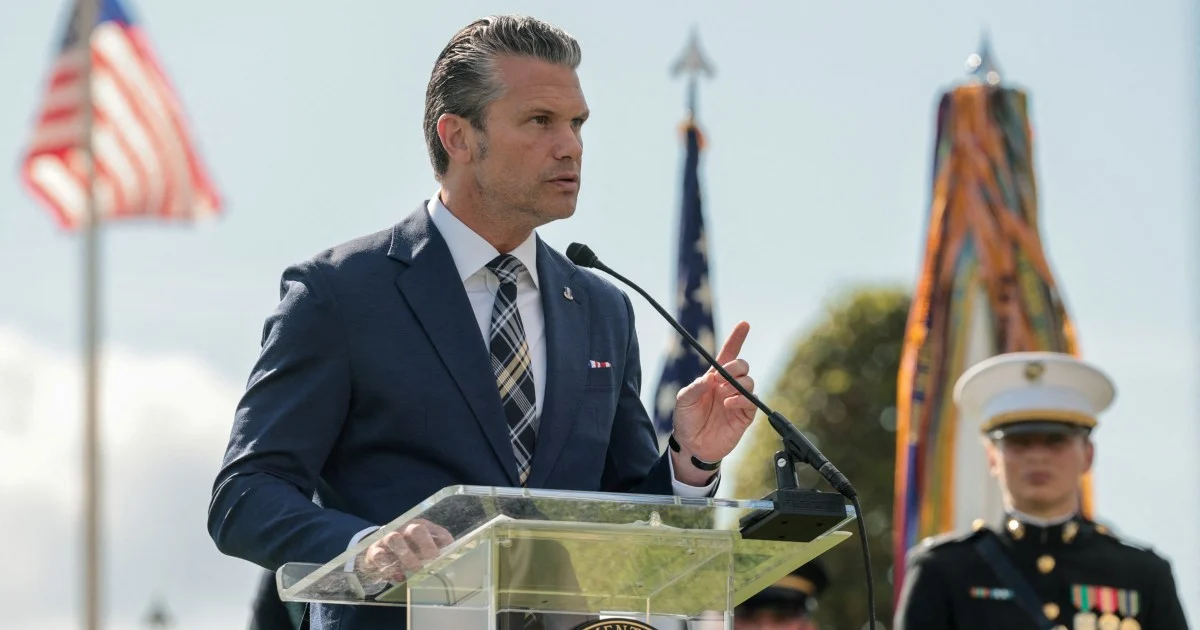
United States Defense Secretary Pete Hegseth is moving forward with a profound restructuring of the American military command structure, directing a 20 percent reduction in the number of positions reserved for generals and admirals across the Army, Navy, Air Force, and Marine Corps. According to a senior Pentagon official speaking on condition of anonymity, the decision will be officially unveiled during Wednesday’s "State of the Force" address at the Marine Corps Base Quantico in Virginia. Hegseth is scheduled to deliver the address directly to an audience of junior officers and enlisted personnel, signaling an intentional shift in focus away from top-heavy administrative command and toward the operational baseline of the armed forces.
The sweeping initiative doubles down on a previous directive issued by the defense secretary last year, which initially mandated a 10 percent reduction across the roughly 800 flag and general officer positions within the Department of Defense. Under the newly calibrated timeline, all military services are now directed to complete the cumulative 20 percent drawdown by January 1, 2027. Media reports from outlets including The Associated Press, Fox News, and The Washington Post indicate that the cuts will directly affect any rank from one-star general and above, as well as equivalent ranks in the naval service. The policy change is poised to reshape the career trajectories of hundreds of current and rising military leaders, carrying profound implications for the operational philosophy, bureaucratic efficiency, and institutional culture of the United States military.
Background Context and Administrative Shake-Ups
The announcement of the 20-percent reduction in senior officer ranks does not occur in a vacuum; rather, it represents the latest escalation in a series of dramatic personnel shifts overseen by the Trump administration since it took office in January 2025. Over the past year and a half, President Donald Trump and Defense Secretary Hegseth have engaged in an unprecedented reshaping of the Pentagon’s upper echelon. More than two dozen high-ranking military leaders have been fired, forced into early retirement, or subjected to stalled promotions.
Among the most high-profile dismissals was that of Army Chief of Staff General Randy George, who was relieved of his duties in April amid a reported string of sweeping administrative ousters. The administration also removed the only two women serving as four-star generals in the United States military, alongside several other senior female officers. These aggressive executive actions have coincided with high-profile voluntary departures, driven by ideological and strategic clashes with the current civilian leadership. Most notably, Army Secretary Dan Driscoll resigned earlier this month following persistent disagreements with Hegseth over the direction and management of the ground forces.
When Hegseth first introduced the concept of pruning the highest military tiers, administration officials defended the move as a long-overdue measure to eliminate redundant force structures, optimize operational leadership, and streamline the military’s administrative framework. In an internal policy memo released in May 2025, the defense secretary asserted that the primary objective was to liberate the armed forces from unnecessary bureaucratic layers that allegedly slow decision-making and dilute accountability.
Chronology of Reform and Cultural Shifts
To understand the trajectory of Secretary Hegseth’s tenure at the Pentagon, it is necessary to examine the chronological sequence of reforms and policy announcements that have defined his leadership since taking office:
- January 2025: The incoming administration assumes control, immediately initiating a review of senior military appointments, strategic doctrines, and administrative efficiency.
- Early 2025: Hegseth orders an initial 10 percent reduction in flag and general officer positions, arguing that the upper tiers of the military command have become bloated and bureaucratic.
- Spring 2025: Alongside force-structure adjustments, the defense secretary formally declares an end to what the administration characterizes as "woke" culture within the ranks. New physical fitness directives are introduced, mandating gender-neutral or male-level standards across all military branches.
- May 2025: A formal policy memorandum is released, outlining the strategy to dismantle unnecessary bureaucratic layers and redirect focus toward core warfighting capabilities.
- April 2026: General Randy George, the Army’s top uniformed officer, is dismissed in a high-profile purge that signals the administration’s willingness to remove established service chiefs.
- September 2026: Army Secretary Dan Driscoll resigns following repeated clashes with Hegseth, highlighting growing friction between civilian political appointees and institutional military leadership.
- October 2026 (Upcoming): Defense Secretary Hegseth prepares to deliver the "State of the Force" address at Marine Corps Base Quantico, where he will announce the doubling of the general officer cuts to a total of 20 percent, targeting completion by January 2027.
Legislative Pushback and Congressional Concerns
The aggressive downsizing of the military’s flag ranks has drawn sharp criticism from lawmakers on Capitol Hill, who argue that the administration is bypassing constitutional oversight and destabilizing the armed forces during a volatile global security environment. Senator Jack Reed, a Rhode Island Democrat and the ranking member of the Senate Armed Services Committee, issued a stern statement condemning the latest planned cuts and demanding greater transparency from the Pentagon.
"Eliminating senior leadership positions must be done in close consultation with Congress, and these planned cuts should alarm every American," Senator Reed stated. "Congress has been clear with the Secretary that he must consult this body and explain his reasoning for senior officer removals and promotion holds. To date, we have not received satisfactory answers."
Reed emphasized that the United States military is currently engaged in complex, major operations around the globe, leaving the active-duty force under severe operational strain. Critics argue that arbitrarily reducing the number of experienced senior leaders during a period of international tension—marked by ongoing conflicts in Eastern Europe, the Middle East, and mounting strategic competition in the Indo-Pacific—risks institutional memory and tactical coordination.
While the total number of general and flag officer billets is ultimately regulated by federal law, the executive branch retains significant latitude in how these positions are managed. The administration can effectively reduce the active footprint of senior leadership by simply choosing not to nominate candidates to fill vacancies as they arise, thereby bypassing the formal legislative repeal of statutory limits while still achieving a significant contraction of the command structure.
Fact-Based Analysis of Strategic Implications
The decision to cut the number of generals and admirals by 20 percent carries multifaceted implications for the future posture of the United States armed services. On one hand, proponents of the plan argue that the military has experienced a phenomenon known as "grade creep" over recent decades, during which the ratio of senior officers to enlisted personnel expanded significantly. Supporters maintain that a leaner command structure can reduce institutional inertia, accelerate communication between the battlefield and the boardroom, and ensure that resources are directed away from administrative overhead toward combat readiness and equipment modernization.
On the other hand, military analysts and defense experts point out several risks associated with rapid, top-down structural purges. A sudden contraction of the general officer pool may create a generational leadership gap, as mid-level and junior officers are thrust into higher responsibilities without the traditional mentorship and seasoning provided by experienced flag officers. Furthermore, the politicization of senior military assignments—evidenced by the dismissal of service chiefs and the stagnation of promotion pipelines—threatens to damage institutional morale and undermine the traditional nonpartisan ethos of the United States armed forces.
As Secretary Hegseth takes the stage at Marine Corps Base Quantico to deliver his "State of the Force" address, the eyes of the national security establishment will be fixed on the details of how the Pentagon plans to implement this historic reduction. Whether the 20 percent drawdown successfully creates a more agile and lethal military, or instead deepens the rift between civilian leadership and the legislative branch, remains one of the most pressing questions facing American defense policy as the military heads toward 2027.









