
 Ronny Sianturi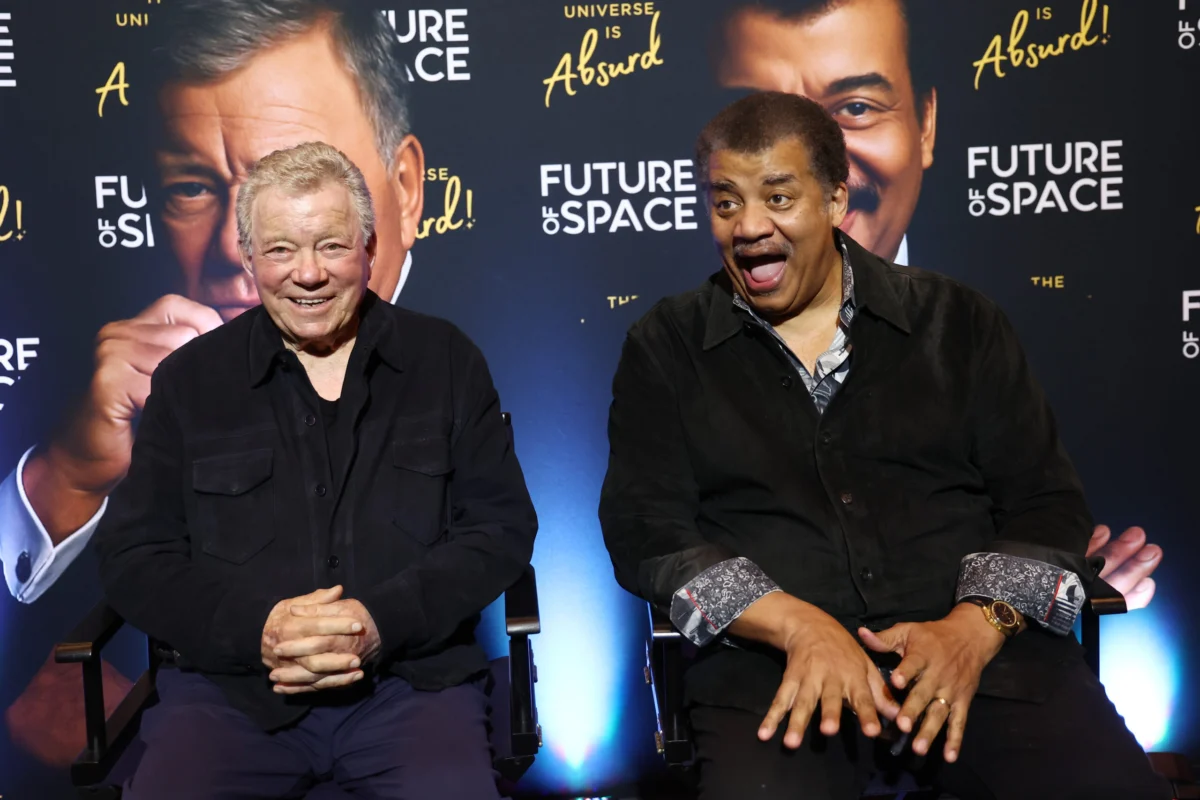
Beverly Hills, CA – In a captivating convergence of acting legend and cosmic explainer, William Shatner and Neil deGrasse Tyson illuminated the Saban Theatre on Wednesday evening, offering an enthusiastic audience a journey through quantum physics, the profound implications of space travel, and the very meaning of existence. The event, aptly titled "The Universe Is Absurd!", marked the second of a two-night engagement that showcased the deep camaraderie and intellectual sparring between the two prominent figures. Their shared anecdotes, ranging from a recent expedition to Antarctica to Shatner’s pioneering flight into space, underscored a shared passion for understanding the universe and our place within it.
A Meeting of Minds: From Antarctica to the Cosmos
The genesis of this unique partnership was traced back to a 2024 expedition to Antarctica, a stark and breathtaking environment that served as the unlikely backdrop for their initial meeting. This shared adventure laid the groundwork for a friendship that now allows them to playfully engage in debates and personal reflections. During their conversation, the audience was treated to insights into the enigmatic world of astrophysics, delivered with Tyson’s characteristic clarity. He offered a glimpse into the perplexing nature of subatomic particles, explaining, "The electron is so small, we do not know how small it is. Every measurement of the electron is smaller than our attempts to measure it. As far as we’re concerned, it’s infinitesimally small." This fundamental concept, the elusive nature of the smallest building blocks of matter, set the stage for a deeper exploration of the universe’s complexities.
Age, Albums, and the Quantum Leap
A recurring theme throughout the evening was Shatner’s remarkable age, 95 years, a milestone that elicited both admiration and playful teasing. The actor, known for his dry wit, preempted a potential round of applause for his longevity by revealing a surprising creative endeavor: a forthcoming heavy metal album slated for release in October. "Why does everyone approach me with a smile when they hear ‘heavy metal album’?" Shatner deadpanned, a question that highlighted the unexpected juxtaposition of his veteran status with his foray into a genre often associated with youthful rebellion.
The conversation then pivoted back to physics when Tyson noted Shatner’s birth year, 1931, a fact that drew applause from the audience. Shatner, ever the showman, playfully bristled, quipping, "I don’t like being applauded for my age. Applaud me for my heavy metal album." This lighthearted exchange segued into a more profound discussion of scientific history. Tyson pointed out that the neutron was discovered by James Chadwick in 1932, the year after Shatner was born, effectively placing Shatner’s existence within a significant period of scientific revelation.
Tyson then delved into the origins of quantum physics, a field that revolutionized our understanding of the universe at its most fundamental level. He explained to the diverse audience, which included individuals with backgrounds in aerospace engineering and those new to the subject, that the 1920s marked a paradigm shift. "We learned that the universe is not continually divisible," Tyson elaborated. "You reach a point, you have a certain amount of energy, then you have less energy and less and less and less. There’s a point where there’s a unit of energy and you cannot have less than that. That is a quantum of energy."

Shatner, however, offered a counterpoint rooted in historical scientific skepticism. He argued that scientists had previously applied similar logic to other discoveries, only to be proven wrong. "They said it about every new discovery of the entrails of a molecule, of an atom," Shatner stated, using vivid, if unconventional, language. When Tyson gently questioned his choice of the word "entrails," the iconic Star Trek actor defended his vocabulary as a means of personal understanding. "I’m trying to use the language that I understand. It’s not your language because you are a Ph.D.," he explained. Tyson, in good humor, responded, "Yeah, that word [entrails] didn’t appear in my thesis at all." This exchange underscored the different, yet complementary, ways in which experts and laypeople engage with complex scientific concepts.
A Personal Journey to the Stars: The Blue Origin Experience
Shatner’s own recent foray into space aboard a Blue Origin rocket in 2021 provided a deeply personal and compelling narrative. He recounted the physical and emotional challenges of the ascent, describing the climb up 11 stories in the gantry to reach the spacecraft’s hatch. A moment of apprehension arose when he noticed gas emitting from a vent, which he was informed was hydrogen, immediately triggering a recollection of the Hindenburg disaster. "So now, with trepidation, I enter the ship and I’m in the chair, a five-point buckle, and the countdown begins," he recalled. The presence of an "anomaly" during the countdown added another layer of suspense, prompting Shatner’s internal, albeit colorful, reaction: "What the fuck is an anomaly?"
As the countdown continued, ground control announced the removal of the gantry, offering passengers a final chance to disembark. Shatner, embodying the spirit of his most famous character, Captain Kirk, felt an innate pull to proceed: "And I go, OK. And I think, ‘I can’t, I’m Captain Kirk. I can’t.’" He vividly described the intense g-force as "an elephant sitting on your chest… and then suddenly it’s off and suddenly you’re floating."
The Weight of Weightlessness and the Soul of Exploration
Upon reaching orbit, Shatner’s immediate instinct was to seek out the window. He recalled videos of Blue Origin founder Jeff Bezos experiencing zero gravity, even humorously noting a teenager tossing Skittles at Bezos. "I thought, ‘That’s not gonna be me,’" he quipped, highlighting a touch of self-awareness amidst the awe.
The experience of landing, however, was far more profound. Shatner described himself as being overcome with emotion, weeping uncontrollably upon his return to Earth. "Jeff Bezos was there with a microphone and international cameras, and I’m weeping," he said. "I’m crying uncontrollably, and I don’t know why." This visceral reaction led him to a deeper introspection about grief. He connected his tears to his work on the show Voice of the Planet, where he visited environmentally challenged regions. His observations of pollution in pristine landscapes, such as the Himalayas, deeply affected him. "Shit is all over the place in this pristine mountains and it echoes the shit that we’ve left all over the planet with," he lamented, drawing a parallel to the pervasive issue of microplastics now found in human blood. "It’s a tragic thing that we’re doing to our planet, and I was in grief for the Earth and the beauty that we see all around us."
Tyson then provided a scientific explanation for the sensation of weightlessness, a concept Shatner admitted the English language struggled to adequately capture due to the rarity of the experience. Tyson likened it to being in a falling elevator, where the occupant and the elevator descend at the same rate, rendering a scale useless. He further explained that individuals in orbit are not truly "weightless" in a vacuum but are in a state of continuous freefall. "So anybody in orbit is weightless because they are continually free-falling toward Earth," Tyson clarified. "Not because they’re in space." This scientific perspective offered a grounding counterpoint to the emotional resonance of Shatner’s experience.

Shatner also articulated a significant evolution in his thinking regarding the necessity of human exploration versus robotic missions. He revisited a previous discussion on The Late Show With Stephen Colbert where he questioned sending "vulnerable" humans into space. His perspective had shifted dramatically: "The voyage of exploration, which going to Mars will be… needs to be experienced by a human being. It takes the human being’s experience, it takes the soul, the brain, the conscious and the unconscious being that we are to experience this magical thing called exploration." He argued that while robots can transmit data, "only a human being can experience that. It’s not the same experience to send mechanical entities… What a marvelous thing for a human being to discover whatever there is to discover on Mars as opposed to a cold robot running along there and running out of power." Tyson succinctly summarized this point with a poignant observation: "Let’s summarize what you just said. No one has ever given a ticker-tape parade for a robot. No one has ever named a middle school after a robot."
Finding One’s Place in the Universe and Legacy
Toward the conclusion of the evening, Shatner spoke with profound sincerity about his growing understanding of his place in the grand cosmic tapestry. "I know I feel an affinity toward this mysterious thing we call the universe and I’m beginning to understand my place in the great unknown," he mused.
Tyson, with characteristic wit and historical awareness, offered a unique perspective on Shatner’s cosmic significance: "Do you know what your place in this great unknown is? You lip-kissed a Black woman on television for the first time." This poignant reference was to the groundbreaking 1968 Star Trek episode where Captain Kirk, portrayed by Shatner, shared a kiss with Lt. Nyota Uhura, played by Nichelle Nichols—a moment that broke significant racial barriers on television.
The event culminated with a dual artistic expression. Tyson, accompanied by a pianist, read three impactful quotes and the concluding paragraphs from his 2007 book, Death by Black Hole: And Other Cosmic Quandaries. Shatner then delivered a performance of his song "Rage" from his upcoming album, accompanied by a trumpeter. He reiterated his initial sentiment about the heavy metal album, noting, "So I was asked to do a heavy metal album. That’s generally greeted by some laughter; I’m not sure it’s derisive or not."
Following the main presentation, VIP ticket holders had the opportunity to attend a meet and greet, where both Shatner and Tyson engaged with fans. Tyson, in particular, spent considerable time discussing a range of topics, from extraterrestrial life to artificial intelligence. The event was masterfully organized by Future of Space, an entity dedicated to creating immersive experiences and events centered around science and space exploration. The gathering served not only as an entertainment spectacle but also as a testament to the enduring power of curiosity and the shared human drive to comprehend the universe and our profound connection to it.








