Ana Megawati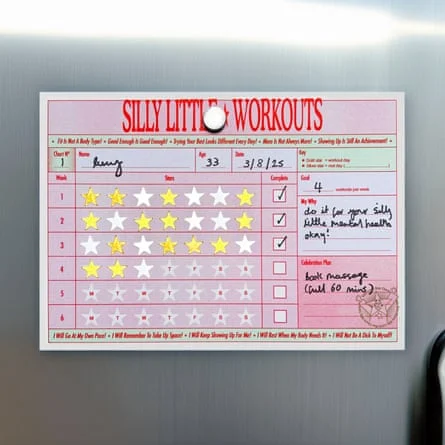
In the bustling city of Birmingham, England, a simple sticker chart adorns the kitchen cupboard of the Gray family home. This chart, however, isn’t for the typical childhood accomplishments of brushing teeth or mastering spellings. Instead, it tracks the achievements of 33-year-old healthcare professional, Bek Gray, whose two children, aged four and ten, eagerly participate in awarding their mother gold stars for her gym visits. "They know that mommy gets a gold star when she goes to the gym," Gray explains, highlighting a growing trend where adults are re-embracing a motivational tool long associated with early education. This seemingly rudimentary system has proven remarkably effective for Gray, who, after undergoing a gastric sleeve procedure in September 2024, has since shed an impressive 142 pounds while simultaneously building muscle mass over the past year and a half.
Gray’s journey illustrates a broader societal shift towards tangible, low-tech solutions for self-motivation, particularly in an era saturated with digital tracking applications. She articulates the appeal, stating, "There’s only so many times you can get told off by an app or your watch. This is a nicer way of trying to motivate and discipline yourself." For Gray, the shift in mindset was profound, transforming the dread of "Ugh, I’ve got to go to the gym" into the proactive determination of "I need to get my three stars this week!" This personal success story is mirrored by countless others seeking to cultivate better habits, from fitness and healthy eating to sobriety and productivity, finding unexpected allies in the humble sticker chart.
The Analog Appeal in a Digital World
The phenomenon of adult sticker charts is gaining significant traction, particularly as many individuals report a sense of "digital fatigue." Google search trends for "adult sticker chart" reached a five-year high in February of this year, indicating a burgeoning interest in these physical motivational aids. This resurgence comes at a time when smartwatches, fitness apps, and digital planners are ubiquitous, offering sophisticated data tracking and personalized nudges. Yet, for many, the constant ping of notifications and the endless scrolling on screens have become counterproductive, fostering a desire for more tactile and visually present reminders.
Lucy Mountain, the 34-year-old London-based entrepreneur behind "Silly Little Star Charts," a brand favored by Bek Gray, attributes much of her company’s success to this very fatigue. Founded in 2024, the business initially began as a side project for Mountain, who also runs her own fitness app. However, the demand for her physical charts, which cater to a diverse range of goals including chores, workouts, sobriety, and even maintaining distance from an ex-partner, quickly outstripped expectations. By last summer, "Silly Little Star Charts" had become her primary source of income, necessitating a move into a dedicated warehouse to manage growing inventory and distribution. Mountain observed, "It’s been so amazing to see how many people really respond well to it." Her charts often come with magnets, designed to be prominently displayed on refrigerators or other visible surfaces, offering a constant, passive reminder of one’s goals without the intrusive nature of a push notification. This physical presence creates an omnipresent commitment device, fostering accountability through visibility rather than digital alerts.
Unpacking the Psychology of Reward
The effectiveness of sticker charts for adults might seem counterintuitive, bordering on childlike, yet psychological research offers robust explanations for their success. At its core, the system taps into fundamental principles of human motivation and behavior.
The Brain’s Drive: Operant Conditioning and Dopamine
Kou Murayama, principal investigator at the Motivation Science Lab at the University of Tübingen in Germany, succinctly states, "Humans and animals work for rewards. That is their nature." This principle is rooted in operant conditioning, a learning process where behavior is strengthened or weakened by the consequences that follow. While children may value the sticker itself as a tangible prize, adults derive satisfaction from the act of "hitting a goal." Murayama elaborates, "Hitting a goal itself serves as a reward for humans, even if it does not give you tangible rewards such as food or money." The visual representation of progress, the satisfying "thwack" of a sticker being placed, triggers the brain’s reward pathways, releasing dopamine – a neurotransmitter associated with pleasure, motivation, and learning. This positive feedback loop reinforces the desired behavior, making it more likely to be repeated. The feeling of accomplishment, visually documented, becomes its own powerful reward.
Goal-Setting Theory: Specific, Proximal, Achievable
The structured nature of sticker charts aligns well with established psychological theories of motivation. According to "goal-setting theory," conceived by psychologists Edwin Locke and Gary Latham, goals that are specific, proximal (shorter-term), and challenging are particularly effective in driving motivation. Murayama notes that "Sticker charts at least meet the first two criteria – perhaps the third one too." By breaking down a larger, often overwhelming objective (like "get fit" or "eat healthier") into daily or weekly achievable steps, the charts provide concrete, immediate targets. For instance, rather than a vague aspiration, a chart might specify "exercise three times this week" or "eat five servings of fruits and vegetables daily." Each sticker represents the completion of a specific, proximal goal, offering a clear sense of progress and accomplishment that is often lacking in the pursuit of long-term aspirations.
Thomas Webb, a professor of psychology at the University of Sheffield in England who specializes in self-regulation, highlights another crucial aspect: addressing the tedium of repetitive tasks. "The problem with long-term goals such as eating fruit and vegetables [regularly] is that the goal is never complete," Webb explains. Unlike a project with a definitive end, healthy habits require continuous effort. Sticker charts provide a mechanism to "complete" the goal, at least for a day, offering a psychological closure that can sustain engagement over time. This daily ‘win’ combats the feeling of an endless, unfinishable task, providing crucial bursts of motivation.
Overcoming the "What the Hell Effect"
Despite their efficacy, sticker charts are not foolproof. The author of the original article recounted how their own chart "stopped working" after a few months. If a good morning momentum led to several stickers, motivation could be sustained. However, a missed target often led to a complete write-off of the day’s goals – a phenomenon scientifically termed the "what the hell effect." This cognitive bias describes how, after a perceived slip-up or failure, individuals tend to abandon their goals entirely, feeling that the day is already "ruined."
Lucy Mountain, understanding this common pitfall, offers a practical solution within her "Silly Little Star Charts" system: silver stars for "skip days." This ingenious addition acknowledges that perfection is an unrealistic and often demotivating expectation. "It’s trying to keep momentum going, because it’s not about perfection," Mountain emphasizes. "It’s just about trying to be consistent as much as you can." By allowing for intentional breaks or acknowledging imperfect days without completely derailing the system, the silver stars mitigate the "what the hell effect," encouraging users to return to their routine rather than giving up entirely. This small adjustment transforms perceived failure into a manageable part of a longer, more forgiving journey towards habit formation.
The Double-Edged Sword: Autonomy and Intrinsic Motivation
While sticker charts offer clear benefits, experts caution against relying solely on extrinsic rewards indefinitely. The long-term sustainability of motivation often hinges on a shift from external incentives to internal drive.

The Pitfalls of External Control
Kou Murayama offers a theory regarding the eventual decline in motivation observed by some users. "Humans have a fundamental need to take control of ourselves or be autonomous," he explains. Initially, a sticker chart might satisfy this need by providing a clear framework for self-directed improvement. However, over time, a subtle shift can occur. If the individual begins to perceive the chart as an external controller rather than a self-chosen tool, it can backfire. "Humans really don’t like to be controlled. Once you come to interpret the charts that way, either implicitly or explicitly, it will backfire," Murayama warns. This aligns with Self-Determination Theory (SDT), which posits that humans thrive when their psychological needs for autonomy, competence, and relatedness are met. When a reward system, even self-imposed, starts to feel like a mandate rather than a choice, it can erode intrinsic motivation.
Nikos Ntoumanis, a professor of motivation science at the University of Southern Denmark, concurs with this nuanced perspective, stating, "Rewards can be a double-edged sword." He advocates for a gradual phasing out of external rewards like stickers. Ideally, these tools should serve as scaffolding, helping to establish a habit until the activity itself becomes intrinsically rewarding. "Otherwise, they end up being the main reason for doing an activity," Ntoumanis explains, "and then, once the rewards are withdrawn, usually the activity returns to a baseline level." The goal, therefore, is to leverage the extrinsic motivation provided by the stickers to bridge the gap until the individual finds inherent enjoyment or value in the behavior itself.
Fostering Lasting Habits
The challenge lies in transitioning from "I do this for a sticker" to "I do this because I enjoy it" or "I do this because it aligns with my values." Murayama emphasizes the importance of finding a more intrinsic source of enjoyment to sustain motivation over the long term. "If you decide to do exercise to reduce your weight, you may find that running itself is a joy," he suggests. This shift requires self-reflection and an active search for the internal rewards of a habit – whether it’s the physical sensation of strength, the mental clarity after meditation, or the satisfaction of preparing a healthy meal. Sticker charts can be a powerful initial push, but they are most effective when coupled with efforts to connect with the deeper, personal benefits of the desired behavior.
The Rise of a Niche Industry
The growing popularity of adult sticker charts is not merely a quirky trend but reflects a broader market for wellness, productivity, and self-improvement tools. Lucy Mountain’s "Silly Little Star Charts" serves as a compelling case study in this burgeoning niche.
"Silly Little Star Charts": A Case Study in Growth
Mountain’s business, which launched in 2024, capitalized on a clear market need. Her initial success, transitioning from a side hustle to a primary income source within a year, underscores the demand for accessible and engaging motivational aids. The product range, from "Silly Little Workout Charts" to "Silly Little Sobriety Charts," demonstrates a keen understanding of diverse adult challenges. The company’s expansion into a warehouse signifies a significant operational scale-up, moving beyond artisanal production to meet widespread consumer interest. This growth is indicative of how effective simple, well-marketed solutions can be in the personal development space, especially when they tap into relatable human psychology.
The Broader Market for Wellness and Productivity Tools
The wellness industry, globally valued at trillions of dollars, encompasses everything from fitness and nutrition to mental well-being and personal development. Within this vast market, productivity tools, habit trackers, and self-help resources form a significant segment. While digital apps have dominated for years, there’s a discernible counter-trend towards analog products – journals, planners, and now, sticker charts. This shift suggests a desire for intentionality, a break from screen time, and the tangible satisfaction of physical progress. Consumers are increasingly willing to invest in tools that help them manage their time, improve their health, and achieve personal goals, indicating a robust and evolving market for innovative motivational solutions. The success of "Silly Little Star Charts" isn’t an isolated incident but rather a symptom of this larger trend towards integrated, user-friendly approaches to self-improvement.
Criticisms and Counterarguments: Embracing the "Silly"
Despite the evident success and psychological grounding, adult sticker charts are not without their critics. Some social media commenters have labeled them "infantilizing," suggesting that adults should be beyond such simple reward systems. However, users like Bek Gray staunchly defend their utility. "We all get caught up in wanting to be grownups, and having to be serious," Gray asserts. "There is no harm if people want to go back to their childhood ways to little extents like this."
This perspective highlights a cultural tension between perceived maturity and practical effectiveness. The criticism often stems from an implicit assumption that adult motivation should always be purely internal or driven by complex rationale. Yet, as psychological research demonstrates, the human brain, regardless of age, responds to positive reinforcement and clear goal attainment. The perceived "silliness" of a gold star might, in fact, be part of its charm – a lighthearted approach to serious self-improvement that disarms internal resistance and fosters a sense of playful engagement. As one reviewer on Etsy for "Silly Little Star Charts" succinctly put it, "Something about getting to stick a silly gold star on to the sticker sheet keeps me accountable," while another testified, "This chart is the only reason I got up to go to the gym today." Lucy Mountain herself acknowledges the critique but stands by the efficacy: "It’s not just about tapping into your inner child. I do just think it’s a system that works." The growing market and positive user feedback suggest that for many, the practical benefits far outweigh any concerns about appearing "childish."
Beyond the Sticker: A Holistic View of Motivation
While adult sticker charts offer a surprisingly effective and accessible method for kickstarting new habits and maintaining momentum, they are not a universal cure-all for motivational challenges. Kou Murayama rightly cautions that "One needs to find a more intrinsic source of enjoyment" to sustain motivation indefinitely. The initial push provided by external rewards is valuable, but long-term success often hinges on cultivating an internal appreciation for the activity itself.
The journey from extrinsic to intrinsic motivation is a continuous process. Sticker charts can serve as excellent entry points, helping individuals overcome initial inertia and establish routines. They provide the structure and immediate gratification needed to solidify nascent habits. However, true, lasting change often requires a deeper connection to why these habits are important – the health benefits, the sense of personal growth, the joy of mastery, or the alignment with one’s core values.
Ultimately, motivation is a complex, multifaceted phenomenon, and no single strategy works for everyone or for every goal. As Murayama wisely concludes, "It is important to understand that there is no panacea for motivation. If so, I wouldn’t need to do research any more." Adult sticker charts represent a charmingly simple, yet scientifically sound, addition to the diverse toolkit of self-improvement strategies. By tapping into fundamental psychological principles and offering a refreshing alternative to digital overload, they empower individuals like Bek Gray to embark on transformative journeys, one gold star at a time, reminding us that sometimes, the most effective solutions are those that embrace simplicity and the enduring power of a small, shiny reward.