
 Reynand Wu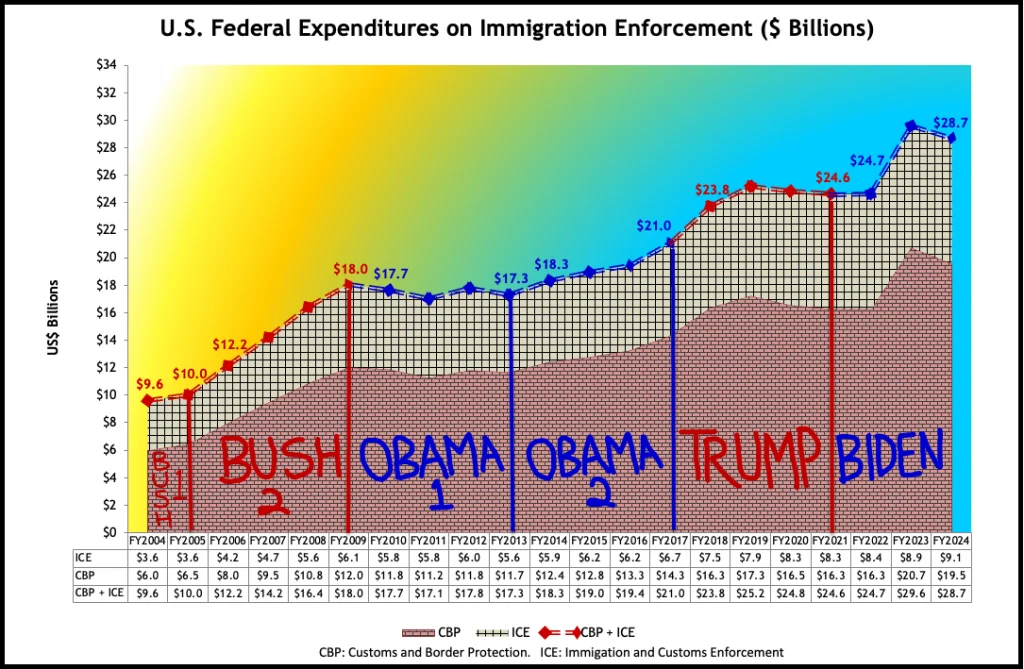
State borders are far more than lines on a map or geographical demarcations; they are the physical manifestations of political conflict, nationalist discourse, and, fundamentally, massive public financial investment. While political rhetoric often frames these boundaries as natural or inevitable features of national sovereignty, a closer examination of federal spending reveals that borders are actively constructed and maintained through sustained fiscal policy. By analyzing over two decades of budgetary data, it becomes clear that the securitization of the United States-Mexico border is not merely a consequence of external threats but a bipartisan project supported by consistent, multi-billion-dollar investments that transcend shifting political administrations.
The Institutional Framework of Border Enforcement
The modern infrastructure of the United States border enforcement apparatus was solidified in the wake of the September 11, 2001, terrorist attacks. The subsequent passage of the Homeland Security Act of 2002 led to the creation of the Department of Homeland Security (DHS), an umbrella organization designed to centralize the nation’s protective functions. Under this mandate, two primary agencies emerged as the gatekeepers of the southern border: Customs and Border Protection (CBP) and Immigration and Customs Enforcement (ICE).
CBP, which identifies itself as one of the world’s largest law enforcement entities, holds the mandate to detect and prevent unauthorized entry, while ICE is tasked with investigating cross-border crime and managing the internal detention and deportation of non-citizens. These agencies operate under a mission statement that equates border control directly with national security and public safety. Since their inception, their combined budgets have grown exponentially, reflecting an increasing institutional reliance on surveillance technology, physical barriers, and tactical personnel to manage the flow of individuals across the frontier.
A Chronology of Fiscal Expansion (2002–2024)
The trajectory of border spending since the early 2000s provides a roadmap for the militarization of the border. In the immediate post-9/11 era, border security was prioritized as a core pillar of domestic defense. During the George W. Bush administration, federal expenditures began to climb as the government shifted toward a policy of "smart borders," utilizing increased surveillance and patrol capabilities.
The Obama administration, while often associated with a more nuanced approach to immigration reform, oversaw a period of significant expansion in detention capacity and enforcement technology. This trend continued through the Trump administration, which emphasized the construction of physical wall segments as a central campaign promise, further driving budget requests for materials and labor. Under the Biden administration, despite shifts in rhetoric, the budgetary commitment to CBP and ICE has remained at record highs, indicating that the institutional apparatus of border enforcement has achieved a level of momentum that persists regardless of which party holds the executive office.
Quantitative Analysis of Bipartisan Spending
A comprehensive analysis of federal budget reports from fiscal years 2006 to 2024 reveals a startling trend: both Democratic and Republican administrations have consistently authorized record-level funding for immigration enforcement. In total, the United States has spent over $400 billion on CBP and ICE operations over the last two decades.
When broken down by party, the data shows that Republican administrations spent approximately $178.9 billion during their terms, while Democratic administrations authorized a total of $230.5 billion. On an annual basis, this averages to roughly $17.9 billion for Republicans and $21.0 billion for Democrats. These figures, which represent raw federal outlays, demonstrate that the "performative" nature of partisan disagreement—where immigration is frequently used as a wedge issue in electoral campaigns—does not translate to a divergence in fiscal priority.
The growth in expenditure is stark. In fiscal year 2004, the combined budget for these agencies stood at $9.6 billion. By fiscal year 2024, that figure had ballooned to $28.7 billion. Even when adjusting for inflation to constant 2024 dollars, the investment has increased from approximately $17.5 billion to $28.7 billion, representing a significant expansion of the state’s capacity to patrol, detain, and deport.
The Role of Regulatory Waivers and Executive Action
The disconnect between political messaging and actual policy implementation is often bridged by executive actions. A notable example occurred in October 2023, when the Biden administration opted to waive 26 federal environmental and cultural regulations to expedite the construction of border wall segments in Texas. This decision, which drew criticism from environmental groups and immigration advocates alike, highlighted the prioritization of security infrastructure over legislative or environmental oversight.
By bypassing existing legal requirements, the administration demonstrated that the executive branch maintains the power to circumvent standard bureaucratic hurdles to fulfill enforcement objectives. This maneuver serves as a prime example of how the "securitization" narrative can justify the suspension of domestic law, further cementing the status of the border as a space governed by unique, often opaque, security protocols.
Economic and Social Implications
The construction and maintenance of a heavily policed border have profound consequences for regional economies and social structures. Borders are not merely defensive lines; they are mechanisms that construct and reinforce economic disparities. By maintaining distinct national currencies, disparate value regimes, and unequal trade relations, the border functions as a filter that regulates the movement of capital and labor to benefit specific domestic interests.
The massive financial investment in enforcement creates a self-sustaining cycle. As the budget for CBP and ICE increases, so does the demand for the technology, surveillance, and detention services provided by private contractors. This "border-industrial complex" creates powerful stakeholders who have a vested interest in the continuation of strict enforcement policies. Consequently, the border becomes a permanent site of economic activity, where the act of policing becomes an end in itself rather than a temporary response to a crisis.
Official Perspectives and Agency Missions
In response to inquiries regarding the necessity of these budgets, DHS officials frequently point to the evolving nature of transnational threats. CBP reports emphasize that their mission is to maintain a "border that works," a concept that includes facilitating legitimate trade and travel while intercepting narcotics and undocumented migrants. ICE officials underscore the necessity of their operations in upholding the rule of law, arguing that a secure border is a prerequisite for a functional immigration system.
However, critics and policy analysts suggest that these missions are inherently contradictory. If the goal of the border system is to facilitate trade, the increasing militarization of that same space creates friction and delays. Furthermore, the reliance on enforcement-first strategies has historically failed to address the root causes of migration, such as economic instability, climate change, and violence in countries of origin.
Broader Impact: The Normalization of Enforcement
The persistence of high-level spending on border enforcement suggests that the United States has reached a "consensus of securitization." Regardless of the political rhetoric surrounding the "humaneness" or "strictness" of immigration policies, the structural reality remains one of increased surveillance and physical barriers.
This normalization has significant implications for the future of democratic governance. When large swathes of the federal budget are allocated to enforcement agencies that operate with limited public transparency, the ability of citizens to hold their government accountable diminishes. The border is transformed from a point of entry into a hardened front, reflecting a national priority that favors exclusion over integration.
As the 2024 fiscal cycle continues, the data remains clear: the border is a central pillar of federal expenditure, a testament to the fact that borders are not natural, but are built, maintained, and paid for by the state. The future of U.S. immigration policy will likely depend on whether this trend of fiscal expansion continues or whether policymakers will eventually seek to decouple the concept of national security from the physical wall. For now, the budget itself serves as the most accurate indicator of the nation’s ongoing commitment to a strategy of persistent, high-cost border enforcement.







