Johny Marice
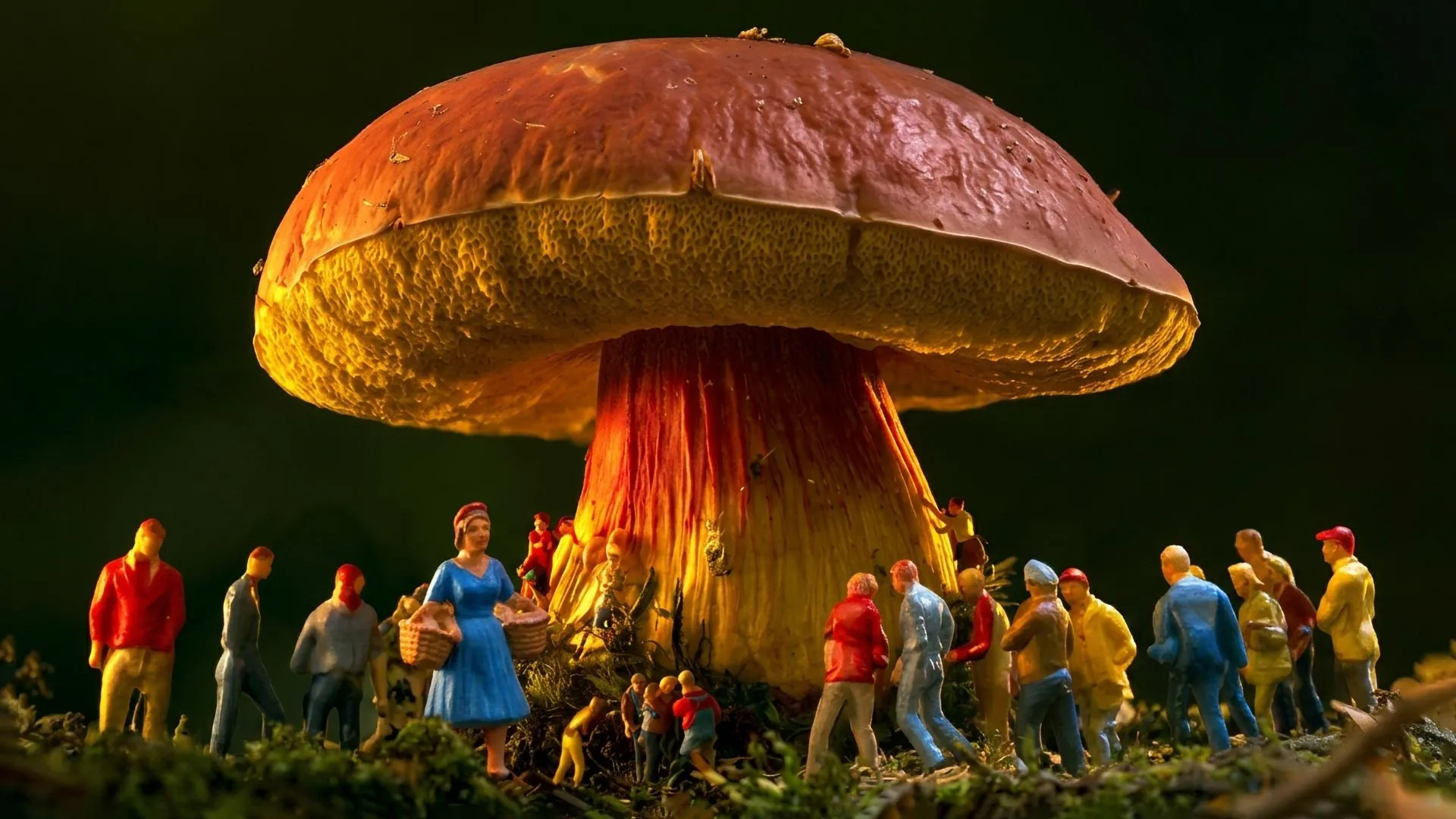
For nearly a century, reports have surfaced from disparate corners of the globe describing a strikingly consistent and bizarre phenomenon: after consuming certain wild mushrooms, individuals experience vivid, interactive visions of miniature human figures. These entities, often described as standing between three and thirty centimeters tall, are frequently observed walking across surfaces, climbing household objects, and behaving with a lifelike, three-dimensional realism that defies the typical, abstract nature of most drug-induced hallucinations. Long dismissed by many in the scientific community as a byproduct of cultural folklore or mass hysteria, a recent breakthrough by researchers at the University of Utah has provided a compelling biological explanation, linking these visions to a specific, previously misunderstood species of fungus.
The study, published in the journal Mycologia, utilizes advanced DNA sequencing to identify Lanmaoa asiatica as the primary suspect in these accounts. By tracing the biological footprint of the mushroom across Southwest China and the northern Philippines, researchers have moved the conversation from the realm of mythology to the domain of neurobiology. The findings not only offer a potential key to understanding how the brain constructs our perception of reality but also underscore the vast, untapped pharmacological potential hidden within the fungal kingdom.
A Chronology of "Mushroom Madness"
The historical record of these hallucinations dates back to 1934, when Western researchers first documented accounts from Papua New Guinea. Local populations reported a phenomenon colloquially dubbed "mushroom madness," which followed the ingestion of specific bolete mushrooms. During the subsequent decades of the 1950s and 1960s, a wave of anthropological interest brought field researchers to the region. Despite their efforts, they were met with a persistent scientific roadblock: chemical analyses of the specimens failed to isolate any known psychoactive compounds, such as psilocybin or muscimol.
The frustration was so significant that even Albert Hofmann—the legendary chemist who famously isolated psilocybin and synthesized LSD—examined samples from the region, ultimately finding no identifiable hallucinogenic agent. In the absence of a chemical culprit, the scientific consensus shifted toward a sociological interpretation. By the late 1960s, the prevailing view among academics was that the "tiny humans" were manifestations of cultural expectations, archetypal imagery, or indigenous belief systems rather than an objective pharmacological response.
The mystery remained largely dormant until the 1990s, when reports of similar hallucinations began to emerge from Yunnan, China, linked to a local mushroom known as "Jian shou qing." While researchers suspected a link to the genus Lanmaoa, the connection remained speculative. It was not until 2024, when Colin Domnauer, a doctoral student at the University of Utah, began investigating reports from the Northern Cordillera region of the Philippines, that the pieces began to align. Local residents there described an edible mushroom called "Sedesdem" that induced the same Lilliputian visions, providing a critical third point of data that demanded a rigorous, modern re-evaluation.
Bridging the Biological Gap
To solve the puzzle, Domnauer and his supervisor, mycologist Bryn Dentinger, initiated a multi-regional study that combined ethnographic fieldwork with high-precision genomic analysis. By collecting specimens from both China and the Philippines, the team performed the first comprehensive DNA sequencing of the Lanmaoa genus. The results were definitive: the mushrooms known as "Jian shou qing" and "Sedesdem" were, in fact, the same species, Lanmaoa asiatica.
The implications of this finding are profound. For decades, it was assumed that these mushrooms were regionally isolated varieties. By confirming that the same species exists across such vast distances, researchers established a biological consistency that mirrors the consistency of the hallucinations themselves. While a planned expedition to Papua New Guinea was hampered by severe, drought-driven environmental conditions—preventing the collection of fresh samples for DNA comparison—the existing evidence is sufficient to strongly suggest that the same fungus is responsible for the phenomenon globally.
The Phenomenological Profile of the Visions
The nature of these hallucinations is distinct from the typical "trip" associated with common psychedelics. According to the data collected by Domnauer, approximately 90% of those affected describe a uniform visual experience. The figures—often described as elves, clowns, or fairy-like beings in vibrant, colorful attire—do not simply fade in and out of the user’s field of vision. Instead, they interact with the physical environment in a way that suggests the brain’s depth perception and object-recognition systems are being hijacked.
One account, noted during the study, describes a user witnessing tiny individuals leaping from a spoon into a bowl of soup, where they proceeded to swim. Even as the user consumed the food, the miniature figures remained visible, maintaining their scale and relative movement. This suggests that the unknown chemical compound in L. asiatica does not merely induce visual static or dreamlike states; rather, it appears to influence the brain’s "spatial mapping" and visual integration centers, forcing the mind to project coherent, moving objects into the immediate physical space.
The Search for an Unknown Compound
The most significant challenge remaining for the University of Utah team is the identification of the specific chemical agent responsible for these effects. Through both chromatography and comparative genetic analysis, researchers have definitively ruled out all known psychoactive compounds. This confirms that L. asiatica does not function like psilocybin, which acts on serotonin receptors, nor like other known entheogens.
The presence of a "mystery compound" suggests that the chemical may represent a new class of psychoactive substances entirely. Because these mushrooms are traditionally eaten as a food source in Asia—provided they are cooked thoroughly—the toxin is likely heat-labile or present in a form that only becomes active under specific metabolic conditions. Identifying this molecule is now a primary goal for the research team, as it could lead to the development of new pharmaceutical tools for probing the visual cortex.
Broader Implications for Neuroscience and Biodiversity
The study of L. asiatica extends far beyond the realm of mycology. Lilliputian hallucinations are a known symptom in various medical contexts, including alcohol withdrawal, delirium tremens, dementia, and macular degeneration (often referred to as Charles Bonnet syndrome). Currently, medical science lacks a clear understanding of why these specific, small-scale figures appear during these conditions. If scientists can isolate the chemical agent in L. asiatica, they may be able to use it in controlled, clinical environments to stimulate these specific visual pathways, potentially revealing the underlying neurological mechanisms of perception and hallucination.
Furthermore, the research underscores the immense value of museum and herbarium collections. By analyzing specimens that had been preserved for decades—some of which were correctly identified as new species only through the retrospective application of DNA sequencing—the team discovered four entirely new species within the Lanmaoa genus. This discovery serves as a stark reminder of the "dark matter" of the biological world: the vast number of organisms that have been documented but remain functionally misunderstood.
As the scientific community turns its attention toward the untapped chemical potential of fungi, L. asiatica stands as a reminder of the complex relationship between human culture and the natural world. What was once dismissed as the stuff of folklore has now become a bridge toward a deeper understanding of the human brain. The ongoing effort to map the evolutionary history of the Lanmaoa genus and isolate its mysterious active compound may well lead to the next generation of neurological breakthroughs, proving that even a small, centuries-old mystery can hold the key to profound biological discovery. The team is currently seeking additional funding to continue their efforts in the field and the lab, with the ultimate goal of synthesizing the compound for clinical study.