Layla Zulfa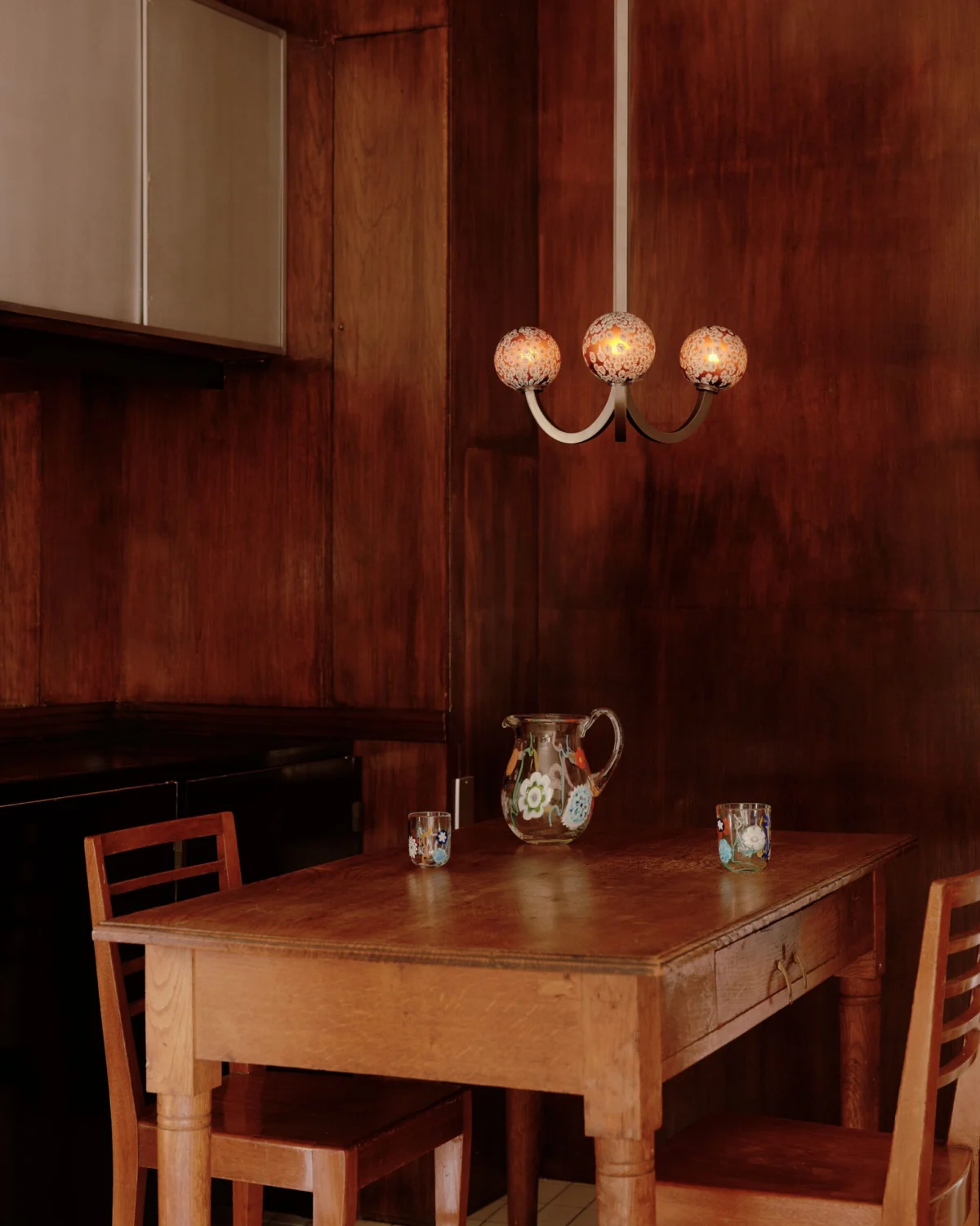
During a high-energy installment of New York Design Week, an event characterized by a dense schedule of product launches and expansive group exhibitions, the Venetian glass atelier Laguna~B emerged as a focal point of critical and commercial interest. The brand’s presence was defined by two significant collaborations released within a fortnight, partnering with prominent New York-based design entities Dusen Dusen and the lighting studio In Common With. While both collaborators are recognized for their distinct use of color and playful aesthetics, these partnerships pushed their respective design languages into new creative territories, utilizing the ancient traditions of Murano glassmaking to achieve unprecedented results in lighting and homeware.
The collaboration with In Common With represented a departure from the studio’s traditional color-blocked lighting, moving instead toward kaleidoscopic floral bulbs and intricate glass structures. Simultaneously, the partnership with Dusen Dusen resulted in a series of anthropomorphic pitchers and patterned drinking glasses that translated the studio’s signature bold graphics into a three-dimensional, translucent medium. These projects underscore a broader trend in the global design market: a growing appetite for authentic, handmade objects that defy the uniformity of mass production.
The Heritage and Evolution of Laguna~B
Laguna~B has been a fixture of the Venetian glassmaking community since its inception in 1994. Founded on the island of Murano, the atelier has maintained a steadfast commitment to the traditional goti de fornasa style. Historically, these were "kiln glasses" made by glassblowers for their own use, often fashioned from leftover materials at the end of a workday. This origin story informs the brand’s signature aesthetic—vibrant, swirling patterns and a tactile, one-of-one quality that ensures no two pieces are identical.

The brand’s creative direction has long been influenced by the abstract movements of the 20th century, drawing inspiration from artists such as Joan Miró and Alexander Calder. This artistic lineage has allowed Laguna~B to bridge the gap between traditional craftsmanship and contemporary fine art. Over the last three decades, the atelier has navigated the complexities of the Murano glass industry—a sector that has faced significant economic challenges due to rising energy costs and the proliferation of counterfeit products—by leaning into high-profile collaborations and maintaining a rigorous standard of manual production.
Strategic Collaborations at New York Design Week
The 2023 New York Design Week, also known as NYCxDESIGN, served as the backdrop for Laguna~B’s latest expansion. The event attracts thousands of designers, architects, and collectors to New York City, providing a global stage for brands to showcase innovation. For Laguna~B, the decision to partner with New York-based studios was a strategic move to solidify its relevance within the American luxury market.
The Dusen Dusen Partnership
Ellen Van Dusen, the founder of Dusen Dusen, is widely celebrated for her application of bold, mathematical patterns and vibrant color palettes across textiles and home goods. In her collaboration with Laguna~B, these patterns were reimagined through the layered Murano glass technique. The resulting collection featured a trio of anthropomorphic pitchers—designed to resemble a zebra, a parrot, and a fish—alongside matching glassware.
Translating Van Dusen’s two-dimensional prints into glass required technical solutions previously unused by the Laguna~B hot shop. Van Dusen noted that the process was "freeing," as she provided technical drawings without knowing exactly how the artisans would achieve the layered depth of the designs. The final products successfully bridged the gap between Van Dusen’s pop-art sensibilities and the organic, fluid nature of molten glass.

The In Common With "Lido Series"
In Common With, led by co-founders Nick Ozemba and Felicia Hung, utilized the collaboration to venture into Murano glassware for the first time. The "Lido Series" included sconces, flush mounts, and a modular chandelier, all of which were debuted at "Quarters," the studio’s multidisciplinary event space in Tribeca.
A key component of this collaboration was the physical presence of the designers in the Venetian studio. Nick Ozemba spent time in the hot shop, adjusting proportions and responding to the material in real time. This hands-on approach was essential for mastering the murrine style—a complex technique where glass canes are layered, stretched, and sliced crosswise to create intricate patterns. The series highlighted the "choreography" of glassblowing, a process where the maker must constantly negotiate with the heat and gravity affecting the material.
A Timeline of Cultural Influence
The recent success at New York Design Week is part of a multi-year trajectory that has seen Laguna~B move from a niche artisanal brand to a globally recognized name in luxury design. The brand’s cultural footprint has expanded through several key milestones:
- 1994: Laguna~B is founded on the island of Murano, focusing on the goti de fornasa tradition.
- Early 2000s: The brand establishes luxury associations through partnerships with fashion houses such as Yves Saint Laurent and JW Anderson.
- 2021-2022: Collaborations with high-end perfumer Frédéric Malle and continued work with JW Anderson elevate the brand’s profile in the lifestyle and fragrance sectors.
- Summer 2023: Laguna~B receives significant mainstream attention when a pair of its "Goto" glasses appears in Greta Gerwig’s Barbie movie, a film noted for its meticulous production design.
- July 2023: The brand is selected to produce custom wedding favors for Jeff Bezos’ ceremony in Venice, further cementing its status as a provider of "ultra-luxury" artisanal goods.
- May 2024: The dual launch with Dusen Dusen and In Common With at New York Design Week marks a new chapter in the brand’s engagement with the contemporary American design scene.
Technical Mastery: The Murano Tradition
The allure of Laguna~B lies in the inherent unpredictability of its medium. Caterina Capelli, the brand’s head of communications, emphasizes that Murano glass often yields unexpected results. This variability is not viewed as a defect but as a hallmark of authenticity. In an era dominated by 3D printing and automated manufacturing, the "handmade error" has become a luxury commodity.

The techniques employed—goti de fornasa and murrine—require years of apprenticeship to master. The murrine technique, in particular, is one of the most labor-intensive forms of glassmaking. It involves creating a "cane" of glass with a specific internal pattern, which is then heated and pulled to a great length while maintaining the integrity of the design. Once cooled, the cane is sliced into small discs, which are then fused together to create a mosaic-like surface. The complexity of this process ensures that each piece of the In Common With "Lido Series" is a unique artifact of its own making.
Market Analysis and Broader Implications
The success of Laguna~B reflects a shift in consumer behavior within the high-end home decor market. Felicia Hung of In Common With observes that many modern consumers are fatigued by objects that "perform heritage without carrying it." This refers to products that are marketed as artisanal or "hand-crafted" but are actually produced on high-volume assembly lines with minimal human intervention.
In contrast, Laguna~B represents "process as product." The value of the object is derived not just from its aesthetic appeal, but from the lineage of the technique and the geographical specificity of its origin. This transparency in production serves as an antidote to the "fast furniture" and mass-produced accessories that have dominated the market for the past decade.
Supporting data from the luxury sector suggests that the market for "collectible design"—items that sit at the intersection of furniture and fine art—has grown significantly. According to industry reports, the demand for unique, non-standardized interior pieces has risen as homeowners seek to personalize their living spaces with items that tell a story. Laguna~B’s ability to sell these high-concept, handmade pieces online at price points ranging from $235 for a single glass to $8,000 for a chandelier demonstrates the viability of this model.

The Future of Artisanal Glass
As Laguna~B continues to expand its reach, the challenge remains to balance its growing global demand with the physical limitations of artisanal production. The "unpredictability" mentioned by Capelli is a double-edged sword; while it provides charm and value, it also makes scaling the business difficult compared to industrial manufacturers.
However, the brand’s recent collaborations suggest a path forward: by partnering with contemporary designers, Laguna~B can continue to innovate its aesthetic while remaining anchored in traditional techniques. These partnerships introduce the brand to new audiences—from the color-loving followers of Dusen Dusen to the architectural lighting community—ensuring that the ancient art of Murano glass remains a dynamic and evolving part of the modern design landscape.
The enduring appeal of Laguna~B serves as a testament to the resilience of traditional craftsmanship. By prioritizing the "material and the maker," the atelier has not only survived the pressures of a globalized economy but has thrived, becoming a symbol of authenticity in a world increasingly dominated by the digital and the mass-produced. Each swirl of color and each unique imperfection in a Laguna~B piece is a reminder of the human element in design—a quality that, as New York Design Week proved, remains more relevant than ever.