Layla Zulfa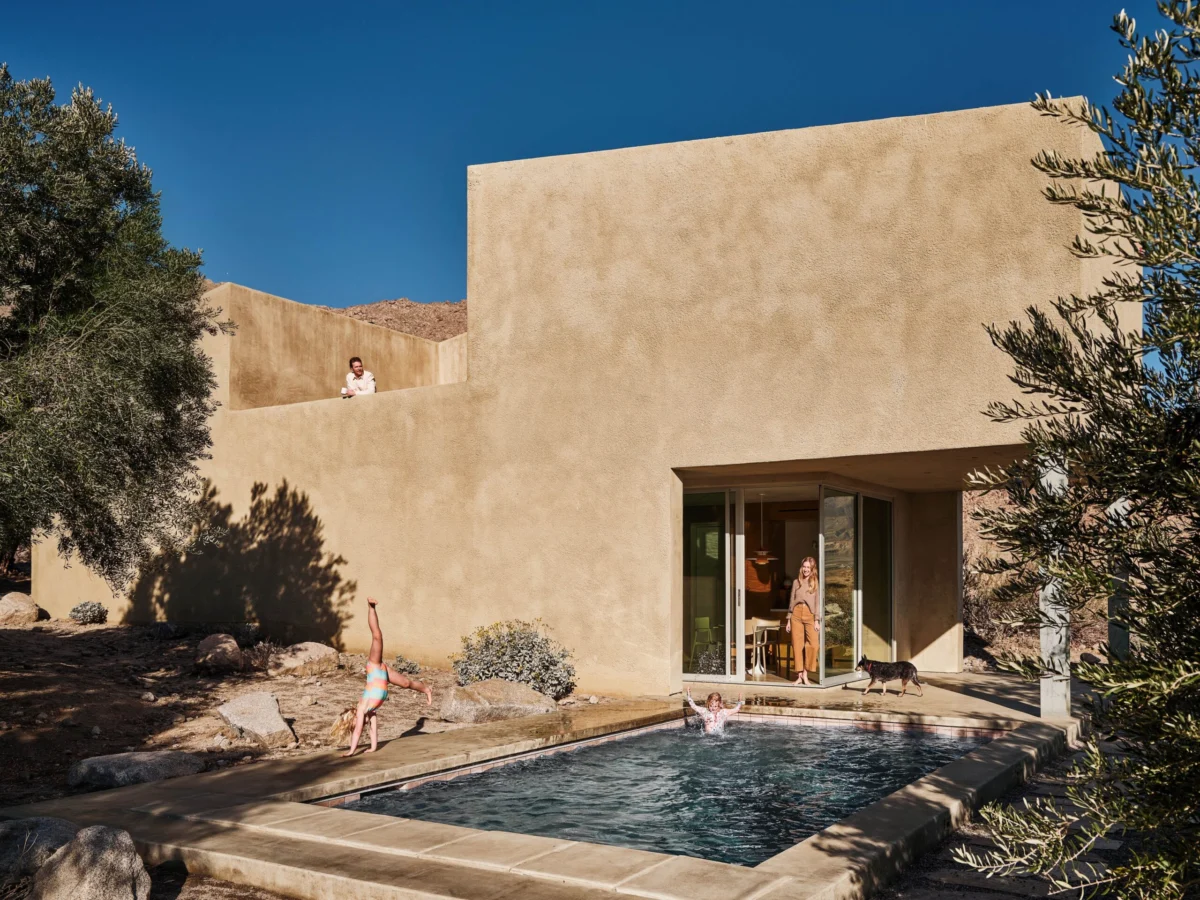
In the rugged transition zone where the urban sprawl of Palm Springs meets the untamed slopes of the San Jacinto Mountains, a new architectural landmark has emerged that redefines the relationship between domesticity and the desert environment. Completed in 2024, the residence of psychotherapist Sonny Granade and artist Rives Granade stands as a testament to the "sculptural-architectural" hybridity required to survive and thrive in the Coachella Valley. Designed by Aaron Schiller of the New York-based firm Schiller Projects, the home is a sophisticated response to the paradoxical demands of the California desert: a landscape that offers breathtaking panoramic beauty while simultaneously threatening inhabitants with relentless solar radiation and scouring winds.

The property is situated at a unique geographical crossroads. To one side lies a mature grove of 44 olive trees, believed to have been planted by Italian immigrants over a century ago. To the other, the site borders federally protected terrain, a designation that ensures the family’s vistas will remain populated by quail, coyotes, and native flora rather than future residential developments. This permanence of view served as a foundational pillar for the design, allowing the architects to treat the landscape not as a backdrop, but as an active participant in the home’s spatial narrative.
Architectural Pedigree and Childhood Influences
The genesis of the project is deeply rooted in the personal history of Sonny Granade. As the daughter of the iconic American artist Ed Ruscha, Sonny’s aesthetic sensibilities were forged in environments where the line between art and architecture was perpetually blurred. Her childhood was spent in an Arata Isozaki-designed residence in Venice, California—a structure known for its geometric precision and Japanese minimalist influence. Furthermore, her upbringing involved frequent travel to the high desert, where her parents maintained separate cabins.

This lifelong intimacy with the arid topography of Southern California informed the Granades’ brief to Schiller Projects. Sonny sought a sanctuary that captured the "architectural spirit" of her youth—one that emphasized clean lines and a profound connection to the earth—while providing a modern retreat for her own husband and daughters. The challenge for Aaron Schiller was to translate these high-design expectations into a functional, off-grid family home that could withstand the specific microclimate of the San Jacinto base.
Design Philosophy: Carving from the Land
Aaron Schiller’s approach to the site was characterized by a refusal to dominate the landscape. The initial design constraint was the preservation of the historic olive grove. Rather than clearing the land to create a traditional building pad, the team pushed the structure into the corner of the property. This placement allowed the "nose" of the house to be partially submerged within the canopy of the olive trees, providing natural shade and a sense of psychological enclosure.

The resulting form of the house is more akin to a geological formation than a traditional dwelling. Schiller describes the structure as having been "carved by the wind," a metaphor reflected in the building’s aerodynamic contours and the choice of materials. The exterior walls are finished in a custom-tinted, plant-based plaster. The pigments were meticulously selected to mirror the hues of the local soil and the historical palette of Frank Lloyd Wright’s Taliesin West, ensuring that the building appears to rise organically from the desert floor.
In a strategic move to manage the extreme heat, the southern façade of the building is entirely solid. By omitting windows and openings on this face, the architects created a thermal shield that protects the interior from the most intense solar gain. This functional necessity contributes to the home’s monolithic, sculptural presence, emphasizing the "compression and release" experienced by those moving through the interior spaces.

Interior Orchestration and the Mythology of Place
The interior of the Granade residence is a study in spatial sequencing. Visitors move from the expansive openness of the desert into a series of intimate, grounded rooms that eventually culminate in a dramatic, double-height living area. At the heart of this space is a sunken conversation pit, a mid-century architectural staple reimagined for the 21st century. The pit is upholstered in a vibrant paprika-hued fabric, a deliberate nod to the iconic carpets of the Yale School of Architecture, where the influence of Brutalism and structural expressionism remains a touchstone for many modern designers.
Schiller’s design minimizes traditional furniture in favor of built-in elements that emerge from the walls like rock outcroppings. This integration ensures that the architectural experience is continuous and uninterrupted. "I don’t think there’s a moment in this house where you’re not having an architectural or spatial experience," Schiller noted, highlighting the intentionality behind every curve and void.

The kitchen serves as a laboratory for light. Circular skylights positioned directly above the island allow the sun to track across the workspace throughout the day, creating a dynamic interplay of shadows. Adding to the personal "mythology" of the home is a mural by Rives Granade. The artwork is an abstracted map of the surrounding wind patterns and terrain, interspersed with drawings by the couple’s daughters. These sketches of cacti, swing sets, and firepits serve as a localized iconography, grounding the family’s daily life in the specific history of their land.
Sustainable Engineering and Off-Grid Autonomy
Beyond its aesthetic contributions, the Granade house is a model of 21st-century self-sufficiency. In an era where the Coachella Valley faces increasing pressure on its electrical grid and water resources, this residence operates entirely off-grid.

Energy and Water Systems
The home’s energy needs are met through a sophisticated array of solar panels. To maintain the building’s sculptural silhouette, these panels are concealed behind raised parapets, invisible from the ground level. This allows the home to harness the very element it seeks refuge from—the sun—to power its climate control and appliances.
The water system is equally innovative, drawing from snowmelt and local sources, reflecting a commitment to living within the biological carry-capacity of the desert. The use of high-thermal-mass materials, such as the thick plastered walls, further reduces the energy required for cooling, as the building naturally regulates its internal temperature through the diurnal cycle.

Material Innovation
The use of plant-based materials for the primary structure represents a shift toward more sustainable luxury construction. By moving away from carbon-intensive concrete and toward bio-based composites, Schiller Projects has demonstrated that high-end residential design can align with environmental stewardship. The durability of these materials is essential in a region where sandstorms and extreme UV exposure can quickly degrade traditional finishes.
Broader Implications for Desert Modernism
The completion of the Granade residence marks an evolution in the "Palm Springs Modern" aesthetic. While the mid-century pioneers like Albert Frey and Hugh Kaptur focused on glass, steel, and the blurring of indoor-outdoor boundaries, the Granade house suggests a more protective, earthen approach. This "New Desert Modernism" acknowledges the reality of a warming climate, prioritizing thermal mass and solar orientation without sacrificing the poetic connection to the landscape.

The project also highlights a growing trend among the creative elite to seek "sanctuary" architecture—homes that serve as fortified retreats from a hyper-connected world. For Sonny Granade, the home is a "little sister" to the Isozaki house of her youth, a structure that provides psychological comfort through its "uncluttered simplicity."
Conclusion: Rooted in the Arid Terrain
As the sun sets over the San Jacinto Mountains, the Granade house undergoes a visual transformation. The tinted plaster catches the long-wavelength light of dusk, glowing in shades of ochre and sienna that match the surrounding peaks. On the roof deck, the family can walk across the reinforced glass of the kitchen skylights, watching the stars emerge over the federally protected wilderness.

This project stands as a successful negotiation of the desert’s paradoxes. It provides refuge without isolation and high design without environmental exploitation. For the Granade family, the house is more than a seasonal retreat; it is a vessel for a new set of traditions, from the annual harvesting and curing of olives from their historic grove to the quiet observation of the desert’s "mythological" wildlife. In a landscape defined by its unforgiving nature, Aaron Schiller has created a space that does not merely shelter a family from the land, but roots them deeply within it.