Ronny Sianturi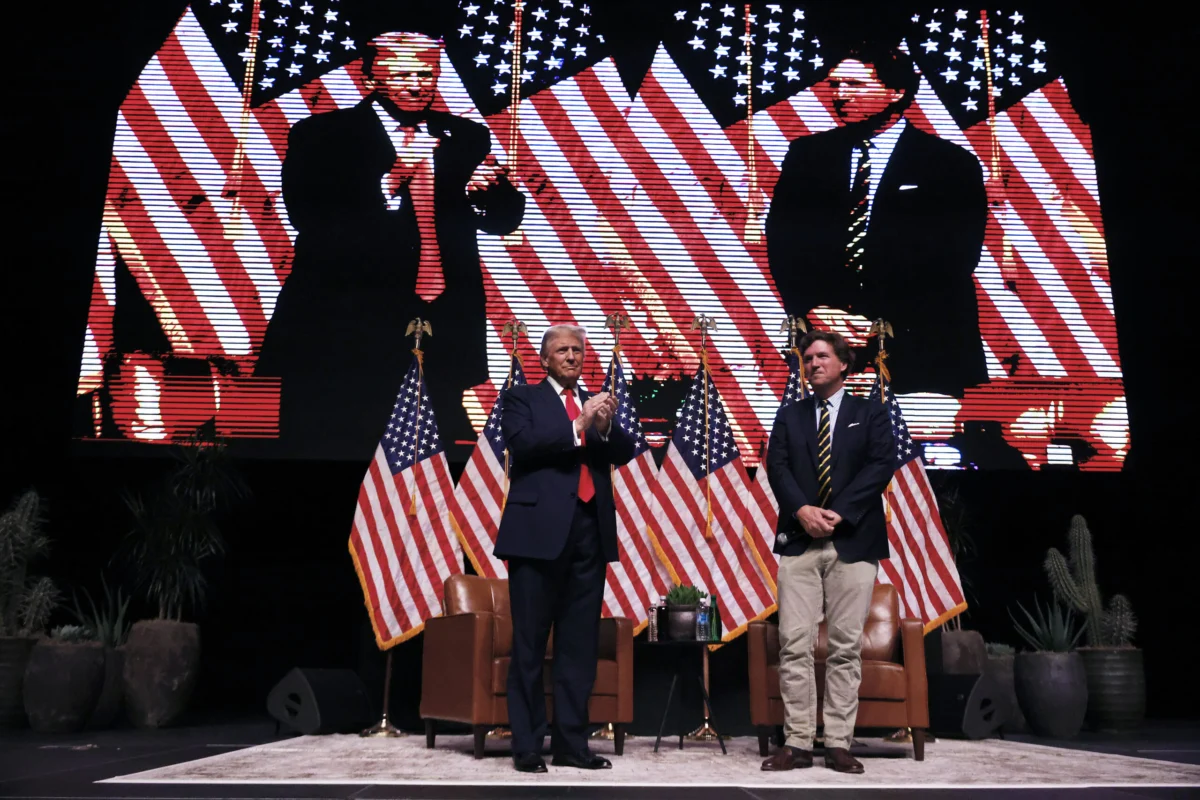
Donald Trump and cable news host-turned-MAGA-sphere player Tucker Carlson have entered an escalating war of words, with the former president calling his onetime ally a "fool" after the staunchly conservative commentator implied Trump is pushing the conflict with Iran toward nuclear war and even suggested he might be the Antichrist. The exchange highlights a deepening rift between two influential figures in conservative media and politics, raising concerns about the rhetoric surrounding international relations and the potential for escalation.
The Spark: A Profanity-Laced Easter Morning Tirade and Carlson’s Scathing Rebuttal
The public spat was ignited by a profanity-laced social media post from Donald Trump on Easter morning, in which he issued a stark warning to Iran. Trump threatened to target the country’s energy infrastructure, specifically mentioning bridges and power plants, while expressing frustration over the ongoing closure of the Strait of Hormuz, a vital global oil shipping lane. His message, delivered on Truth Social, was laced with aggressive language and veiled threats of catastrophic consequences for Iran, framed within a narrative of regime change and impending global significance.
"A whole civilization will die tonight, never to be brought back again. I don’t want that to happen, but it probably will," Trump wrote, in a post that also included a seemingly contradictory reference to "different, smarter, and less radicalized minds prevail" in Iran. He continued, "We will find out tonight – one of the most important moments in the long and complex history of the world. Forty-seven years of extortion, corruption, and death will finally end. God bless the great people of Iran!" The post concluded with a raw, expletive-laden demand: "open the f***ing strait, you crazy bastards, or you’ll be living in hell – just watch! Praise be to Allah."
Tucker Carlson, who has emerged as a formidable voice in the online conservative media landscape with an estimated 21 million followers across X and YouTube by late 2025, did not let Trump’s Easter morning pronouncements pass without sharp criticism. On a subsequent episode of his video podcast, Carlson launched a pointed and extensive critique, labeling Trump’s post "vile on every level." He condemned both the substance and the timing of the message, questioning the appropriateness of such aggressive and violent rhetoric on a day of Christian observance.
"How dare you speak that way on Easter morning to the country?" Carlson challenged, directly addressing Trump. "Who do you think you are? You’re tweeting out that word on Easter morning." Carlson’s initial criticism focused on the perceived indecency of Trump’s language and the implied scope of presidential authority to threaten mass destruction.
Escalation: Trump’s Retaliation and the "Low-IQ" Accusation
The former president, unaccustomed to such public rebuke from figures within his own political orbit, did not remain silent. In a recent interview with the New York Post, Trump vehemently pushed back against Carlson’s commentary, dismissing the pundit as unintelligent and out of touch.
"Tucker’s a low-IQ person who has absolutely no idea what’s going on," Trump stated to the tabloid. He went on to reveal a personal dynamic, adding, "He calls me all the time; I don’t respond to his calls. I don’t deal with him. I like dealing with smart people, not fools." This personal attack signaled a significant deterioration in the relationship between the two men, who had previously been seen as aligned.
Trump’s response aimed to frame Carlson’s critique as stemming from ignorance rather than principled objection, a common tactic in political discourse to discredit opponents. By questioning Carlson’s intelligence and claiming he doesn’t engage with the commentator’s calls, Trump sought to diminish his influence and portray himself as a leader who surrounds himself with astute advisors, not those he deems "fools."
Carlson’s Deeper Allegations: The Antichrist and a Call to Resignation
Carlson’s critique, however, did not stop at the surface level of Trump’s language. He delved into more speculative and eschatological territory, drawing a connection between Trump’s rhetoric and the concept of the Antichrist. This move, while unusual for mainstream political commentary, tapped into a vein of religious and conspiratorial thinking prevalent in certain segments of the conservative base.
"From there, Carlson’s critique of Trump’s language gave way to a more speculative argument invoking Christian eschatology, in which the Antichrist is described as a deceptive political figure who ushers in global upheaval," the original report stated. While the exact wording of Carlson’s explicit comparison to the Antichrist was not detailed in the provided text, his implication that Trump’s actions and rhetoric could align with such a figure represents a significant escalation in the personal and ideological attack. This framing suggests Carlson views Trump not merely as a flawed politician, but as a potentially dangerous, even apocalyptic, force.
Furthermore, Carlson used his platform to issue a broader call to action for government officials. He urged those in direct contact with the president to refuse to carry out orders they deem unlawful or dangerous. "Those people who are in direct contact with the president need to say, ‘No, I’ll resign. I’ll do whatever I can legally to stop this, because this is insane. If you give the order, I’m not carrying it out. Figure out the codes on the football yourself,’" Carlson advised, framing his stance as a moral imperative to prevent potentially catastrophic decisions.
Background and Historical Context: A Shifting Alliance
The public animosity between Trump and Carlson is particularly noteworthy given their past relationship. For years, Carlson was a prominent figure at Fox News, a network that often served as a conduit for Trump’s messaging and a platform for his supporters. Trump, in turn, frequently granted interviews to Carlson and often praised his work.
A notable point of tension, revealed during the Dominion Voting Systems defamation lawsuit against Fox News, involved Carlson’s private communications in 2021. In text messages, Carlson reportedly expressed a strong personal dislike for Trump, describing him as a "demonic force" and stating he "passionately hated" him. These private sentiments offer a glimpse into a more complex and perhaps less admiring view of Trump that existed beneath the surface of their public interactions.
Despite these underlying tensions, the two appeared to reconcile in 2023. Trump publicly defended Carlson following his ouster from Fox News and notably chose to grant Carlson an interview for his web show rather than participate in a Republican primary debate. This demonstrated a continued strategic alliance, or at least a willingness to engage, between the two influential conservative figures.
However, in recent times, Carlson has increasingly positioned himself as a contrarian voice within the MAGA sphere. While still a significant figure in conservative media, he has, at times, diverged from Trump’s direct endorsements and aligned himself with other prominent conservative personalities such as Candace Owens and Megyn Kelly. This shift suggests a desire by Carlson to carve out his own distinct ideological lane, which may not always align perfectly with Trump’s immediate agenda.
Supporting Data and Implications: The Strait of Hormuz and Global Oil Markets
The focus on the Strait of Hormuz is strategically significant. This narrow waterway, located between the Persian Gulf and the Gulf of Oman, is one of the world’s most critical chokepoints for oil transportation. Approximately 20 percent of the world’s total petroleum liquids, including crude oil and refined products, pass through the strait daily. In 2023, an estimated 15.5 million barrels per day of oil and petroleum products transited the strait, according to the U.S. Energy Information Administration (EIA).
Any disruption to this vital shipping lane would have immediate and severe consequences for global energy markets. Oil prices would likely surge, potentially leading to widespread inflation, economic instability, and geopolitical tensions. The threat of Iran closing the strait, or being provoked into doing so, is a recurring concern in international relations and a primary driver of U.S. naval presence in the region.
Trump’s aggressive stance and threats of targeting Iran’s energy infrastructure are thus not merely rhetorical flourishes but carry tangible implications for global economic stability and international security. The escalation of rhetoric from both Trump and Carlson contributes to a volatile information environment that could, in a worst-case scenario, influence decision-making in a high-stakes geopolitical confrontation.
Broader Impact and Analysis: The Fracturing of the MAGA Coalition
The public feud between Trump and Carlson underscores a potential fracturing within the broader MAGA coalition. While both figures command significant followings, their disagreements highlight the ideological nuances and personal dynamics at play within the conservative movement. Carlson’s willingness to publicly criticize Trump, even to the point of invoking religious eschatology, suggests a growing confidence in his own platform and a potential challenge to Trump’s absolute authority within the movement.
The inclusion of a brief mention of Megyn Kelly’s support for Trump, even in an extreme hypothetical scenario ("Trump could drop a nuke and I’d still vote Republican over those people"), illustrates the deep partisan loyalty that remains among some segments of the electorate. This contrasts sharply with Carlson’s more critical stance, indicating a divergence in how influential media figures are approaching the current political landscape.
The exchange between Trump and Carlson raises important questions about the role of rhetoric in international relations, particularly concerning nuclear threats. The normalization of such language, even if intended for domestic political consumption, can have dangerous implications in a world where miscalculation or unintended escalation is a constant risk. As the situation between the U.S. and Iran remains fraught with tension, the public discourse surrounding it, amplified by figures like Trump and Carlson, becomes a critical factor in shaping perceptions and potentially influencing real-world outcomes. The conflict between these two prominent voices serves as a stark reminder of the complex and often unpredictable nature of political alliances and the power of media narratives in shaping public opinion and international discourse.