
 Reynand Wu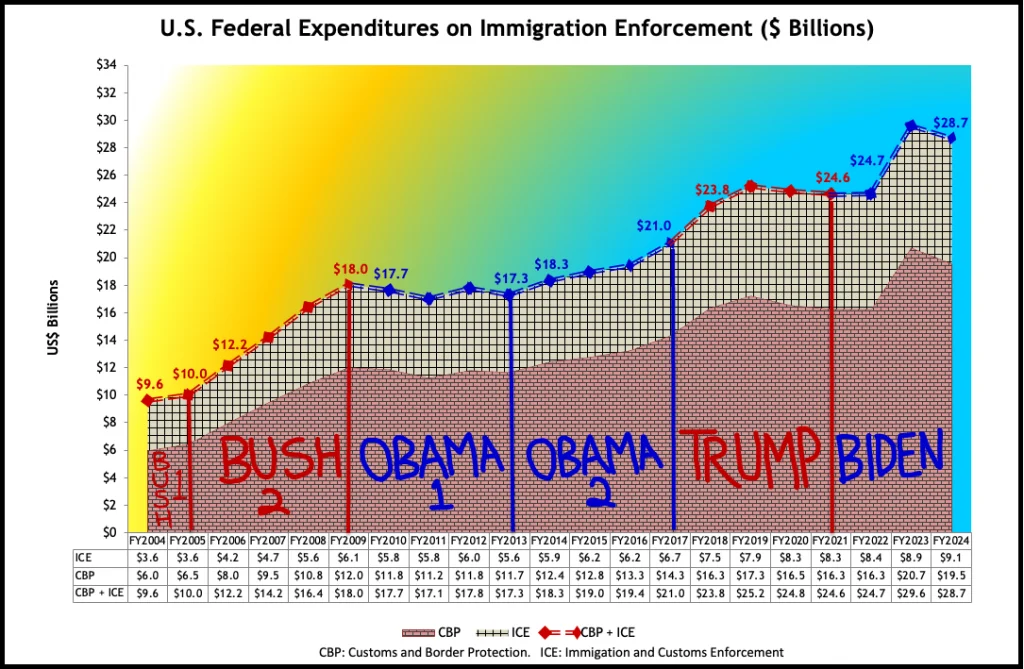
State borders are rarely the static, natural lines depicted on maps; rather, they are the product of sustained political conflict, nationalist discourse, and, most crucially, significant public financial investment. While political rhetoric often frames borders as inevitable defenses of national sovereignty, they are, in reality, arbitrary constructions maintained through intensive state-led securitization. By examining the fiscal trajectory of the United States’ border policy over the past two decades, a clear pattern emerges: the securitization of the US-Mexico border is not merely a policy preference of one political party, but a structural consensus that has persisted across multiple administrations, regardless of their stated ideological differences regarding immigration.
The Genesis of Modern Border Securitization
The contemporary architecture of US border control is largely a post-9/11 creation. The national security paradigm shift following the September 11, 2001, terrorist attacks provided the political capital necessary to fundamentally restructure how the United States approaches territorial integrity. Central to this was the Homeland Security Act of 2002, which established the Department of Homeland Security (DHS) and consolidated an array of federal agencies under a single cabinet-level department.
Two agencies emerged as the primary executors of this vision: Customs and Border Protection (CBP) and Immigration and Customs Enforcement (ICE). CBP, which identifies as one of the world’s largest law enforcement organizations, has focused its mandate on detecting and preventing "illegal entry." Simultaneously, ICE has operated with a mission to protect the nation from cross-border crime and undocumented immigration, which officials frequently characterize as threats to public safety. This institutional framework has effectively turned the border into a high-tech, heavily funded zone of constant surveillance and apprehension.
Chronology of Expenditure: A Two-Decade Expansion
Since the founding of DHS, the fiscal commitment to border enforcement has seen an almost uninterrupted upward trajectory. The following chronology tracks the evolution of this budgetary expansion across various presidential administrations:
- 2002–2003: The legislative foundation is laid with the Homeland Security Act. Initial budgets are focused on structural integration.
- 2006: The Secure Fence Act is signed into law, authorizing the construction of hundreds of miles of additional fencing and surveillance infrastructure, signaling a transition toward more physical and permanent barriers.
- 2008–2012: Despite the global financial crisis, the Obama administration maintains and expands the enforcement apparatus, focusing on "smart" border technology and increased deportations.
- 2017–2020: The Trump administration shifts the narrative toward high-visibility wall construction and executive orders aimed at accelerating border barrier deployment.
- 2021–2024: The Biden administration, while shifting some rhetoric, continues to request and approve high-level funding for enforcement, culminating in the 2023 decision to waive federal regulations to allow for wall construction in parts of Texas.
Analyzing the Fiscal Data
An examination of federal budget data from FY2006 to FY2024 reveals a striking continuity in spending that defies the expected partisan divergence. Over a 21-year period, the United States has spent approximately $409.4 billion on immigration enforcement and border security.
When categorized by the party in power, the data presents a counter-intuitive narrative. During the terms of Republican presidents, a total of $178.9 billion was allocated, averaging $17.9 billion annually. During the terms of Democratic presidents, that figure rose to $230.5 billion, averaging $21.0 billion annually.
These figures—unadjusted for inflation—demonstrate that the expansion of the border enforcement apparatus has not been a partisan project, but a bipartisan one. Federal expenditures on immigration enforcement have nearly tripled, rising from $9.6 billion in FY2004 to $28.7 billion in FY2024. Even when adjusting for inflation to constant 2024 dollars, the trend remains clear: the state’s financial investment in the border has grown from approximately $17.5 billion to $28.7 billion over two decades.
Official Rationales and Agency Perspectives
The agencies tasked with managing the border maintain that these expenditures are essential to national security. CBP spokespeople have consistently argued that "borders that work" require significant technological and personnel investments, including drones, sensors, and increased agent staffing levels. ICE maintains that their operations are a critical component of internal security, focusing on the apprehension of individuals who have bypassed official ports of entry.
Critics, however, point to the "political performativity" of these budget requests. In public discourse, the parties often clash on the morality and efficacy of immigration policy. Yet, in the quiet, bureaucratic realm of the federal budget, these disagreements are rarely reflected in the final appropriations. As researchers note, the consistent funding increases suggest that the "border-industrial complex"—a network of private contractors, security technology firms, and federal agencies—exerts a significant influence that transcends the current administration’s ideological leanings.
Socio-Economic Implications
The implications of this massive, sustained financial commitment go beyond the budget itself. Borders act as filters for economic difference, maintaining disparate value regimes and unequal trade relations. By pouring hundreds of billions of dollars into the physical and administrative fortification of the border, the state reinforces the idea that the border is an "objective" necessity rather than a political choice.
The economic impact is also felt in the growth of the private sector surrounding border security. Private security firms, construction companies, and data analytics firms have become deeply integrated into the DHS supply chain. This creates a vested interest in the continuation of high-security border policies, as these industries depend on the recurring budget increases provided by Congress.
The Contradictions of Liberal Democracy
The persistent funding of the border under both Republican and Democratic administrations highlights what some political theorists call the fundamental contradictions of bourgeois liberal democracy. While elected representatives frequently campaign on platforms that emphasize either strict enforcement or humanitarian reform, the machinery of the state—the "deep" administrative apparatus—tends toward the preservation of existing structures of control.
When the Biden administration opted to waive 26 federal regulations in October 2023 to resume wall construction in Texas, it served as a stark illustration of this phenomenon. The move was widely interpreted by analysts as an attempt to mitigate political pressure ahead of the 2024 election cycle, signaling that the Democratic Party’s policy has increasingly converged with the securitization strategies of its predecessors. This convergence suggests that in the absence of a strong, centralized progressive movement capable of exerting leverage over the federal budget process, the default policy of the state will continue to be one of increased securitization and enforcement.
Broader Impact and Future Outlook
The "border-as-budget" paradigm provides a lens through which to view the future of US immigration policy. As long as the fiscal infrastructure of the DHS continues to receive bipartisan support, the physical and legal barriers at the US-Mexico border will likely remain, regardless of which party occupies the White House.
The social consequences of this are profound. The naturalization of the border as a high-security zone reinforces the division between "insiders" and "outsiders," shaping the public’s perception of national identity and sovereignty. Furthermore, the massive diversion of public funds into enforcement limits the capital available for other social investments, such as housing, healthcare, or infrastructure, which are arguably more effective at addressing the root causes of regional inequality that drive migration in the first place.
As the US continues to navigate the complexities of global migration, the fiscal data suggests that the border will remain a central pillar of state policy. Whether this trend can be reversed depends on whether the political discourse moves beyond the superficial differences of partisan rhetoric and begins to interrogate the foundational decisions made during the appropriations process. For now, the budget itself serves as the most accurate map of the US border policy: a document of persistent, expensive, and escalating fortification.







