Layla Zulfa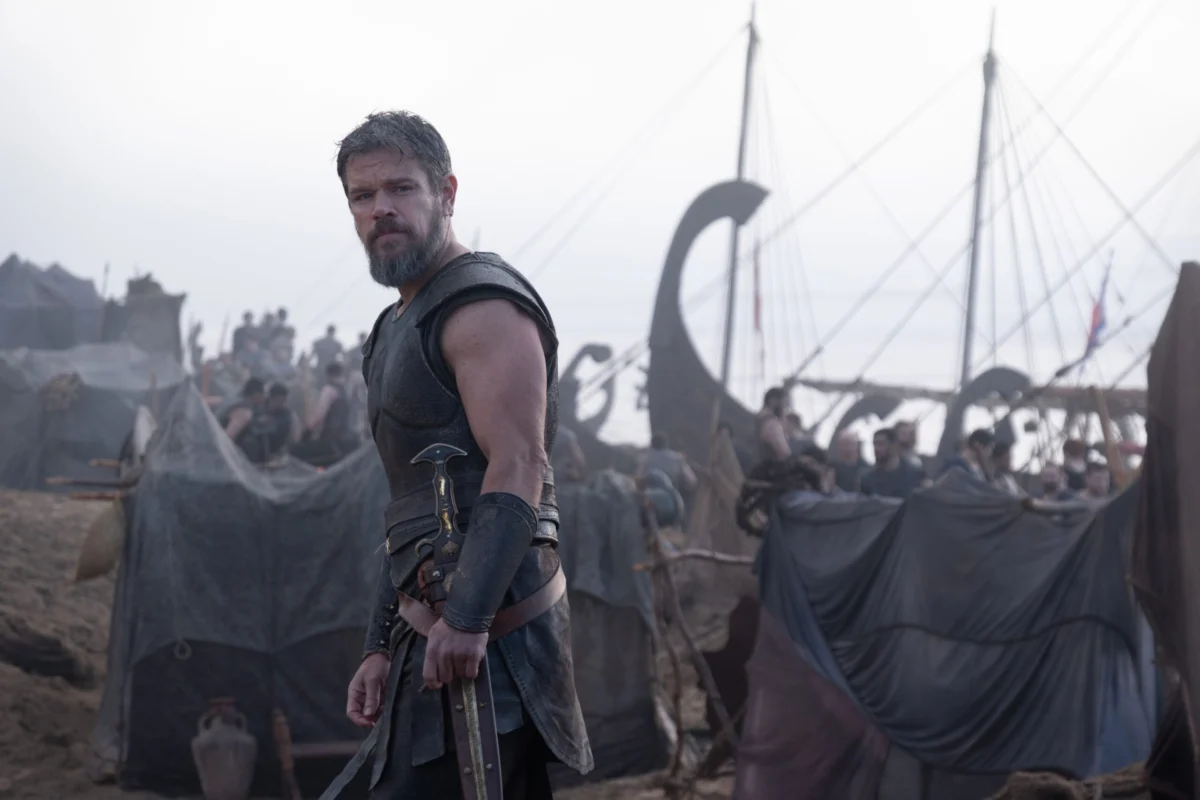
Following the critical and commercial triumph of Oppenheimer, visionary director Christopher Nolan has transitioned from the dawn of the atomic age to the foundations of Western literature with his latest epic, The Odyssey. While Homer’s original poem is celebrated as a cornerstone of the hero’s journey—replete with supernatural entities, divine intervention, and sorcery—Nolan’s adaptation distinguishes itself through a rigorous commitment to physical realism. Collaborating once again with Oscar-nominated production designer Ruth De Jong, Nolan has eschewed the industry-standard reliance on digital environments in favor of a massive, 91-day global production that utilized six countries and sprawling practical sets. This architectural and logistical undertaking seeks to ground the fantastical elements of the Greek mythos in a tangible, weathered reality, providing an immersive experience for a star-studded cast including Matt Damon, Anne Hathaway, and Tom Holland.
The Ethos of Tangibility: Rejecting the Digital Void
The production of The Odyssey was guided by a foundational philosophy shared by Nolan and De Jong: the total immersion of the actor within a physical space. In an era where high-budget blockbusters are frequently filmed against monochromatic blue or green screens, De Jong emphasized to Architectural Digest that their team was "not interested in having actors engage with blue or green screens." This "practical-first" mandate required the construction of entire environments that allowed the cast to interact with authentic textures, lighting, and weather conditions.

Industry analysts note that this approach, while significantly more expensive and logistically complex than digital compositing, has become a hallmark of Nolan’s directorial brand. By building the world of Odysseus from the ground up, the production aimed to capture the "ethos of practically building an entire set," ensuring that the audience perceives a sense of weight and history that CGI often struggles to replicate. This methodology extends the tradition of mid-century epics, drawing comparisons to the scale of legendary productions such as David Lean’s Lawrence of Arabia.
A Global Canvas: The 91-Day Production Timeline
The scope of the film was established during the earliest stages of pre-production. When De Jong asked Nolan for the parameters of the project’s visual world, the director’s response was characteristically ambitious: "The entire world." This directive initiated a scouting process that spanned several continents, seeking locations that offered a sense of "the unknown" and the "atmospheric scale" necessary to represent the ancient Mediterranean.
The production timeline was a grueling 91 days of principal photography, a relatively tight window considering the geographical breadth of the shoot. The schedule required the crew to navigate diverse climates and terrains, moving from the North Atlantic to the Sahara.

- Scotland: The rugged, windswept cliffs and stormy coastal waters of Scotland served as the backdrop for the island of Aeaea, where Odysseus (Matt Damon) encounters the sorceress Circe (Samantha Morton). The natural gloom and jagged topography were selected to emphasize the peril and enchantment of the encounter.
- Iceland: The production utilized the volcanic, black sand beaches of Iceland to represent Hades. The stark, monochromatic landscape provided a naturalistic interpretation of the Underworld, avoiding the fiery tropes of traditional fantasy.
- Morocco: The remote coastlines and desert provinces of Morocco played a dual role. The coastal areas served as the home of the sea nymph Calypso (Charlize Theron), while the Ouarzazate province became the site for the reconstruction of Troy.
- Sicily, Italy: The island of Favignana provided the exterior foundation for Odysseus’s home kingdom, Ithaca.
- Greece and the United States: Additional filming took place in Greece for historical authenticity and in Los Angeles for large-scale interior soundstage work.
Architectural Reconstruction: Creating Ithaca and the Megaron
A central challenge for De Jong was the creation of Ithaca, the destination of Odysseus’s twenty-year quest. For the exteriors of the Bronze Age palace, the team selected the 15th-century Castle of Santa Caterina, perched 900 feet above the Mediterranean on the island of Favignana. The location required the cast and crew to perform daily hikes up the steep terrain, a physical demand that Nolan believed added to the authenticity of the performances. Anne Hathaway, portraying Penelope, and Tom Holland, as Telemachus, filmed key sequences against the "bones" of this historic structure, which provided a backdrop of genuine antiquity.
However, the interior of the palace—the "Megaron" or great hall—required a scale that no existing historical site could provide. To depict the siege of the palace by Penelope’s suitors, including the nefarious Antinous (Robert Pattinson), De Jong oversaw the construction of a massive set on a Los Angeles soundstage. The structure was three stories high and spanned the length of two football fields. The design focused on "seamless" transitions between the Sicilian exteriors and the California-built interiors, ensuring that the audience would never detect the shift from a real-world location to a controlled environment.
Nautical Engineering and the Trojan Horse
The "hero ship" used by Odysseus and his crew was not a digital asset but a functioning 115-foot-long vessel. Sourced from Stavanger, Norway, the ship was heavily modified by De Jong’s team to resemble a Greek warship of the era. This included the addition of bronze decaling, custom sails, and functional oars. The ship was not merely a stationary prop; it was a sea-worthy vessel that traveled from the North Sea to the coast of Morocco, carrying the actors through real waves and open water.

The reconstruction of the Trojan War further illustrated the production’s massive scale. Shot in the historic mud-brick village of Ait Benhaddou in Morocco’s Ouarzazate province, the set for Troy covered two-and-a-half acres. De Jong described Troy as the "New York City of the ancient world," necessitating the construction of the Temple of Athena, massive gates, defensive towers, and intricate stairways. To enhance the environment, the production even transported mature olive trees to the desert location.
The iconic Trojan Horse was another feat of practical engineering. Designed and built in Los Angeles, the hollow wooden statue was shipped across the Atlantic to Morocco. For the scene where the horse is discovered, Nolan chose a beach in Essaouira, Morocco. In a testament to the production’s commitment to realism, the actors were required to pack into the belly of the structure while it sat half-submerged in the freezing coastal waters, capturing the genuine physical discomfort of the soldiers waiting to infiltrate the city.
Supporting Data and Production Logistics
While the official budget for The Odyssey remains undisclosed, industry estimates suggest the production costs exceeded $250 million, driven largely by the logistics of the six-country shoot and the construction of massive physical assets.

- Set Construction: The Troy set utilized over 500 local Moroccan craftsmen to assist in the mud-brick and timber construction, contributing to the local economy of Ouarzazate.
- Maritime Logistics: The 115-foot ship required a specialized crew of modern mariners to navigate the vessel between filming locations, coordinated with local maritime authorities in four different countries.
- Environmental Impact: The production team implemented a "leave no trace" policy, particularly in sensitive areas like the Icelandic beaches and the Sicilian castle, where temporary structures were removed and the sites restored to their original states.
Broader Impact and Industry Implications
The release of The Odyssey has sparked a renewed debate within Hollywood regarding the future of the "epic" genre. In a landscape increasingly dominated by the "Volume" technology (LED screen environments) used in series like The Mandalorian, Nolan’s insistence on location filming and physical sets is seen by some as a necessary preservation of cinematic craft.
"This movie is like the Lawrence of Arabia of our times," De Jong remarked, reflecting on the crew’s execution of such a massive vision. Critics argue that the tactile nature of the film—the real spray of the Mediterranean, the genuine grit of the Moroccan desert, and the tangible height of the Sicilian cliffs—creates a psychological depth that digital effects cannot mirror.
The success of the film also suggests a high audience appetite for "prestige blockbusters" that combine intellectual source material with high-concept practical filmmaking. By reimagining Homer’s poem through the lens of architectural and geographical realism, Nolan and De Jong have not only retold an ancient story but have also reaffirmed the viability of large-scale, practical production in the 21st century. The legacy of this production is expected to influence upcoming historical and mythological projects, potentially signaling a shift away from the "uncanny valley" of digital fantasy and back toward the grounded, physical spectacle that defined the golden age of cinema.