Reynand Wu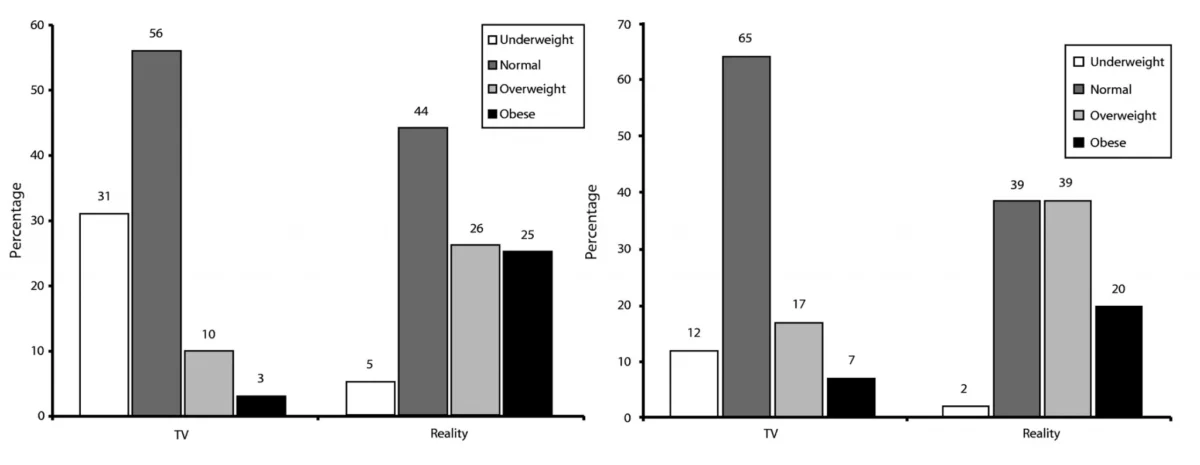
The pervasive influence of television often paints a skewed and detrimental picture of individuals with larger body types, reducing them to one-dimensional caricatures whose narratives are rarely afforded depth or significance. A study by Tzoutzou et al. starkly revealed this bias, noting that all 36 appearance-related compliments given to women in surveyed media were exclusively directed towards thin women. Not a single positive message regarding physical appearance was extended to a woman of average or overweight body type. This alarming pattern mirrored findings for male characters, with only one overweight male receiving a positive appearance-related comment. Such portrayals actively construct and reinforce a narrow definition of external beauty, equating it solely with thinness and effectively excluding a vast majority of the population who do not conform to this restrictive ideal. This consistent messaging can profoundly impact viewers, leading them to internalize the "thin ideal" and fostering negative self-perception, particularly among those whose bodies deviate from this relentlessly promoted standard. The observed treatment of larger individuals on screen can directly influence how viewers perceive their own bodies and navigate societal expectations.
The Historical Arc of Body Representation in Media
To understand the current state, it is crucial to examine the historical trajectory of body representation in media. Early Hollywood, particularly during its "Golden Age," often featured a broader range of body types, though still within a generally slender aesthetic. Actresses like Marilyn Monroe and Elizabeth Taylor, while celebrated for their curvaceous figures, were often positioned as exceptions within a prevailing narrative that increasingly championed slenderness as a hallmark of glamour and desirability. The mid-20th century saw the rise of fashion and advertising industries further solidifying the thin ideal, often presenting it as attainable through diet and exercise, subtly linking body size to personal discipline and moral character.
By the late 20th and early 21st centuries, as obesity rates began to climb in many Western countries and public health discourse intensified, media portrayals often became more overtly negative. The "war on obesity" narrative, while ostensibly health-focused, inadvertently fueled a societal bias against larger bodies, often conflating weight with laziness, lack of self-control, and poor health, irrespective of individual circumstances. Television, as a powerful cultural mirror and shaper, amplified these stereotypes, further entrenching the idea that larger bodies were inherently problematic, comedic, or villainous. This chronological evolution illustrates a gradual but persistent narrowing of acceptable body types on screen, culminating in the current landscape where diverse body shapes are either absent or stereotyped.
Underrepresentation and the Caricature Trap
Beyond the overwhelmingly negative framing, individuals with larger bodies are significantly underrepresented on television. Data from Brownell et al. (2003) comparing female and male body types on television versus reality in 1999-2000 starkly illustrated this disparity. While acknowledging this data is over two decades old, subsequent analyses and anecdotal observations suggest that despite growing calls for diversity, the gap largely persists. The vast majority of characters across genres continue to reflect a predominantly slender aesthetic, creating a visual disconnect between fictional worlds and the diverse reality of audiences.
When larger characters do appear, their roles are frequently limited and stereotypical, preventing any meaningful character development. They are often relegated to the periphery, serving as comedic relief or antagonists, rather than fully realized individuals with complex internal lives and narratives. This pattern of dehumanization through limited and stereotypical roles reinforces the idea that their stories and identities are less valuable or interesting than those of their thinner counterparts.
The "Funny Fat Friend" and the "Evil Overweight Villain" Tropes
One of the most pervasive stereotypes is the "funny fat friend" or "comedy sidekick." Research indicates that in comedic contexts, audiences are often encouraged to laugh at overweight women, not with them. Overweight female characters are approximately twice as likely to be the subject of a joke compared to thinner women. These characters frequently occupy smaller roles, are less likely to be involved in romantic relationships, and engage in fewer positive interactions than thin characters. Their comedic value is often derived from their size, clumsiness, or insatiable appetite, rather than wit or nuanced personality. This reduction to a punchline strips them of dignity and reinforces societal biases that link larger bodies with inherent silliness or lack of seriousness.
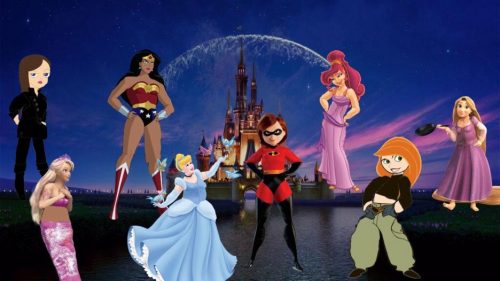
Equally damaging is the consistent portrayal of overweight characters as villains. A study by Himes and Thompson found that in 64% of the most popular children’s videos, obesity was explicitly equated with negative traits such as evil, unattractiveness, unfriendliness, and cruelty. Iconic examples abound in children’s media, from Ursula in The Little Mermaid to the Queen of Hearts in Alice in Wonderland. These larger-bodied antagonists often embody gluttony, laziness, or malice, forging a subconscious connection between physical size and moral depravity in young, impressionable minds. By consistently associating fatness with villainy, television does not merely ignore larger body types; it actively demonizes them, contributing to a deeply ingrained prejudice that extends far beyond the screen.
Broader Societal Implications and Expert Commentary
The relentless negative portrayal of larger bodies on television has profound and multifaceted implications for individuals and society at large. Academics and mental health professionals have consistently highlighted the detrimental effects of such media representation on body image and self-esteem. Dr. Sarah Beth Johnson, a media studies researcher, notes, "When media consistently presents a singular, unattainable body ideal, it creates a powerful internal pressure on viewers to conform, leading to pervasive body dissatisfaction, particularly among adolescents."
Studies, such as the one by Fouts and Burggraf, have demonstrated that even brief exposure—as little as 30 minutes of television—can negatively impact how young women view their own bodies, potentially leading to a cascade of external struggles. This rapid internalization is a critical concern for public health, given the ubiquity of television and streaming content.
The Tzoutzou et al. study further highlighted how media directly influences girls’ desires to be thin and adhere to prevailing beauty standards. This desire often manifests in frequent dieting and, in more severe cases, can contribute to the development of disordered eating patterns. Unrealistic body standards propagated by mass media are a significant driver of body dysmorphia and a range of eating disorders, underscoring the serious public health ramifications of current media practices.
Beyond individual self-esteem, these misrepresentations can instill a fear of social judgment and discrimination. Viewers may internalize the belief that they will face the same sexist or disparaging treatment depicted on screen if they do not conform to the "body norm." This fear can lead to social anxiety, avoidance behaviors, and a reluctance to engage fully in life, all rooted in the distorted realities presented by fictional narratives. The cumulative effect is a heightened sense of vulnerability and shame regarding one’s appearance, often manifesting as a self-fulfilling prophecy where perceived negative reactions from others are anticipated and internalized.
Industry Reactions and the Call for Change
The media industry’s response to these critiques has been varied. Historically, some executives and creators have argued that they are merely "reflecting reality" or catering to "audience demand." However, this stance often overlooks media’s powerful role in shaping reality and demand. In recent years, growing pressure from advocacy groups, body positivity movements, and increasingly vocal audiences has prompted some introspection within the industry. There’s a nascent, albeit slow, shift towards more inclusive casting and storytelling. Initiatives by organizations like the Geena Davis Institute on Gender in Media have provided data-driven insights into representation gaps, pushing for more authentic and diverse portrayals.
However, progress remains incremental. While some groundbreaking shows and films have begun to feature more diverse body types in nuanced, non-stereotypical roles, these examples are often exceptions rather than the norm. Industry insiders, speaking anonymously, sometimes cite commercial pressures, perceived audience preferences for "aspirational" body types, and ingrained biases within creative teams as obstacles to faster change. Yet, the economic success of projects that do prioritize authentic representation, such as certain independent films or streaming series, increasingly challenges these traditional assumptions.
Body positivity advocates, like the National Association to Advance Fat Acceptance (NAAFA), consistently call for a radical overhaul of media representation. Their statements emphasize the need for diverse body types to be shown as capable, desirable, intelligent, and healthy, without their size being the sole focus of their character or the butt of a joke. They argue that true inclusion means moving beyond tokenism to genuinely integrate a spectrum of body sizes into narratives in a way that normalizes and celebrates human diversity.
The Path Forward: Towards Inclusive Storytelling
Television, at its best, is a communal space meant for entertainment, reflection, and connection. However, for a significant portion of the audience, the current landscape transforms this space into one of judgment and alienation. Viewers cannot truly relax and enjoy content if they feel their bodies are constantly being critiqued or ridiculed by the very shows they watch. All bodies, in their vast and varied forms, deserve to see themselves authentically represented on screen, occupying roles that are rich, complex, and devoid of harmful stereotypes.
The imperative for change falls on writers, directors, casting agents, and network executives to consciously challenge existing biases. This means actively seeking out diverse talent, crafting narratives that explore the full spectrum of human experience irrespective of body size, and ensuring that characters with larger bodies are afforded the same depth, agency, and romantic possibilities as their thinner counterparts. It requires moving beyond tokenistic inclusion to genuinely embed body diversity as a standard element of authentic storytelling.
Ultimately, media has the power to either perpetuate harmful prejudices or dismantle them. By committing to authentic, diverse, and nuanced representation, television can transform from a source of body image anxiety into a powerful force for positive social change, fostering empathy, self-acceptance, and a more inclusive societal narrative for everyone. The goal is not just to "see" more fat bodies, but to see them in a way that humanizes, dignifies, and celebrates the richness of human form and experience.