Reynand Wu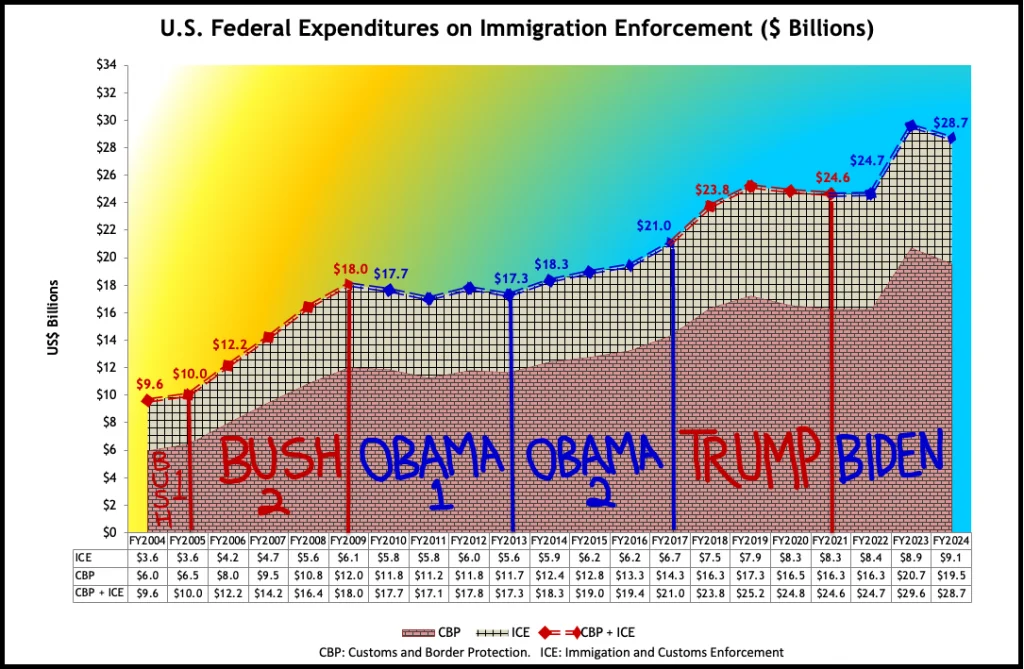
The United States’ state borders are not inherent geographical features but intricate constructs, fundamentally shaped by political conflicts, nationalist narratives, uneven economic systems, and, crucially, monumental public financial investment. This extensive financial commitment underpins policies and narratives that often naturalize state borders, obscuring their frequently arbitrary and violent origins. While commonly perceived as markers following war or territorial disputes, borders serve additional, complex social functions, including the preservation of distinct political systems and the categorization of individuals into "insiders" and "outsiders." Furthermore, borders actively forge economic disparities by maintaining unequal trade relations, distinct national currencies, and disparate value regimes across states and regional zones. This article delves into the substantial public funds dedicated to constructing and upholding these boundaries, particularly focusing on the post-9/11 securitization of the U.S.-Mexico border and the consistent, bipartisan escalation of enforcement budgets.
A Post-9/9/11 Paradigm Shift: The Securitization of Borders
The tragic events of September 11, 2001, catalyzed a profound transformation in U.S. border policy, intertwining the discourse of anti-terrorism with that of border regulation. This period marked an unprecedented securitization of the U.S.-Mexico border, shifting its primary focus from traditional immigration management to national security imperative. In response, President George W. Bush’s administration enacted the Homeland Security Act of 2002, a landmark piece of legislation that fundamentally restructured the federal government’s approach to national security. This act led to the creation of the Department of Homeland Security (DHS), a colossal new cabinet department consolidating 22 existing federal agencies, including the Immigration and Naturalization Service (INS), which was subsequently dissolved.
Under the umbrella of DHS, two key agencies emerged as central pillars of border enforcement: Customs and Border Protection (CBP) and Immigration and Customs Enforcement (ICE). CBP, which describes itself as "one of the world’s largest law enforcement organizations," explicitly states its primary mission as "to detect and prevent the illegal entry of individuals into the United States" and to "maintain borders that work." Its responsibilities span securing land borders, ports of entry, and coastal areas, employing a vast array of personnel, technology, and infrastructure. ICE, on the other hand, focuses on interior enforcement, stating its mission as "to protect America from the cross-border crime and illegal immigration that threaten national security and public safety." This includes apprehending, detaining, and deporting immigrants, as well as investigating various transnational crimes. The establishment and empowerment of these agencies signaled a definitive shift towards a more militarized and expansive approach to border management, justified largely by the new national security paradigm.
Historical Context of U.S. Border Enforcement
While the post-9/11 era dramatically escalated border securitization, the foundations of U.S. border enforcement have a long and complex history. Prior to the formation of DHS, immigration enforcement was primarily handled by the Immigration and Naturalization Service (INS), established in 1933. However, significant efforts to control the U.S.-Mexico border gained momentum decades earlier. Programs like the Bracero Program (1942-1964), which allowed millions of Mexican guest workers into the U.S., paradoxically led to increased enforcement efforts against those outside the program. Operation Wetback in 1954, a controversial large-scale deportation campaign, highlighted early federal resolve to control immigration flows.
The late 20th century saw a gradual militarization of the border, particularly after the passage of the Immigration Reform and Control Act (IRCA) of 1986, which, while offering amnesty to millions, also significantly increased border patrol funding and personnel. In the 1990s, strategies like "Operation Gatekeeper" in San Diego (1994), "Operation Hold the Line" in El Paso (1993), and "Operation Safeguard" in Arizona (1994) aimed to concentrate enforcement in urban areas, effectively pushing migrants into more perilous desert and mountainous terrains. These operations led to the construction of initial border fences and a noticeable increase in Border Patrol agents. By 2001, before the creation of DHS, the Border Patrol already employed over 9,000 agents, a significant increase from fewer than 4,000 in 1990. The post-9/11 transformation, therefore, built upon existing frameworks of enforcement, amplifying them to an unprecedented degree under the banner of national security.
The Escalation of Spending: A Bipartisan Consensus
A detailed examination of federal spending on immigration enforcement and border security reveals a staggering and consistent upward trend, demonstrating a bipartisan consensus on funding these operations. Over a 21-year period, from Fiscal Year 2004 to Fiscal Year 2024, Republican and Democratic administrations combined have allocated an astounding total of $409.4 billion of public funds to immigration enforcement. This figure, unadjusted for inflation, underscores the immense financial priority placed on border securitization.
Breaking down this monumental expenditure, Republican Presidents have overseen the spending of $178.9 billion, averaging approximately $17.9 billion annually during their terms. Democratic Presidents, despite often articulating a more pro-immigrant stance rhetorically, have authorized even greater financial outlays, spending $230.5 billion, which averages to $21.0 billion per year. This data vividly illustrates that, in practice, Democratic administrations have been no less enthusiastic than their Republican counterparts in funding the apparatus of border policing and immigration enforcement.
Overall federal expenditures on immigration enforcement have nearly tripled within this period, surging from $9.6 billion in FY2004 to an estimated $28.7 billion in FY2024. While these figures are not adjusted for inflation, even when factoring in inflation to 2024 dollars, the increase remains substantial, rising from approximately $17.5 billion to $28.7 billion. This indicates a real and significant growth in the financial commitment to border security, irrespective of economic fluctuations.
The allocation of these funds has primarily gone to the two core agencies: $275 billion has been dedicated to Customs and Border Protection (CBP), responsible for patrolling and securing the border itself, including infrastructure development like walls and surveillance technology. The remaining $134.4 billion has been allocated to Immigration and Customs Enforcement (ICE), which handles interior enforcement, detention facilities, and deportation operations. This financial investment has facilitated a massive expansion of personnel, infrastructure, and technological capabilities along the U.S. borders, particularly the U.S.-Mexico border. For instance, the number of Border Patrol agents more than doubled from approximately 10,000 in 2004 to over 20,000 by 2010 and has remained around that level since. Similarly, the number of ICE agents has also seen significant growth.
Presidential Policies and the "Border Wall" Saga
The trajectory of border spending is closely tied to the policies and rhetoric of successive presidential administrations, though the underlying trend of increased funding persists across party lines.
George W. Bush Administration (2001-2009): Following 9/11, the Bush administration laid the groundwork for modern border securitization. Beyond establishing DHS, key legislative actions included the REAL ID Act of 2005, which set standards for state-issued identification and restricted asylum claims, and the Secure Fence Act of 2006. This act mandated the construction of approximately 700 miles of fencing along the U.S.-Mexico border, marking a significant federal commitment to physical barriers. By the end of Bush’s term, over 670 miles of primary and secondary fencing had been constructed. The annual budget for CBP and ICE saw substantial increases, reflecting the new national security priority.
Barack Obama Administration (2009-2017): Despite initial hopes for comprehensive immigration reform and a more humane approach, the Obama administration oversaw record numbers of deportations, earning him the moniker "deporter-in-chief" from some critics. While his administration introduced programs like Deferred Action for Childhood Arrivals (DACA) in 2012, offering temporary protection to certain undocumented immigrants brought to the U.S. as children, it also continued to heavily invest in border enforcement. The budgets for CBP and ICE remained elevated, demonstrating a strategy often described as "enforcement-first" to pave the way for future reform. Surveillance technology, including drones and ground sensors, saw increased deployment under his tenure.
Donald Trump Administration (2017-2021): President Trump made border security, and specifically the construction of a "big, beautiful wall," a central promise of his campaign and presidency. His administration pushed aggressively for increased funding for border infrastructure and personnel. While he struggled to secure full congressional funding for his ambitious wall project, his administration redirected military funds and waived environmental regulations to construct or replace hundreds of miles of barriers. Policies like "zero tolerance" at the border led to controversial family separations. Despite intense political rhetoric and calls for unprecedented border fortification, the actual year-over-year percentage increase in combined CBP and ICE budgets under Trump, while substantial, did not deviate dramatically from the upward trend established by previous administrations. The average annual spending remained high, underscoring the bipartisan nature of the financial commitment.
Joe Biden Administration (2021-Present): President Biden entered office pledging a departure from Trump’s more draconian immigration policies, halting wall construction on his first day and emphasizing a more "humane" approach. However, his administration has faced persistent challenges at the border, leading to a continuation of many enforcement-focused strategies. While initially pausing wall construction, in October 2023, the Biden administration controversially waived no fewer than 26 federal regulations – including environmental laws like the Clean Air Act, Safe Drinking Water Act, and Endangered Species Act – to construct new sections of border wall in South Texas. This move, seen by critics as mimicking his Republican predecessor Donald Trump, highlights the deep-seated political pressures surrounding border security, especially in advance of the 2024 presidential election. The decision underscored the perceived political necessity of demonstrating a tough stance on the border, even at the cost of previous pledges and environmental concerns. The budgets for CBP and ICE have continued their upward trajectory under Biden, reflecting the ongoing commitment to robust border enforcement despite rhetorical shifts.
The Underlying Contradictions: Rhetoric Versus Reality
The striking contrast between partisan rhetoric on immigration policy and the observable partisan consensus on immigration enforcement funding exposes a fundamental contradiction within bourgeois liberal democracy. While elected representatives are theoretically meant to embody the will of the populace, the reality often suggests they represent the interests of dominant economic, political, and racial elites. This discrepancy helps explain why, despite Democratic politicians frequently articulating a more compassionate, pro-immigrant stance, their administrations consistently approve substantial, even increasing, budgets for agencies responsible for apprehension, detention, and deportation.
The "lie" given to partisan differences by the consistent funding trends suggests that the political performance of ideological divides often overshadows a deeper, shared commitment to maintaining a securitized border apparatus. This apparatus serves not only to control migration but also to reinforce existing economic hierarchies and to differentiate between a cheap labor pool and a more privileged citizenry.
Substantive progress toward decarcerating the United States’ immigration detention system and truly desecuritizing the U.S.-Mexico border would likely necessitate a significant shift in political power. Such change would require progressives to exercise greater influence within Congress, and for Congress, in turn, to exert more stringent oversight and control over the federal budget and immigration enforcement agencies. In the current political landscape, however, such a fundamental reorientation appears unlikely. The recent decision by the Biden administration to waive environmental regulations for border wall construction exemplifies how, in the absence of a strong, unified progressive ideological agenda within the Democratic Party, anti-immigrant violence, often masked as necessary security, continues to fill the void. This reinforces the idea that the border is not merely a physical line but a heavily funded and ideologically charged institution, sustained by a bipartisan political will that prioritizes enforcement above all else.
Economic and Social Implications of Extensive Border Spending
The immense financial investment in border enforcement carries profound economic and social implications, extending far beyond the immediate goal of preventing unauthorized crossings. Economically, the continuous growth of CBP and ICE budgets creates a powerful industry around border security, involving contractors for surveillance technology, infrastructure construction, and detention services. This "border-industrial complex" incentivizes further spending, as vested interests benefit from the expansion of enforcement capabilities. However, questions persist regarding the cost-effectiveness of this spending. Despite billions poured into walls, agents, and technology, irregular migration flows continue, adapting to new barriers and enforcement tactics. The economic impact on border communities, both positive through job creation in enforcement and negative through disruptions to local economies and cross-border trade, is also significant.
Socially, the securitization of the border has devastating human costs. Increased enforcement pushes migrants into more dangerous routes, leading to a tragic rise in deaths due to exposure, dehydration, and drowning. The expansion of detention facilities, often operated by private companies, raises concerns about human rights, due process, and conditions of confinement. Policies like family separation, though officially ended, have inflicted lasting trauma on thousands. The constant presence of a heavily armed border force in communities transforms the social fabric, leading to heightened tensions, racial profiling, and a climate of fear for many residents, regardless of their legal status. The construction of physical barriers often divides communities, separates families, and disrupts ecosystems, causing irreversible environmental damage.
A Global Perspective on Border Securitization
The U.S. approach to border securitization is not an isolated phenomenon but part of a broader global trend. Many nations worldwide are increasingly investing in physical barriers, surveillance technology, and increased personnel to manage their borders, often in response to migration pressures, perceived security threats, or nationalist political agendas. From Europe’s external borders to frontiers in Asia and Africa, the militarization of boundaries is a growing reality. However, the scale and sustained financial commitment of the United States to its border enforcement apparatus, particularly along its southern border, remain among the most significant globally. This global context highlights how borders, far from being static lines on a map, are dynamic sites of immense investment, political contestation, and human consequence, reflecting complex interactions between state power, economic interests, and the movement of people.
Conclusion: The Enduring Financial Wall
In conclusion, the construction and maintenance of state borders, particularly the U.S.-Mexico border, are revealed not as natural phenomena but as the direct outcome of deliberate political choices, fueled by immense and consistent public financial investment. The post-9/11 era fundamentally reshaped U.S. border policy, transforming it into a national security priority that led to the creation of the Department of Homeland Security and its powerful enforcement arms, CBP and ICE. The analysis of federal spending data unequivocally demonstrates a robust and bipartisan commitment to this securitized approach, with both Republican and Democratic administrations overseeing a near-tripling of expenditures on immigration enforcement over two decades, totaling over $400 billion. This financial