Johny Marice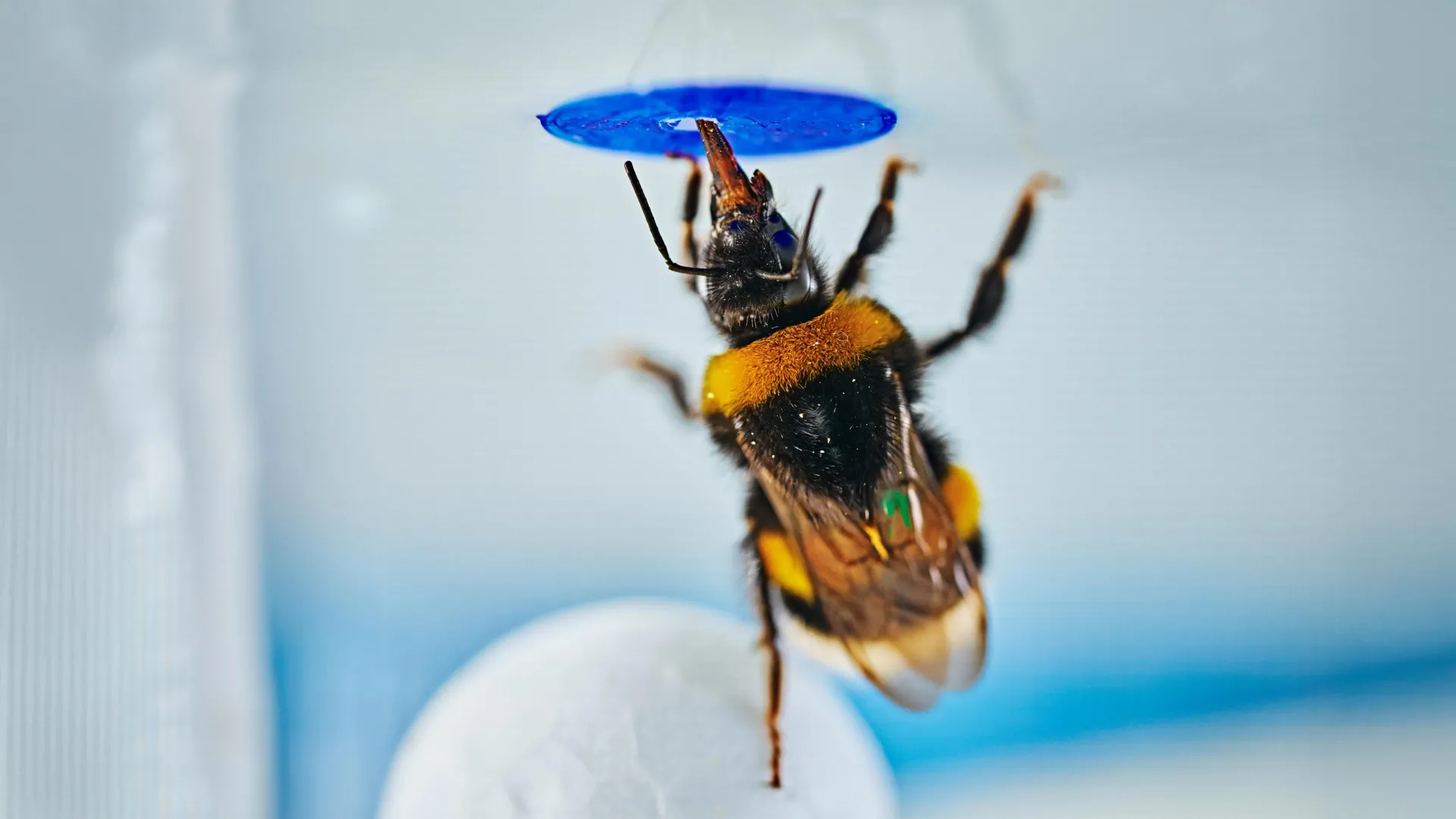
A groundbreaking study published in the prestigious journal Science has revealed that bumblebees possess a remarkable capacity for spontaneous problem-solving, an ability previously thought to be exclusive to humans and other vertebrates with significantly larger and more complex brains. Researchers from leading Finnish institutions, including the University of Oulu, the University of Helsinki, and the University of Turku, have demonstrated that these insects can successfully navigate and solve entirely novel object manipulation tasks without any prior training or learned experience. This discovery challenges long-held scientific assumptions about the cognitive boundaries of invertebrates and opens new avenues for understanding the evolution of intelligence.
A Centuries-Old Enigma Reimagined in Miniature
The genesis of this research can be traced back over a century to the pioneering experiments of German psychologist Wolfgang Köhler. In the early 20th century, Köhler’s seminal work with chimpanzees at the primate research station on Tenerife offered the first compelling evidence of "insight" – the sudden, intuitive solution to a problem by restructuring the elements of a situation. His classic "box-and-banana" experiments, where chimpanzees would spontaneously stack boxes or use sticks to retrieve out-of-reach food, became defining examples of cognitive flexibility in animals. For decades, this form of spontaneous, goal-directed problem-solving was considered a hallmark of higher-order vertebrates, a testament to their advanced neural architecture. The current findings, however, suggest that such sophisticated cognitive processes may not be as dependent on brain size as once believed.
The Novel Challenge: A Bee’s Ingenuity
The Finnish research team designed an ingenious experiment to test the problem-solving capabilities of bumblebees (specifically Bombus terrestris). The setup involved a transparent arena where the bees were initially trained to associate a blue artificial flower with a sugary reward. The crucial phase of the experiment saw this blue flower moved to the ceiling of the arena, placing it tantalizingly beyond the bees’ natural reach.
To access the reward, the bees were presented with a small, movable ball. The critical element was that the bees were never taught to use the ball in conjunction with the flower. Their prior learning was limited to two distinct facts: the blue flower contained a reward, and the ball was an object that could be moved. The challenge required the bees to synthesize this disparate knowledge and devise a novel strategy.
The results were astonishing. A significant proportion of the bumblebees, when faced with the inaccessible flower, demonstrated an emergent solution: they rolled the ball directly beneath the flower and then climbed onto the ball to reach the reward. This sequence of actions—locating the ball, propelling it to a specific location, and then using it as a platform—was entirely outside their learned repertoire.
"This is essentially an insect version of the classic ‘box-and-banana’ problem," stated senior author Olli Loukola, Docent at the University of Oulu. "The animal must realize that an object can be repositioned and then used as a tool to reach an otherwise inaccessible goal. What stands out about the result is that this kind of spontaneous problem-solving is now demonstrated in an insect."
Lead author Akshaye Bhambore from the University of Oulu further emphasized the novelty of the bees’ behavior. "What makes this behavior especially remarkable is that the bees had never been trained to roll the ball. This was a completely new challenge. Their behavior appeared goal-directed with successful individuals showing more directed movement patterns."
Eliminating Simpler Explanations: Rigorous Controls
Recognizing the potential for simpler explanations, the researchers implemented a series of rigorous control experiments to meticulously rule out alternative interpretations of the bees’ behavior. The goal was to ensure that the observed problem-solving was genuine insight rather than accidental success, learned association, or simple stimulus-response reactions.
One of the most crucial aspects was ensuring the bees were truly naive to the specific solution. They were not exposed to situations where balls were used to reach elevated targets, nor were they given extensive practice with the experimental apparatus. Their prior experience was strictly limited to learning about the reward-bearing flower and the movable nature of the ball.
"Another important aspect is that our bees were fully naive," Loukola elaborated. "In many previous studies of insight-like problem-solving, the animals have had extensive experience with objects, test environments, or other problem-solving tasks. Here, the bees had never been trained to use the ball to reach the flower, and they had no previous experience with this kind of solution. We also designed the experiments to rule out simpler explanations such as accidental success, play behavior, trial-and-error learning, or direct visual guidance."
To address the possibility of direct visual guidance, where bees might simply be moving the ball towards the flower as a visible target, more demanding tests were conducted. In these scenarios, the blue flower was temporarily hidden from view while the bees manipulated the ball. Even when the target was not directly visible, many bees still managed to move the ball to the correct location beneath where the flower would be. This strongly suggested that the bees were not merely reacting to a visual cue but were forming a mental representation of the goal and planning their actions accordingly.
"By analyzing the bees’ behavior across unusually stringent control experiments, we could show that they were not simply reacting to visual stimuli or moving the ball randomly," Bhambore added. This meticulous approach ensured that the observed ingenuity could be attributed to genuine cognitive flexibility.
Tiny Brains, Monumental Capabilities
The scientists involved in the study expressed a sense of awe at the bees’ performance. The transition from seemingly undirected exploration to a highly efficient, purposeful sequence of actions was a captivating spectacle.
"One moment the animal is exploring seemingly without direction, and the next it performs a highly efficient sequence of actions leading directly to the solution," remarked co-author Ece Nur Akmeşe from the University of Helsinki. "Watching the bees solving the task was genuinely fascinating."
This latest research adds significant weight to a growing body of evidence indicating that bees possess sophisticated cognitive abilities that belie their minuscule brain size. Their nervous systems, while vastly different from those of vertebrates, are capable of remarkable feats. Previous studies have already documented their ability to learn through social observation, solve complex puzzle-like tasks, engage in cooperative behaviors, and adapt their actions in response to changing environmental conditions.
However, the researchers are careful to temper these findings with a crucial distinction. They are not suggesting that insects possess human-like consciousness or subjective experience. Instead, the emphasis is on the functional capabilities of their neural systems.
"We are not claiming that bees think like humans," clarified Loukola, who is now a Senior Researcher at the University of Turku. "But our findings show that miniature brains can generate flexible solutions to novel problems in ways we are only beginning to understand."
Broader Implications: Re-evaluating Intelligence
The implications of this study extend far beyond the realm of entomology. The results suggest that the capacity for spontaneous, goal-directed problem-solving may be a more widespread phenomenon in the animal kingdom than previously assumed, potentially emerging in organisms with vastly different neural architectures and evolutionary histories.
For over a century, the study of spontaneous object-based problem-solving has been predominantly focused on vertebrates, from primates to birds and even some fish. This research firmly places insects, particularly social insects like bumblebees, into this important scientific conversation. It prompts a re-evaluation of what constitutes "intelligence" and how it can manifest across diverse biological forms.
The study, officially titled "Spontaneous problem-solving in bumble bees," was authored by Akshaye A. Bhambore, Ece N. Akmeşe, Emma Hämäläinen, Milla K. Jussila, Juha-Heikki Kantola, and Olli J. Loukola. Its publication in Science on June 4, 2026, marks a significant milestone in our understanding of animal cognition, reminding us that profound cognitive abilities can be found in the most unexpected of creatures, challenging our anthropocentric views and opening new frontiers in the quest to comprehend the diversity of minds on Earth. The research also has implications for understanding the ecological roles of insects, suggesting their complex behaviors may contribute significantly to their survival and resource acquisition in ways not fully appreciated. Further studies could explore the neural mechanisms underlying these problem-solving skills in bees, potentially revealing novel principles of computation and adaptive behavior that could even inspire future advancements in artificial intelligence.