Jono Maryono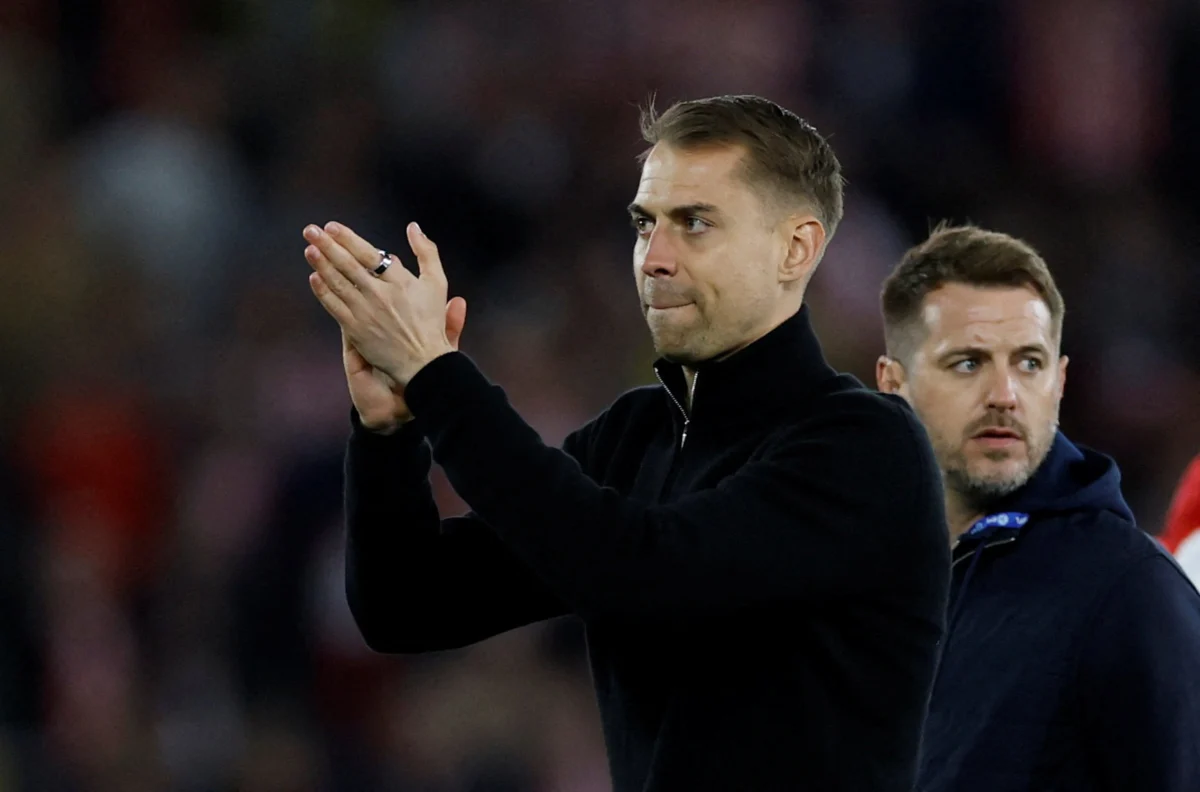
Southampton Football Club has publicly reaffirmed its commitment to manager Tonda Eckert, despite the severe repercussions of the "spygate" scandal that saw the club expelled from the Championship playoffs and forfeit their chance at Premier League promotion. Club owner Dragan Solak has unequivocally stated that Eckert will not be sacked, emphasizing the board’s continued confidence in the German tactician to lead the Saints forward.
Eckert’s Apology and the Nature of the Scandal
In a candid video statement released on Tuesday, Eckert issued a heartfelt apology for orchestrating the clandestine operations that led to the club’s downfall. "For everything that’s happened, I do want to apologize, and I hold my hand up because as a head coach, I am responsible for everything that has happened in this football club," Eckert declared. His admission acknowledges the gravity of his actions and the cascading consequences for Southampton.
The club was disqualified from the highly lucrative Championship playoff final last month after admitting to a series of breaches involving observing training sessions of their semifinal opponents, Middlesbrough, and engaging in two other similar incidents throughout the season. This admission, coupled with the independent disciplinary commission’s findings, painted a stark picture of a "contrived and determined plan from the top down to gain a competitive advantage" through underhanded tactics. The commission specifically highlighted Eckert’s authorization of these methods, noting the "particularly deplorable" use of junior staff members to execute these covert missions.
The Disciplinary Fallout and Missed Opportunity
The disciplinary actions levied against Southampton were substantial. Beyond the playoff expulsion, the club has also incurred a four-point deduction that will be applied to the 2026-27 Championship league table. Furthermore, the Football Association has launched its own independent investigation, leaving open the possibility of further charges against Eckert personally.
Southampton had initially triumphed over Middlesbrough in the playoff semifinals with a 2-1 aggregate victory over two legs. However, their disqualification saw Middlesbrough reinstated. The Teesiders, ultimately, were unable to capitalize on their reprieve, falling to Hull City in the playoff final. This final, widely regarded as the most financially rewarding single fixture in world football, offers a gateway to the English Premier League, the wealthiest domestic football league globally. For Hull City, victory translates to an estimated £200 million ($268 million) in additional revenue. For Southampton, this represents a significant missed opportunity for financial and sporting advancement.
Eckert’s Defense and Cultural Context
Eckert, who was appointed head coach in December, elaborated on his perspective in an eight-minute video statement shared across Southampton’s social media channels. The 33-year-old expressed his profound disappointment, stating, "I am devastated that after six months of building that relationship [with fans] back up, the season has come to an end, come to an end that couldn’t have left us in a worse place than we are in right now."
He attempted to contextualize his actions by suggesting that observing opposing teams’ training sessions is a common practice in other footballing cultures. Eckert cited his experiences in Italy, where he spent over four years, as an example. "When I worked in Italy for over four years, every starting lineup that we’ve chosen for the games was always out in the media before games," he explained. "And the reason is that our training sessions, especially the ones before games, have always been observed from the media and have always been observed from opponent teams that we came up against." He also drew parallels to comments made by Pep Guardiola regarding similar practices in Germany during his tenure at Bayern Munich, suggesting it was "common practice in Germany to observe training sessions, knowing that other teams would do the same." However, Eckert conceded that this cultural normalization did not serve as a valid excuse for his conduct within the framework of English football regulations.
Owner’s Unwavering Support
In stark contrast to the widespread expectation that Eckert would face dismissal, club chairman Dragan Solak has offered robust and unwavering support. In a statement posted on the club’s official channels, Solak declared, "Tonda’s period as our head coach has been a success so far. Our form during 2026 has been remarkable, and we believe he is the man to take us forward." He continued, "As a board, we are fully behind him, and together we only have one objective – we want promotion back to Premier League."
Solak further articulated his perspective in a separate interview with the BBC, characterizing Eckert as the subject of a "witch-hunt" in the media. He firmly believes that Southampton has been "over-sentenced" for their transgressions. The Serbian billionaire, whose media company acquired a majority stake in the south-coast club in 2022, expressed his personal conviction and that of the board that Eckert may not have fully understood the specific rules he was violating. "I believe Tonda that he didn’t know that it was the rule that he was breaking," Solak stated. "My personal opinion, and the opinion of the board, is that he is a manager who deserves to be backed by us and to be supported by us."
Broader Implications and Future Outlook
The "spygate" scandal and its aftermath raise significant questions about the ethics of competitive advantage in professional football. While the pursuit of information is an inherent part of sports strategy, the methods employed by Southampton, under Eckert’s direction, crossed a line deemed unacceptable by the English Football League. The disciplinary commission’s ruling that there was a "contrived and determined plan from the top down" underscores the seriousness with which such actions are viewed.
The club’s expulsion from the playoffs has not only cost them a direct shot at Premier League riches but also inflicted reputational damage. The four-point deduction for the following season adds an immediate hurdle to their promotion ambitions. For rival clubs, the incident may serve as a cautionary tale about the potential consequences of circumventing fair play principles.
Despite these setbacks, Solak’s decisive backing of Eckert signals a clear intent from the ownership. The emphasis on future promotion, rather than dwelling on past transgressions, suggests a strategy focused on rebuilding and renewed efforts. The coming seasons will undoubtedly be scrutinized, with supporters and rivals alike observing how Southampton navigates the aftermath of this scandal under Eckert’s continued leadership. The club’s commitment to Eckert, while potentially controversial, underscores a belief in his ability to deliver on the ultimate objective: returning Southampton to the Premier League. The club now faces the challenge of regaining trust and demonstrating their commitment to sporting integrity while simultaneously striving for on-field success. The coming period will be a critical test of both Eckert’s managerial acumen and the club’s long-term vision under its current ownership.