Prabowo Widodo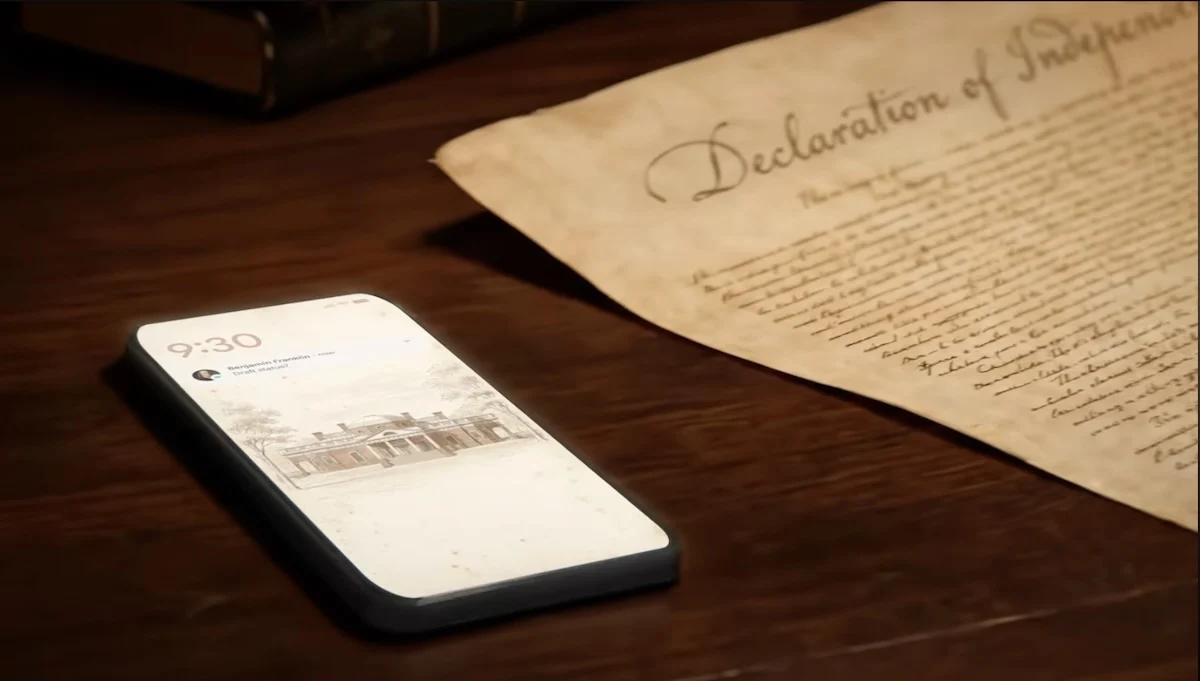
Two hundred and fifty years after the momentous signing of the Declaration of Independence, Google has launched a new commercial for its Workspace suite, posing a provocative hypothetical: What if the Founding Fathers had access to modern collaboration tools like Google Docs, Calendar, Meet, and Gemini AI? The ad, set to coincide with the nation’s Quartercentennial in 2026, aims to highlight the efficiency and collaborative power of Google Workspace, but has ignited a broad spectrum of public reactions, from amusement to sharp criticism.
A Revolutionary Collaboration: Google’s 1776 Vision
The commercial, aptly titled "Group project, but make it 1776," transports viewers to the summer of 1776, reimagining the arduous process of drafting one of history’s most pivotal documents through a decidedly modern lens. The narrative centers on a largely unseen Thomas Jefferson, presumably deep in the throes of drafting the Declaration, when his solitary pursuit is interrupted by a text message from Benjamin Franklin. This initiates a rapid-fire, Google-centric collaboration process that stands in stark contrast to the historical reality of parchment, quill, and arduous correspondence.
The advertisement meticulously showcases various Google Workspace applications. Edits and suggestions for Jefferson’s seminal text are made in real-time within Google Docs, demonstrating the platform’s collaborative editing capabilities. A crucial meeting among the Founders is swiftly scheduled via Google Calendar, bypassing the logistical nightmares of 18th-century travel and communication. The meeting itself takes place remotely through Google Meet, humorously depicting a scenario where every attendee, despite the technological leap, opts to keep their cameras off—a relatable modern-day meeting quirk. The finalization of the Declaration is then depicted through the convenience of e-signatures, culminating in a celebratory display of fireworks, symbolizing the birth of a nation facilitated by digital efficiency.
The commercial’s creative direction attempts to blend historical gravitas with contemporary levity, using humor to underscore the transformative potential of its products. The tagline itself encapsulates this playful anachronism, suggesting that even the most monumental "group projects" could benefit from a digital overhaul. This approach aligns with a long tradition of advertisers using historical figures or scenarios to illustrate the benefits of modern technology, creating a relatable bridge between past challenges and present-day solutions.
Weaving AI into the Historical Tapestry
In line with the rapid advancements in artificial intelligence and Google’s aggressive push into this domain, AI plays a discernible role within the commercial’s narrative. The fictionalized Founding Fathers leverage Google’s "help me visualize" AI tool, which assists them in brainstorming and trying out different animals for the national seal – a process that historically involved considerable debate and artistic iteration. Furthermore, Gemini, Google’s advanced multimodal AI, is depicted taking notes during the crucial remote meeting, streamlining information capture and dissemination. Perhaps most notably, the Founders consult Gemini for advice before decisively declining King George III’s rather audacious "document access request," injecting a layer of strategic digital defense into the historical drama.
The integration of AI, while present, is notably more discreet than in many other recent advertisements from tech companies. The commercial carefully sidesteps any suggestion that AI could improve the actual text of the Declaration of Independence itself, a move that likely aims to avoid potential backlash regarding the sanctity of historical documents and human creativity. This cautious approach contrasts with previous Google commercials, such as one where Gemini was used to write a fan letter for a daughter, which drew criticism for potentially devaluing genuine human expression. The most overtly AI-forward element of the ad, ironically, might be the footage itself; some viewers have noted what they describe as the "uncanny glow" of AI-generated video, raising questions about the production methods employed and adding another layer to the AI discussion. This potential use of AI in production not only showcases the technology but also subtly normalizes its presence in creative endeavors.
The Historical Context and Modern Parallels
To fully appreciate the commercial’s premise, it is essential to consider the historical context of the Declaration of Independence and the challenges faced by its creators. In 1776, communication across the thirteen colonies was a slow, laborious process. Information traveled by horseback, ship, or foot, often taking weeks or months to reach its destination. Collaboration was inherently difficult, requiring physical presence, numerous handwritten drafts, and endless rounds of correspondence. The Continental Congress, convening in Philadelphia, represented a monumental effort in logistics and coordination. The very act of drafting, debating, and approving the Declaration was a testament to human perseverance in the face of immense practical and political obstacles.
Against this backdrop, Google Workspace represents the zenith of modern collaborative efficiency. Launched initially as Google Apps for Your Domain in 2006 and later rebranded as G Suite before becoming Google Workspace in 2020, the platform has evolved into a comprehensive suite of cloud-based productivity and collaboration tools. Its core applications—Gmail, Calendar, Drive, Docs, Sheets, Slides, Meet, and Chat—have become indispensable for businesses, educational institutions, and individuals worldwide, particularly in the wake of the global pandemic that accelerated the shift to remote and hybrid work models. The commercial effectively highlights how these tools address the very pain points that the Founding Fathers would have undoubtedly experienced, from version control in Docs to instant communication in Chat and real-time meetings in Meet.
Google Workspace operates in a highly competitive market dominated by Microsoft 365, which offers a similar suite of productivity applications. Both companies continually innovate, with AI integration now a central battleground. Google’s strategic decision to embed Gemini across its Workspace offerings is a direct response to this competition, aiming to differentiate its products by enhancing user experience with intelligent assistance. By showcasing these features in a humorous, historical context, Google seeks to broaden its appeal beyond corporate users, demonstrating the universal applicability of its tools.
Google’s Broader AI Strategy and Advertising Trends
This commercial is more than just a promotional piece for Google Workspace; it is a significant artifact in Google’s overarching strategy to position itself at the forefront of the AI revolution. Following the launch of Gemini, Google has been actively integrating its advanced AI capabilities across its product ecosystem, from search to cloud services and productivity tools. The ad serves as a public demonstration of Gemini’s practical applications, such as note-taking and offering strategic advice, thereby demystifying AI and showcasing its utility in everyday (or historically significant) tasks.
The tech industry, in general, has been heavily investing in AI-centric advertising. Major events like the Super Bowl have become showcases for AI commercials, with brands ranging from liquor companies to enterprise software providers highlighting AI’s transformative power. This trend reflects a broader societal shift towards AI adoption and the imperative for companies to educate and excite consumers about these new technologies. Google, with its deep roots in AI research and development, is particularly keen on shaping public perception of AI as a helpful, accessible, and even humorous assistant rather than a complex or threatening force.
However, Google’s journey in AI advertising has not been without its challenges. The aforementioned commercial featuring Gemini writing a fan letter for a child garnered criticism for potentially undermining the value of genuine human effort and emotion. Learning from such experiences, the "1776" ad demonstrates a more nuanced approach to AI evangelism. By presenting AI as a tool for visualization, organization, and tactical advice, rather than for generating core creative or historical text, Google attempts to position AI as an enhancer of human capabilities, not a replacement for them. This careful calibration of messaging is crucial as the public navigates the ethical and societal implications of rapidly advancing AI technologies.
Public Opinion: A Divided Digital Forum
The commercial’s release has generated a starkly bifurcated response across various social media platforms, highlighting the complexities of engaging a diverse digital audience with historical re-imaginings and AI integration. On platforms like YouTube, where the commercial is hosted, and Instagram, initial viewer comments have been largely positive. Many users expressed appreciation for the ad’s humor, its creative concept, and the clever juxtaposition of historical figures with modern technology. The lighthearted tone and the imaginative scenario resonated with those who enjoyed the "tongue-in-cheek" approach, seeing it as an entertaining way to showcase product features. The relatable "group project" analogy, especially, seemed to strike a chord with many.
However, the response on Bluesky, a more niche social media platform often frequented by tech critics, academics, and journalists, has been overwhelmingly critical. Posters there swiftly labeled the commercial "cringey" and "stunningly tone deaf." The primary target of this criticism was the AI angle. Critics argued that the integration of AI trivialized the gravity of the Declaration of Independence and the profound human effort involved in its creation. There was a strong sentiment that historical events of such magnitude should not be reduced to a marketing gimmick for productivity software, especially with the added layer of AI.
Among the most vocal critics was historian Angus Johnston, who remarked on Bluesky that it was "amazing how little of this is actually AI." Johnston articulated a broader concern, stating, "Even in a corny fantasy joke, it’s impossible to make the case that AI is a useful tool for political organizing, writing, or human collaboration." This commentary encapsulates the core of the critical backlash: a belief that certain human endeavors, particularly those requiring deep thought, political negotiation, and original authorship, cannot and should not be effectively (or even humorously) substituted or significantly aided by AI. The perceived lack of substantial AI utility in the ad, despite its presence, fueled the argument that Google’s AI evangelism felt forced or disingenuous in this particular historical context.
Deconstructing the Criticisms: AI, Authenticity, and Tone
The "cringey" and "tone deaf" criticisms leveled against the Google commercial on platforms like Bluesky reveal a deeper tension between technological promotion and the reverence for historical authenticity. Critics argue that reducing the drafting of the Declaration of Independence—a document born from intense intellectual debate, profound philosophical ideals, and immense personal risk—to a "group project" facilitated by modern software, particularly AI, trivializes its historical significance. The humor, while intended to be lighthearted, was perceived by some as disrespectful to the gravity of the period and the sacrifices made by the Founding Fathers.
The AI component became a particular flashpoint. While Google carefully avoided suggesting AI could write the Declaration itself, the mere presence of AI tools like Gemini advising on King George III’s access request or visualizing the national seal was seen by some as an attempt to imbue AI with a level of agency or wisdom that felt misplaced and exaggerated. Historian Angus Johnston’s observation that "it’s impossible to make the case that AI is a useful tool for political organizing, writing, or human collaboration" in this context highlights a fundamental philosophical disagreement. For many, the very essence of political organizing and profound writing lies in human discernment, empathy, and strategic thinking—qualities that AI, in its current form, cannot fully replicate. The commercial, therefore, inadvertently sparked a debate about the true value proposition of AI in human creative and political processes.
Furthermore, the observation about the "uncanny glow" of potentially AI-generated video footage adds another layer of complexity. If the medium itself is produced by AI, it complicates the message, creating a recursive loop where AI is promoting AI, using a historical narrative. This can either be seen as a seamless integration of technology or as a further dilution of authenticity, depending on one’s perspective. The delicate balance between creative license and historical accuracy, particularly when combined with cutting-edge technology, proved to be a challenging tightrope for Google to walk.
Implications for Brand Perception and the Future of AI Marketing
The varied public reception of Google’s "1776" commercial carries significant implications for Google’s brand perception and the broader landscape of AI marketing. While positive reactions on mainstream platforms suggest that a segment of the audience appreciates the humor and the demonstration of productivity tools, the sharp criticisms from intellectual and tech-savvy circles cannot be ignored. These criticisms highlight a growing public skepticism, particularly among thought leaders, about the overzealous promotion of AI and its potential to diminish human ingenuity or trivialize significant historical events.
For Google, a company deeply invested in the ethical and responsible development of AI, such critical feedback is valuable. It underscores the challenges of effectively communicating AI’s benefits without triggering concerns about its limitations or its impact on human agency. Marketing AI requires a nuanced approach that emphasizes augmentation rather than replacement, and the "1776" commercial, despite its careful crafting, illustrates how easily that message can be misconstrued or rejected. The incident suggests that while humor can be a powerful tool, it must be deployed with extreme caution when dealing with subjects of historical or cultural gravitas, especially when paired with a technology as transformative and sometimes contentious as AI.
The broader implication for AI marketing is a call for greater authenticity and a more realistic portrayal of AI’s capabilities. As AI becomes more ubiquitous, consumers and critics alike are becoming more discerning. Ads that merely "slap AI on it" without demonstrating genuine, impactful utility are likely to face increasing scrutiny. The "1776" commercial serves as a case study in the delicate art of marketing AI: showcasing innovation while respecting context, history, and the inherent value of human endeavor.
Conclusion: More Than Just a Commercial
Google’s "Group project, but make it 1776" commercial is far more than a simple advertisement for Google Workspace. It is a cultural artifact of 2026, reflecting the ongoing societal dialogue about the role of technology, particularly AI, in our lives and our understanding of history. As the United States approaches its 250th anniversary, the commercial invites a fascinating, albeit controversial, thought experiment: how would the tools of today have reshaped the foundational moments of our past?
The diverse reactions underscore the complexities of navigating this intersection of history, technology, and marketing. While Google successfully demonstrated the collaborative power of Workspace, its integration of AI sparked a more profound debate about authenticity, historical reverence, and the appropriate scope of artificial intelligence in human endeavors. This commercial will likely be remembered not just for its creative concept, but for its unintended role in prompting a wider reflection on how we choose to celebrate our past, envision our future, and integrate the rapidly evolving capabilities of AI into our collective narrative.