Ferry Irwandi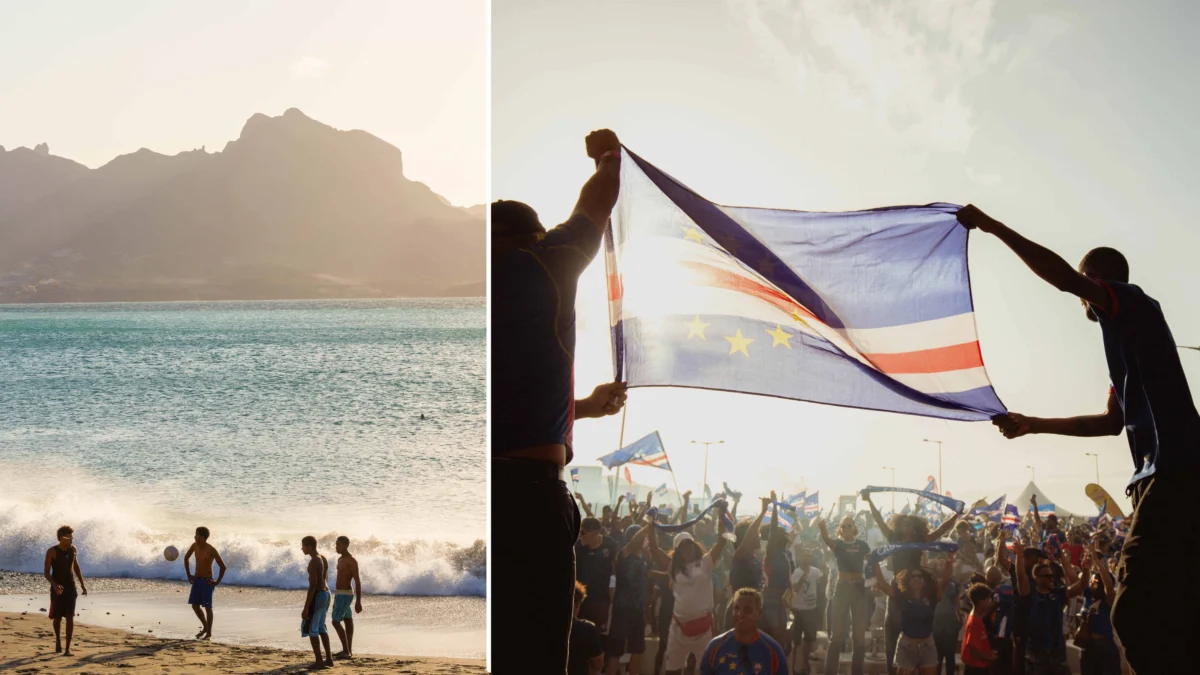
As the late afternoon sun begins its descent over the Atlantic, the cooling air signals a daily transformation on the shores of Santa Maria. In Cape Verde, a volcanic archipelago situated 500 miles off the West African coast, the end of the workday does not lead to quiet isolation but rather to the vibrant, rhythmic sounds of beach soccer. For locals like Leonardo Lopez, a 25-year-old hotel receptionist, the white sands beyond the tide’s reach become a makeshift stadium where black volcanic stones serve as goalposts and the turquoise horizon provides a backdrop for a sport that is woven into the national identity. This grassroots passion is now converging with a historic milestone: the Cape Verde national team, known as the Blue Sharks, has qualified for the 2026 FIFA World Cup for the first time in the nation’s history.
The qualification marks a watershed moment for the second-smallest nation ever to reach the global tournament. With a population of approximately 500,000, Cape Verde joins Curaçao as one of the debutants in the expanded 48-team format. The journey to the 2026 World Cup, which will be hosted across the United States, Mexico, and Canada, represents more than just athletic prowess; it is a manifestation of a culture that has long used the "freest form of the game"—beach soccer—as its primary incubator for talent.

A Historic Milestone in International Sports
The road to the 2026 World Cup has been a decade-long climb for the Cape Verdean Football Federation (FCF). The nation’s qualification in November sparked unprecedented scenes of jubilation across the islands. At Quebra Canela Beach on Santiago Island, players and fans celebrated in a collective outpouring of emotion. Sidny Lopes-Cabral, a 23-year-old professional player who stars on the national team, recalls the intensity of the moment, noting that the happiness displayed by the citizenry was unlike anything he had witnessed in his career.
Cape Verde’s opening match in the tournament will see the historic underdog face Spain, a global powerhouse and former World Cup champion. While the odds may favor the European giant, the "Blue Sharks" view the match as an opportunity to showcase the country’s unique narrative to a global audience. This narrative extends beyond the football pitch, encompassing a story of resilience, a vast global diaspora, and a transition from a colonial past to a burgeoning tourism-driven economy.
The Cultural Significance of Beach Soccer
In Cape Verde, soccer is rarely confined to manicured grass fields. The archipelago’s 600 miles of coastline serve as the primary training ground for youth and professionals alike. Beach soccer, characterized by its lack of rigid structure and emphasis on individual flair, allows players to experiment with ambitious maneuvers. On the soft sand, the risk of injury from falls is minimized, encouraging the bicycle kicks, diving headers, and intricate footwork that define the Cape Verdean style.

For professionals like Lopes-Cabral, who was born in the Netherlands to Cape Verdean immigrants, the beaches of Tarrafal were where he honed his skills during annual family visits. He now plays for a top-tier club in Lisbon, representing a full-circle moment for a member of the diaspora. The diaspora itself is a critical component of Cape Verde’s success; there are more Cape Verdeans living abroad—primarily in Portugal, the United States, and the Netherlands—than there are on the islands themselves. This global network has allowed the national team to recruit high-level talent, including players like Roberto "Pico" Lopes, who was born in Ireland but chose to represent his grandfather’s homeland.
Socio-Economic Impact and the Tourism Sector
The international spotlight provided by the World Cup is expected to provide a significant boost to Cape Verde’s economy, which is heavily reliant on tourism. Since declaring independence from Portugal in 1975, the nation has leveraged its natural beauty to build a stable middle-income economy. Tourism currently accounts for approximately 25% of the country’s Gross Domestic Product (GDP) and provides one-third of all domestic jobs.
In 2023, Cape Verde welcomed a record-breaking one million visitors, a figure that the government aims to exceed in the coming years. The infrastructure is expanding rapidly to meet this demand; at the start of 2025, over 5,000 new hotel rooms were under development across the islands. César Frederico, a restaurateur in Praia, notes that the growth of tourism has been a source of national pride, particularly given the islands’ lack of traditional natural resources like minerals or oil.

The concept of "Morabeza"—a Kriol word signifying a deep-seated, laid-back hospitality—is central to the tourist experience. Locals often invite tourists to join their beach soccer games, bridging the gap between service provider and guest. This organic interaction has helped position Cape Verde as an "authentic" destination, distinct from the more commercialized resort hubs in other parts of the world.
Historical Context and National Identity
The pride surrounding the 2026 World Cup is also rooted in the nation’s complex history. Cape Verde was uninhabited until 1462, when Portuguese traders established the first European settlement in the tropics at Cidade Velha. The site, now a UNESCO World Heritage destination, remains a haunting reminder of the islands’ role as a central hub in the transatlantic slave trade. The Forte Real de São Filipe and the 16th-century marble pillar in the town square stand as monuments to a period of profound suffering and exploitation.
Centuries of colonial neglect left the islands underdeveloped, a factor that contributed to the large-scale emigration that created the modern diaspora. However, the post-independence era has been defined by a concerted effort to reclaim the national narrative. The official language remains Portuguese, but the soul of the country is found in Kriol, the local language spoken in homes and on the soccer pitches. The national team’s new jerseys, featuring patterns inspired by inter-island flight routes, symbolize this modern, connected identity.

Strategic Implications of Global Visibility
The 2026 World Cup serves as a massive marketing platform for a country that is still unknown to many global travelers. Analysts suggest that the "World Cup effect" could lead to a diversified tourist demographic. While the majority of current visitors originate from Western Europe—specifically the UK, Germany, and France—the participation in a tournament hosted in North America is expected to increase interest from the United States and Canada.
Lina Iliano, founder of Cabo Mundo Tours, observes that more travelers are seeking island-hopping itineraries that go beyond the all-inclusive resorts of Sal and Boa Vista. They are increasingly drawn to the volcanic craters of Fogo, the lush jungle valleys of Santo Antão, and the cultural hub of Mindelo. The visibility of the national soccer team acts as a catalyst for this broader exploration, proving that the country has more to offer than just sun and sea.
Chronology of Cape Verde’s Rise
- 1462: Portuguese discovery and settlement of the islands.
- 1975: Cape Verde gains independence from Portugal.
- 1982: The Cape Verdean Football Federation (FCF) is founded.
- 2013: The national team reaches the quarter-finals of the Africa Cup of Nations (AFCON) for the first time, signaling their arrival on the continental stage.
- 2023: Cape Verde records its highest-ever tourist arrivals, surpassing one million visitors.
- November 2025: The "Blue Sharks" officially secure their place in the 2026 FIFA World Cup.
- June 2026: Cape Verde is scheduled to make its World Cup debut against Spain.
Future Outlook: Sustainability and Growth
As the nation prepares for its World Cup debut, the government and private sector are facing the challenges of rapid growth. Maintaining the "Morabeza" spirit while scaling infrastructure requires a delicate balance. Environmental sustainability is also a priority, particularly for islands like Sal and Boa Vista, where sea turtle nesting grounds and fragile coastal ecosystems are major draws for eco-tourists.

The success of the national soccer team has also sparked renewed investment in youth academies and local sports facilities. By formalizing the skills learned on the beach, the FCF hopes to create a sustainable pipeline of talent that can compete at the highest levels of European football, further strengthening the link between the islands and the global community.
In the final analysis, Cape Verde’s presence at the 2026 World Cup is not merely a sporting achievement. It is a declaration of presence by a small island nation that has transformed its historical challenges into a vibrant, modern culture. Whether the Blue Sharks win or lose against Spain, the world will see a nation that plays with the freedom of the sand and the hospitality of a people who have finally found their place on the world stage. For the regulars at Santa Maria Beach, the games will continue as they always have—until the sun sets and the ball can no longer be seen—but now, they play with the knowledge that the world is finally watching.