Reynand Wu
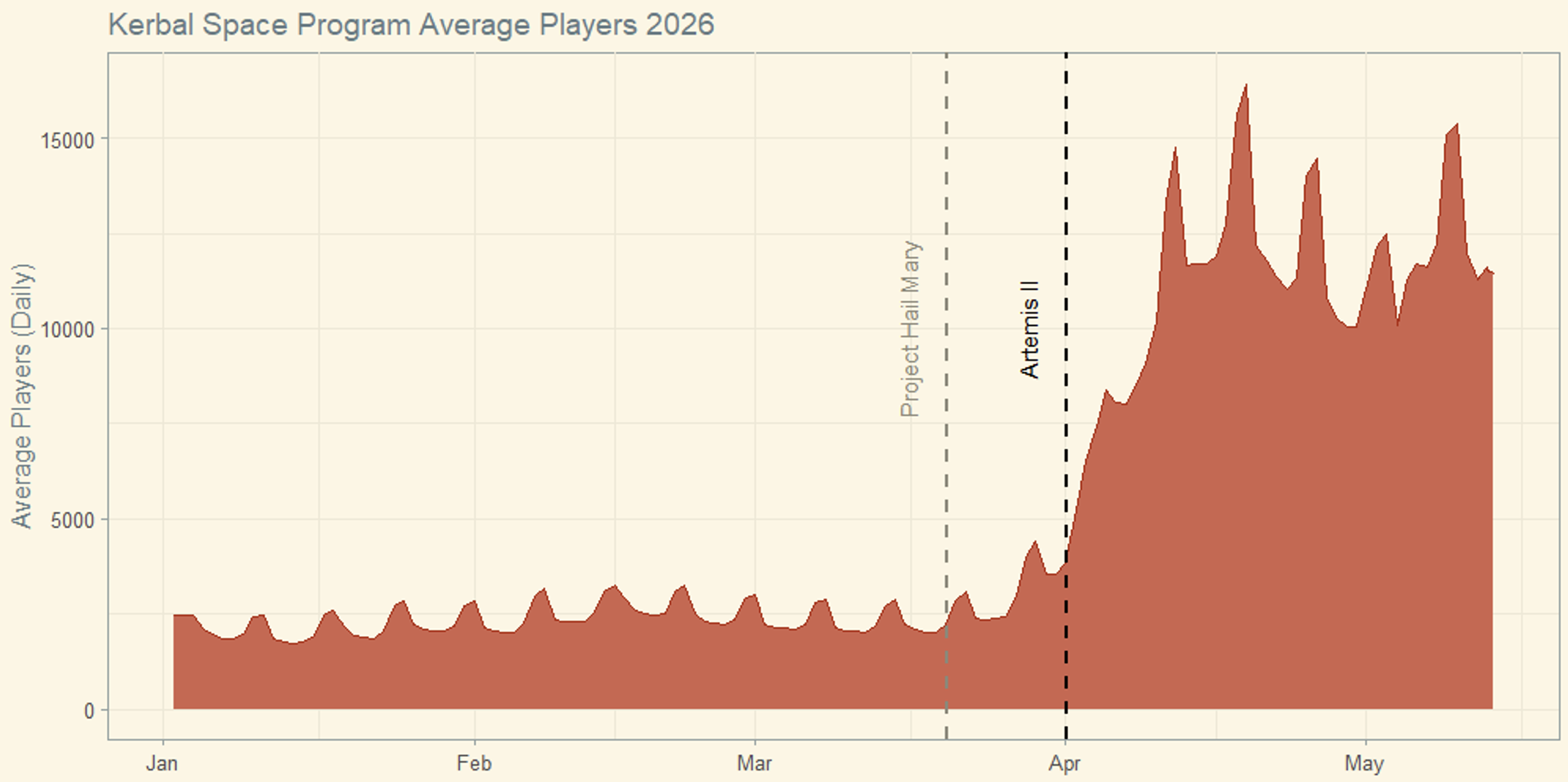
For decades, the cultural conversation surrounding video games in the United States has been dominated by moral panic, focusing disproportionately on the potential for violent content to influence real-world behavior. From the 1990s legislative hearings regarding titles like Mortal Kombat to the intense scrutiny of the 2010s regarding the realism of military-themed shooters, the medium has often been treated as a social risk. However, this narrow perspective frequently ignores the capacity of digital interactive experiences to foster social joy, scientific literacy, and communal optimism. A striking case study in this shift is the recent, anomalous resurgence of the spaceflight simulator Kerbal Space Program (KSP), which has seen a fivefold increase in its active user base during the spring of 2026. This trend suggests that video games function not merely as escapist entertainment, but as vital "testing grounds" that mirror and amplify public interest in real-world technological frontiers.
A Chronology of Space-Age Enthusiasm
The surge in KSP’s popularity did not occur in a vacuum; it followed a specific trajectory of high-profile events that reignited global interest in space exploration. In early 2026, the cultural appetite for aerospace topics reached a saturation point, driven by a convergence of media and state-led initiatives.
The timeline began in early March 2026, as anticipation mounted for the release of the cinematic adaptation of Andy Weir’s Project Hail Mary. Upon its release, the film achieved significant commercial success, grossing over $655 million globally. Unlike dystopian sci-fi tropes, the narrative focused on scientific cooperation and the optimistic potential of humanity to solve existential problems through physics and engineering. This served as a catalyst for a broader cultural conversation about space travel.
Shortly thereafter, in April 2026, NASA successfully executed the Artemis II mission. As the first crewed flight to orbit the Moon since the Apollo era, the mission captured the imagination of the public, with millions tuning into live broadcasts. By sending four astronauts further into deep space than any human had traveled in over five decades, the mission provided a tangible, real-world anchor for the themes explored in science fiction. SteamDB data indicates that KSP’s player counts began to mirror this momentum, showing a sustained, steep upward curve that defied the typical "decay" of active users for a title of its age.
The Sociology of Play as a Cultural Barometer
Sociologists have long utilized the concept of "play" as a lens to understand human behavior and societal values. The work of Georg Simmel and Erving Goffman established the idea that play is a highly structured form of social interaction, governed by implicit rules and performances. In this context, gaming is not an isolated activity but a social ritual that mirrors the complexities of the workplace or civic competition.
Johan Huizinga, in his seminal work Homo Ludens, posits that play is, in fact, a foundational element of civilization. Huizinga argued that play exists as a distinct, protected space where individuals can test the boundaries of reality without the immediate, irreversible consequences found in "serious" life. This framework is essential to understanding the appeal of KSP. The game’s mechanics require players to grapple with genuine orbital mechanics—Delta-V, TWR (Thrust-to-Weight Ratio), and gravitational slingshots—within a cartoonish, forgiving environment. When a player’s spacecraft explodes on the launchpad, it is a failure, but it is a failure that encourages iterative learning and experimentation.
Thomas S. Hendricks, in his study of human emotions and society, further refines this by describing play as a "test ground." In KSP, the objective is not simply to "win" a match, but to master a process. This process-oriented engagement allows players to cultivate an awareness of their own capabilities, turning the frustration of a failed orbital insertion into a lesson in Newtonian physics. This aligns with modern educational theories that favor "productive failure," where the struggle to reach a goal is more valuable than the goal itself.
Economic and Educational Implications
The juxtaposition of the multi-billion-dollar Artemis program and the modest $40 price tag of a simulator like KSP offers a compelling perspective on the democratization of aerospace engagement. While the state-funded missions provide the infrastructure and the vision, digital platforms provide the accessibility.
Industry analysts suggest that the rise in simulation-based gaming represents a shift in consumer demand toward "meaningful play." As users spend more time in environments that simulate complex engineering tasks, they are effectively engaging in a low-stakes form of scientific literacy training. Even if only a small percentage of these players transition into formal careers in STEM, the collective impact on public support for space exploration is significant.
There is an inherent "social joy" found in shared gaming experiences. Online communities, such as the active KSP subreddit, function as hubs for knowledge sharing. When a player celebrates their first successful landing on "the Mun," they are not just reporting a digital achievement; they are participating in a communal rite of passage. These interactions reinforce the idea that science is not just the domain of government agencies, but an accessible frontier for the public.
Implications for Future Policy and Media
The sustained popularity of KSP serves as a data point for policymakers and educators looking to engage the public in complex, long-term technological goals. If video games are viewed as a "leading indicator" of interest in scientific and exploration-based endeavors, then the success of titles like KSP should be categorized as an asset rather than a distraction.
Furthermore, the data suggests that the public has a high threshold for complexity. Despite the "brutally punishing" nature of orbital physics in the game, the player base continues to grow. This contradicts the long-held assumption that mass-market entertainment must be simplified to achieve success. Instead, it appears that when a game provides a sense of purpose—such as the noble goal of exploring the solar system—users are willing to invest considerable effort into mastering its systems.
In conclusion, the resurgence of Kerbal Space Program provides a unique window into the current state of public sentiment. By moving past the outdated moral panics that have historically plagued the gaming industry, we can begin to appreciate these digital spaces for what they are: sophisticated platforms for experimentation, learning, and the cultivation of a collective, optimistic vision for the future of space travel. As the gap between digital simulation and real-world achievement continues to narrow, the role of interactive media in shaping the next generation of scientists, engineers, and space enthusiasts will only become more pronounced. Whether this spike in player numbers marks a permanent shift or a temporary enthusiasm, the takeaway remains clear: when given the tools to reach for the stars, even in a virtual capacity, people will consistently choose to do so.