Ana Megawati
In a significant illustration of evolving family structures and advancements in reproductive technology, a lesbian couple, Rosa and Leah, recently welcomed their daughter, Mara, into the world via reciprocal In Vitro Fertilization (IVF). This method, which involves one partner providing the eggs and the other carrying the pregnancy, is gaining traction among queer individuals seeking biological and gestational connections to their children. Their journey, culminating in the birth of their 6lb 10oz daughter on a warm October day, highlights both the profound joys and the unique complexities inherent in modern family building for same-sex couples.
Understanding Reciprocal IVF: A Path to Shared Parenthood
Reciprocal IVF, often referred to as "partner-assisted IVF" or "co-maternity IVF," is a fertility treatment specifically designed for cisgender lesbian couples or trans male individuals with ovaries who wish to share the biological and gestational experience of parenthood. Unlike conventional IVF, where the embryo is typically transferred back into the body of the person who provided the eggs, reciprocal IVF involves a "body swap." Eggs are retrieved from one partner (the genetic mother), fertilized with donor sperm, and the resulting embryo is then transferred into the uterus of the other partner (the gestational mother). This process allows both partners to have a direct, tangible role in the creation of their child.
The increasing adoption of reciprocal IVF reflects a broader societal shift towards recognizing diverse family formations and the desire of LGBTQ+ individuals to experience biological parenthood. According to data from the Society for Assisted Reproductive Technology (SART), the number of IVF cycles performed for same-sex female couples has steadily risen over the past decade. While specific statistics for reciprocal IVF alone are not always disaggregated, its growth is a notable subset of this trend, driven by its unique ability to foster a shared biological experience. Medical experts note that the procedure offers not only a genetic link for one parent and a gestational link for the other but also involves subtle biological intertwining. Emerging fields like epigenetics explore how the uterine environment of the gestational parent can influence gene expression in the embryo, effectively acting as a "gene DJ," while microchimerism describes the enduring exchange of cells between mother and baby through the placenta, creating a lasting cellular connection.
The Journey to Parenthood: A Chronology of Intentional Choices
For Rosa and Leah, the decision to pursue reciprocal IVF was made years prior, during early discussions about building a family. Recognizing the inherent challenges for same-sex couples, often termed "social infertility" due to the absence of compatible gametes from partners, they sought a path that would provide both an "irrefutable relationship" with their future children and a balanced, mutual experience. Their initial hope was a sequential process: Leah carrying Rosa’s embryo first, followed by Rosa carrying Leah’s.

A critical early step was the selection of a sperm donor. Opting for a "known donor" rather than an anonymous sperm bank, the couple embarked on a thoughtful and intentional search. Their criteria extended beyond typical genetic considerations, focusing on personal qualities such as "knowability," emotional stability, and access to joy. This preference for a known donor reflects a growing trend among LGBTQ+ families who prioritize transparency and a connection for their children with their genetic origins. After discreet inquiries among their social circle, a close friend emerged as the ideal candidate, enthusiastically embracing the role of a godfather figure. This choice necessitated extensive legal and medical preparations, including comprehensive tests, counseling sessions, and the drafting of detailed consent forms and contracts to define the donor’s role and parental rights clearly.
The medical phase of their journey was meticulously choreographed. Rosa and Leah underwent egg retrievals less than 24 hours apart, a remarkable synchronicity attributed by the couple to their menstrual cycles aligning on the same day. These eggs were then fertilized with their chosen donor’s sperm in a Manhattan petri dish, initiating the crucial waiting period characteristic of IVF. This stage is fraught with uncertainty, as the number of viable embryos diminishes from fertilization to the critical five-day blastocyst stage. For couples undergoing reciprocal IVF, an additional layer of contemplation arises: the emotional impact if the process is successful for one partner’s eggs but not the other’s.
In January, after navigating the uncertainties of embryo development, one of Rosa’s embryos was successfully transferred into Leah’s uterus. The couple, like many others seeking an extra layer of luck, engaged in the popular fertility tradition of eating McDonald’s fries post-transfer, then endured a tense 10-day wait. The confirmation of pregnancy, received unexpectedly in the bathroom of the Metropolitan Museum of Art, was met with a sense of shock despite the immense planning and effort invested. This moment marked the tangible beginning of their family and the commencement of their distinct experiences of pregnancy.
Navigating the Pregnancy: Unique Dynamics of a Shared Experience
The pregnancy brought with it a unique dynamic for Rosa and Leah, illustrating the distinct roles of genetic and gestational parents in reciprocal IVF. While Leah, as the gestational mother, experienced the profound and continuous physical changes of pregnancy, Rosa, the genetic mother, found herself in a more observational role, which she lightheartedly termed "Dad-land." This period, characterized by physical distance from the immediate physiological experience of pregnancy, presented its own emotional complexities.
Medical professionals and counselors specializing in LGBTQ+ family building often highlight these differing experiences. The gestational parent endures morning sickness, fatigue, and the physical transformation of their body, while the genetic parent witnesses these changes without directly experiencing them. This can lead to feelings of helplessness or a desire to share the burden, as Rosa articulated: "I’d want to be able to take the discomfort into my own body. And yet I couldn’t and I hadn’t." Despite these challenges, Leah embraced her pregnancy with remarkable vitality, remaining active and largely free from common discomforts, which Rosa playfully noted set "outrageously high standards" for her own future gestational journey.
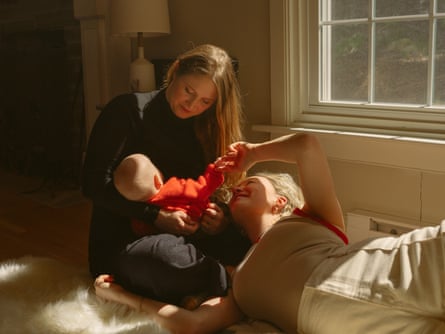
Societal perceptions and the need for greater understanding were also evident during this period. The couple frequently found themselves explaining their family-building method, a necessity born from the relative novelty of reciprocal IVF and the scarcity of visible role models. This proactive sharing of their story, including long-distance phone calls and shared Google documents with inquiring queer couples, underscores the demand for information and community support within the LGBTQ+ population. Interestingly, friends often "forgot" the couple’s inability to conceive naturally, making comments about combining their genetic traits, which speaks to a broader societal default towards heterosexual reproductive norms. Rosa’s occasional affectionate labeling as "the dad" at birth classes also reflected these evolving, and sometimes humorous, attempts to categorize non-traditional family roles.
The Arrival of Mara: A Testament to Modern Family Building
As spring transitioned into summer, Leah experienced the "quickening," the first discernible movements of the baby within her. For Rosa, a period of separation from Leah meant that upon her return, the pregnancy was undeniably visible. The moment she first felt Mara move, described as "a shock, like a finger had flicked me from within," was a profound turning point, dissolving any lingering sense of injustice about the need for external intervention in their family-making process. The reality of their child’s impending arrival solidified the bond, making the baby "so clearly ours."
On that warm October day, their daughter, Mara, was born. Rosa supported Leah, holding her hand and head, as Mara emerged. The physical appearance of their newborn, with blond hair and a resemblance to Rosa, particularly when she frowned, immediately reinforced the genetic connection. More importantly, the experience of holding Mara and gazing into her newborn eyes transcended any theoretical fears about parental identity or connection. The deep love and instant bond they felt confirmed the profound truth: parenthood is forged not solely by genetics or gestation, but by love, commitment, and shared experience.
The initial fears Rosa harbored about family acceptance, particularly concerning grandparents, proved "deeply unfounded." Leah’s mother’s "purer love" for Mara exemplified the powerful, unconditional bonds that transcend biological definitions. This widespread acceptance and affection underscore a growing understanding and embrace of diverse family structures within wider society.
Broader Implications and Challenges for Queer Families
While the personal narrative of Rosa and Leah is one of profound joy and success, it also illuminates significant broader implications and ongoing challenges for queer families pursuing reciprocal IVF and other assisted reproductive technologies.

Medical Considerations: For couples like Rosa and Leah, whose "infertility" is purely social, the medical invasiveness of IVF is a significant consideration. IVF pregnancies, in general, are associated with slightly higher risks than naturally conceived pregnancies, and being a gestational carrier (even for one’s partner) introduces additional medical complexities that are still "understudied" when specifically applied to same-sex female couples. Further research is needed to fully understand the health outcomes and specific risks in this context.
Legal Hurdles and Parental Rights: One of the most critical challenges highlighted is the disparity in legal recognition for same-sex parents. Despite both partners being intimately involved in Mara’s conception and birth, Rosa, as the non-gestational parent, faces the "expensive and simply strange" necessity of adopting her own daughter. This "second-parent adoption" process, required in many jurisdictions even when both parents are on the birth certificate, underscores the legal system’s slow adaptation to modern family structures. Legal scholars and LGBTQ+ advocates consistently push for reforms that grant automatic parental rights to both partners in a same-sex couple who conceive via assisted reproduction. The article also touches upon the alarming reality of international travel, where same-sex parents must sometimes plan routes that allow them to "pass for straight" in countries where being gay is illegal, a stark reminder of the global political landscape affecting LGBTQ+ families.
Social and Political Context: The act of forming a family through reciprocal IVF is, for many queer couples, inherently political. As Rosa notes, "Seismic shifts towards conservatism make having a family like ours feel political." Each birth within an LGBTQ+ family contributes to increased visibility and normalization, challenging traditional definitions of family and advocating for broader acceptance and legal protections. The lack of "models" and the constant need to explain their process reveal an ongoing societal learning curve, but also a powerful opportunity for education and advocacy.
Paving the Way: The Future of Reciprocal IVF
The experience of Rosa and Leah underscores that reciprocal IVF is not merely a "mimic or replication" of heterosexual reproduction but "very much its own thing." It represents a unique intertwining of biological and emotional connections, fostering a profound sense of mutuality and shared creation. The balance and symmetry of the process – one partner providing the genetic material, the other the gestational – resonate deeply with couples seeking a truly shared experience of parenthood. The couple’s anticipation of a second child, where Rosa will carry Leah’s embryo, further exemplifies this commitment to shared experience and the reciprocal nature of their family building.
The journey of families like Rosa and Leah contributes significantly to the ongoing evolution of family law, medical practice, and social understanding. Their willingness to openly discuss their process serves as an invaluable resource for other queer couples considering similar paths, offering both practical guidance and emotional solidarity. As more families are formed through reciprocal IVF, the demand for equitable legal frameworks, comprehensive medical research, and inclusive societal narratives will continue to grow. The "delightful project of mutuality" that Rosa’s philosopher friend described is not just a personal endeavor but a powerful force shaping the future of family in a diverse and interconnected world.