Jono Maryono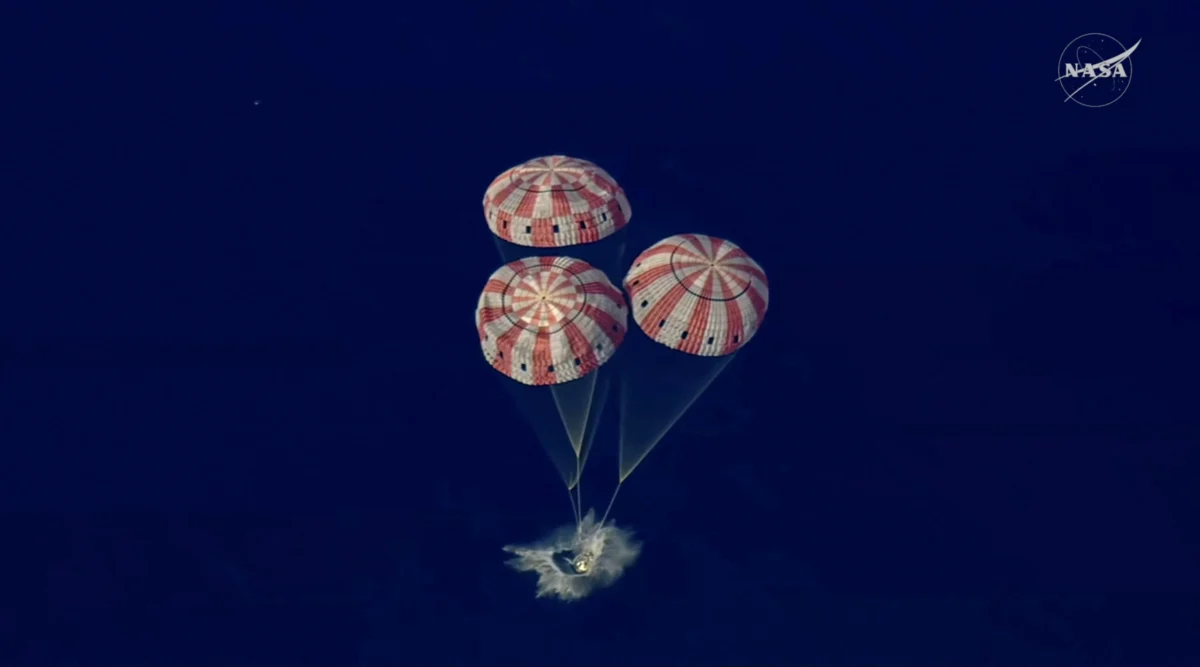
The Artemis II astronauts have successfully splashed down in the Pacific Ocean, marking the triumphant conclusion of a 10-day mission that carried humans around the Moon and back for the first time in over half a century. The Orion capsule, carrying Commander Reid Wiseman, Pilot Victor Glover, Mission Specialist Christina Koch, and Canadian Space Agency astronaut Jeremy Hansen, executed a high-speed re-entry through Earth’s atmosphere, a critical phase that rigorously tested the spacecraft’s formidable heat shield. Recovery teams, strategically positioned off the coast of California, were on hand to retrieve the crew following their safe landing at 5:07 PM Pacific Time (00:07 GMT). The astronauts will now undergo comprehensive medical evaluations before their return to NASA’s Johnson Space Center in Houston, Texas.
This landmark mission represents a pivotal step in NASA’s ambitious Artemis program, which aims to re-establish human presence on the Moon and eventually pave the way for crewed missions to Mars. The Artemis II voyage, launched from Florida’s Kennedy Space Center, pushed the boundaries of human space exploration, with the crew traveling farther into space than any human has previously ventured. Their journey included a daring loop around the far side of the Moon, a region seldom seen by human eyes, and provided invaluable real-world data on the performance of Orion’s systems in the deep space environment.
A Mission of Firsts and Technical Milestones
The return of the Artemis II crew signifies the first time humans have journeyed to lunar vicinity since the Apollo 17 mission in 1972. Beyond this historic feat, the mission was punctuated by several significant "firsts" that resonate deeply within the global space exploration community. Victor Glover made history as the first person of color to travel around the Moon. Christina Koch, a veteran of long-duration spaceflight, became the first woman to undertake such a lunar journey. Adding to the international significance, Jeremy Hansen of the Canadian Space Agency became the first non-American to venture this far from Earth.
During their 10-day expedition, the astronauts provided captivating real-time updates, describing the stark beauty of the lunar surface and sharing breathtaking views of celestial phenomena. They witnessed a solar eclipse from an unparalleled vantage point and observed the distant impacts of meteorites, offering a unique perspective on the dynamic nature of our solar system. Mission Commander Reid Wiseman articulated the profound sentiment shared by the crew: "What we really hoped in our soul is that we could, for just a moment, have the world pause – and remember that this is a beautiful planet in a very special place in our universe. We should all cherish what we have been gifted."

The Rigors of Re-entry and the Performance of Orion
The journey back to Earth presented one of the most demanding phases of the mission: atmospheric re-entry. As the Orion capsule plunged through Earth’s atmosphere at speeds approaching 25,000 miles per hour, friction generated intense heat, creating a plasma sheath around the spacecraft. This phenomenon temporarily interrupted communications, a phenomenon known as a communication blackout, which lasted for approximately two minutes. This period is a critical stress test for the Orion capsule’s heat shield, designed to withstand temperatures of up to 5,000 degrees Fahrenheit (2,760 degrees Celsius). Engineers will now meticulously analyze data from this re-entry phase, focusing on the thermal protection system’s performance, alongside data from navigation systems, life-support technology, and other critical onboard components. The success of this re-entry is paramount for the safety of future Artemis missions, particularly those targeting the lunar surface.
A Stepping Stone to the Lunar Surface
The Artemis II mission, while not involving a lunar landing, served as an indispensable precursor to more complex future endeavors. It is widely regarded as a crucial test flight for the subsequent Artemis missions, most notably Artemis IV, which is slated to land astronauts on the Moon for the first time since the Apollo era. The data gathered from Artemis II will be instrumental in refining operational procedures, validating spacecraft systems, and ensuring the safety and success of these ambitious lunar landings. This includes rigorous analysis of the Orion capsule’s environmental controls, its ability to navigate in deep space, and its capacity to protect astronauts during prolonged missions.
Chronology of the Artemis II Mission
- Launch: The Artemis II mission commenced with the successful launch of the Orion spacecraft atop a Space Launch System (SLS) rocket from Kennedy Space Center in Florida. This marked the beginning of a 10-day journey into lunar space.
- Lunar Flyby: The crew performed a precise trajectory that took them around the Moon, providing stunning views and extensive data collection opportunities. This included a flyby of the far side of the Moon, a region that has been visited by robotic probes but not by humans in over five decades.
- Deep Space Systems Check: Throughout their journey, the astronauts rigorously tested various onboard systems in the harsh environment of deep space. This included communications, navigation, and life support, ensuring their reliability for future, more extended missions.
- Return Trajectory Initiation: After completing their lunar objectives, the crew initiated the burn necessary to set Orion on a direct trajectory back to Earth.
- Atmospheric Re-entry: The Orion capsule endured a high-speed re-entry into Earth’s atmosphere, a critical phase involving intense heat and a temporary communication blackout.
- Splashdown: The mission concluded with a successful parachute-assisted splashdown in the Pacific Ocean, where recovery teams awaited to retrieve the crew and the Orion capsule.
Broader Implications and Future Prospects
The success of the Artemis II mission reverberates beyond the immediate achievement of a lunar flyby. It injects renewed optimism and tangible progress into the broader goals of space exploration. The data gleaned from this mission will directly inform the development and execution of Artemis III, which aims to land the first woman and the first person of color on the lunar surface. This, in turn, is a critical stepping stone towards NASA’s long-term vision of human exploration of Mars.
The international collaboration demonstrated by the inclusion of a Canadian astronaut highlights the growing trend of global partnerships in space exploration, fostering a shared sense of purpose and pooling resources for ambitious undertakings. Furthermore, the mission’s success underscores the critical role of public engagement. NASA has been actively involving the public through various initiatives, including sending daily songs to the astronauts to uplift their spirits. On the day of their return, the astronauts awoke to Live’s "Run to the Water" and Zac Brown Band’s "Free," a testament to the human element of these monumental missions.
The images and experiences shared by the Artemis II crew serve as powerful reminders of humanity’s place in the cosmos and the importance of preserving our home planet. As engineers begin the meticulous analysis of the mission’s data, the world looks forward to the next chapter in humanity’s return to the Moon, propelled by the courage and ingenuity demonstrated by the Artemis II astronauts. The Orion capsule, having weathered the rigors of deep space and atmospheric re-entry, stands as a testament to human innovation and our enduring drive to explore the unknown.