Ronny Sianturi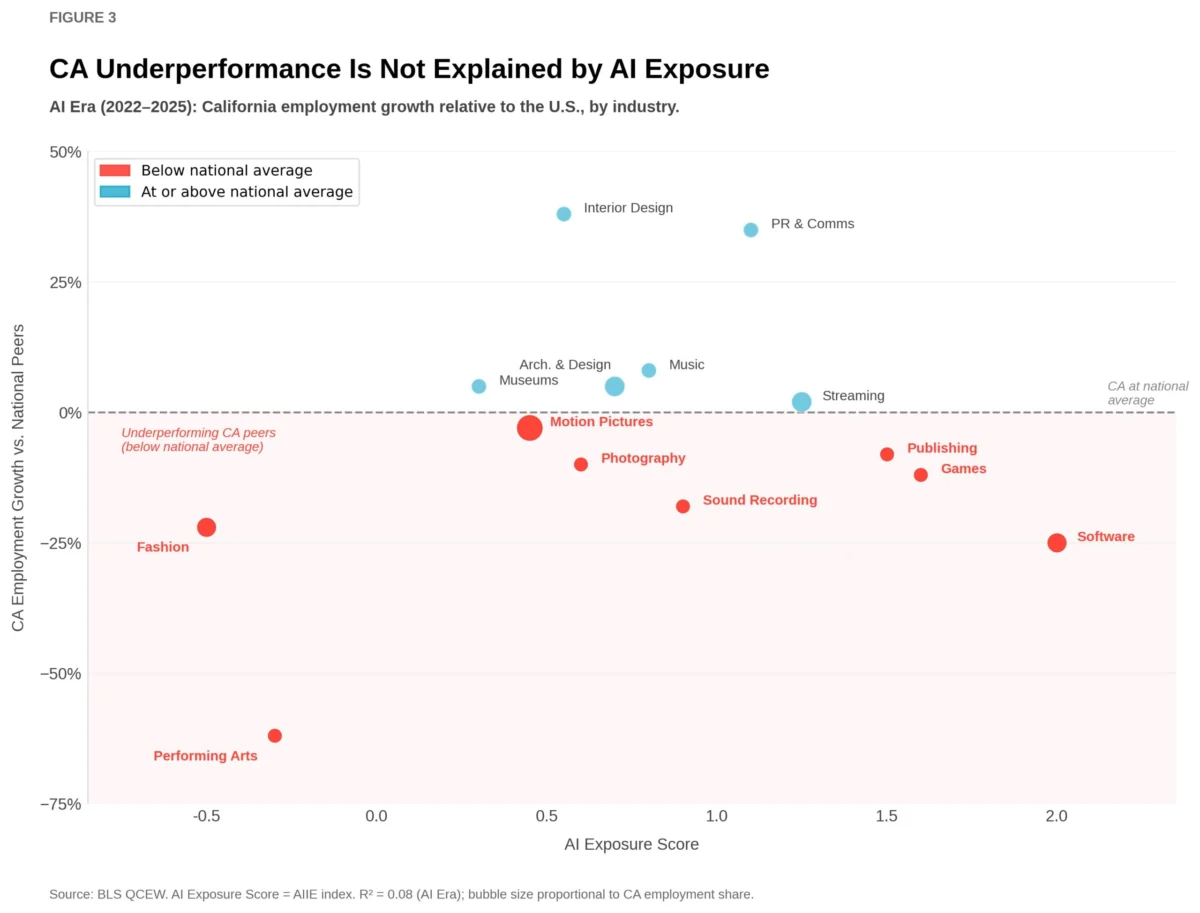
A comprehensive new report from the Otis College of Art and Design, in collaboration with Westwood Economics and Planning Consultants, has delivered a stark assessment of California’s creative economy, revealing a significant contraction in jobs between 2022 and 2025. Contrary to prevailing anxieties, the study asserts that the precipitous decline in creative employment, particularly within the film, television, and traditional media sectors, cannot be attributed to the advent and rapid advancement of generative artificial intelligence (AI). Instead, the research points to a confluence of economic pressures, including budget cuts and the ongoing restructuring of major entertainment conglomerates, as the primary drivers behind the workforce reduction.
The report, titled "Creative Disruption: AI and California’s Creative Economy: 2022-2025," meticulously analyzes employment trends across California’s diverse creative industries, encompassing film, fashion, gaming, media, advertising, arts, and architecture. Its findings challenge the narrative that generative AI, popularized by the release of tools like ChatGPT in 2022, is directly displacing human workers. Instead, the study posits that AI is fundamentally altering the nature of creative work, rather than eliminating entire roles. This period of contraction coincided with a pivotal shift in Hollywood’s business model, as major studios and streaming services pivoted towards profitability, leading to a widespread recalibration of budgets and operational strategies.
The Scale of the Decline: A Deep Dive into Job Losses
Between 2022 and 2025, California’s vibrant creative economy experienced a substantial downturn, shedding approximately 14% of its workforce, which equates to a loss of 114,000 jobs. The most significant impacts were felt in two key sectors:
- Film, Television, and Sound: This cornerstone of California’s creative output saw a dramatic reduction of nearly 30% in employment during the report’s timeframe. This decline signifies a substantial retrenchment in an industry historically characterized by robust job creation.
- Traditional Media: This sector, encompassing print journalism, radio, and older forms of broadcasting, experienced an even steeper decline, with a nearly 34% loss in jobs. This highlights the ongoing challenges faced by established media formats in an increasingly digital landscape.
These figures paint a clear picture of an industry grappling with profound structural changes. The period under review was marked by an unprecedented wave of mergers and acquisitions among major media conglomerates, a trend aimed at consolidating market share and streamlining operations. This consolidation often led to the elimination of redundant positions and a general tightening of belts across various departments. Simultaneously, the streaming wars, which had fueled massive content production in the preceding years, began to mature, with a renewed focus on subscriber retention and profitability rather than unchecked growth. This strategic pivot resulted in a more conservative approach to content budgets, directly impacting staffing levels.

Dispelling the AI Myth: What the Data Reveals
The Otis College report directly confronts the burgeoning concern that generative AI is the primary culprit behind these job losses. Patrick Adler, co-author of the report and founding partner of Westwood Economics and Planning Consultants, stated unequivocally, "The pattern of job loss in terms of the types of jobs that are being lost and when they’re being lost does not support the fact that there’s been this displacement of workers by AI."
Further bolstering this assertion, the report highlights a counterintuitive trend: the very occupations most frequently cited as vulnerable to AI – writers, software developers, and artists – have, in fact, seen an increase in job postings and a growth in their numbers within California’s creative economy during the specified period. This suggests that while AI may be influencing how these roles are performed, it is not leading to their wholesale elimination.
The research employed a dual methodology, combining quantitative analysis of public data with qualitative assessments derived from in-depth interviews with creative professionals. This comprehensive approach allowed for a nuanced understanding of the complex factors at play. Taner Osman, the other co-author, contributed to the report’s rigorous examination of both the macro-economic trends and the on-the-ground realities faced by workers.
The True Drivers of Workforce Reduction
According to the report, the significant job losses are more accurately explained by a combination of factors:
- Cost-Driven Displacement of Lower-Paying Roles: The high cost of living in California has, over time, contributed to a natural attrition of workers in lower-paying creative positions who seek more affordable locales. This gradual exodus, while not directly linked to AI, has nonetheless thinned certain segments of the workforce.
- Structural Changes Within Creative Sectors: Beyond the broad industry shifts, specific structural changes have disproportionately affected California. The report points to the aftermath of the "Peak TV" era, a period of hyper-production that led to unsustainable cost structures. As the market recalibrated, significant budget cuts were implemented, impacting a wide array of creative roles.
- Consolidation and Efficiency Drives: The wave of mergers and acquisitions in the media landscape inevitably led to redundancies. Companies sought to leverage their expanded scale to achieve greater operational efficiencies, which often translated into workforce reductions.
AI’s Evolving Role: Augmentation, Not Annihilation
A crucial finding of the report is that generative AI, in its current implementation within creative industries, appears to be augmenting human capabilities rather than replacing them entirely. Interviews with creative professionals revealed a consistent theme: no respondent reported AI having replaced an entire role or workflow. Instead, AI is being deployed for specific, well-defined tasks where its output is verifiable, time savings are demonstrable, and the quality meets established expectations.

One illustrative example cited in the report pertains to post-production in film and television. AI tools can efficiently handle tasks such as rotoscoping and wire removal, which are often repetitive and time-consuming. However, these tools currently struggle with more nuanced and creative aspects of the process. Furthermore, the need to meticulously check and correct AI-generated output is creating new avenues for human labor.
One VFX company owner shared a telling anecdote: "They have 15 artists that are sitting at workstations fixing the AI… When you multiply the rate of the artists by 15 and put that against the cost of the work you’re doing, it negates any savings that AI is giving you." This suggests that while AI can offer efficiencies, the human oversight and refinement required can offset any perceived cost benefits, particularly in high-stakes creative projects.
Worker Agency and the Ethics of AI
The report also underscores the significant agency that creative workers possess in shaping the integration of generative AI into their fields. While they may operate within organizational guidelines, the direct application of AI tools often rests with the individual worker. This dynamic fosters diverse responses to the technology.
"A worker who believes in the technology will iterate patiently; a skeptical one may conclude that AI is not yet able to perform a particular task. Both views were present among interviewees," the authors note. Concerns about the ethical implications of AI use were prevalent, with some workers even choosing to conceal their use of AI for fear of being perceived as expendable.
Despite the lack of direct job displacement, the report acknowledges that AI is indeed transforming the nature of creative work. Interviewees reported increased productivity expectations, a perceived shift in management investment from human collaborators to AI tools, and pressure to produce work that may be of lower overall quality.

A motion creative director quoted in the study reflected on a concerning trend: "The creative director said, ‘At a certain point, you just have to say it’s good enough,’ which I think is the biggest danger of AI. We lower our standards." This sentiment highlights a potential erosion of creative quality and artistic integrity as efficiency and cost-saving measures take precedence.
Recommendations for a More Trusting Adoption
The authors of the report offer actionable recommendations for creative organizations to navigate the evolving landscape of AI integration. They advocate for a cautious and deliberate approach to implementing AI tools, emphasizing the importance of addressing the skepticism and uncertainty felt by many creative professionals.
Key to fostering a more positive and productive integration of AI is the creation of an environment where workers feel secure in their roles. The report suggests implementing policies such as firing freezes to alleviate concerns about AI adoption leading to job elimination. "Workers who know they will not be adopting themselves out of a job will experiment more openly, share insights more freely, and invest genuine effort into making AI tools work," the authors explain.
Patrick Adler further elaborated on this point: "There’s pretty good evidence that we’re uncovering that AI adoption would be a lot faster, a lot deeper if creative workers had more trust in it." Building this trust requires transparent communication, collaborative implementation strategies, and a clear commitment to valuing human creativity and expertise alongside technological advancements.
The findings from Otis College of Art and Design provide a critical counterpoint to the widespread fear that generative AI is poised to decimate creative workforces. While the industry has undoubtedly faced significant challenges and job losses, attributing these solely to AI oversimplifies a complex economic and technological transition. The report offers a more nuanced perspective, highlighting the interplay of economic forces and the evolving role of AI as a tool that, when implemented thoughtfully and ethically, can augment human creativity rather than replace it. The future of California’s creative economy, the study suggests, hinges on fostering collaboration, transparency, and trust between human talent and emerging technologies.