Layla Zulfa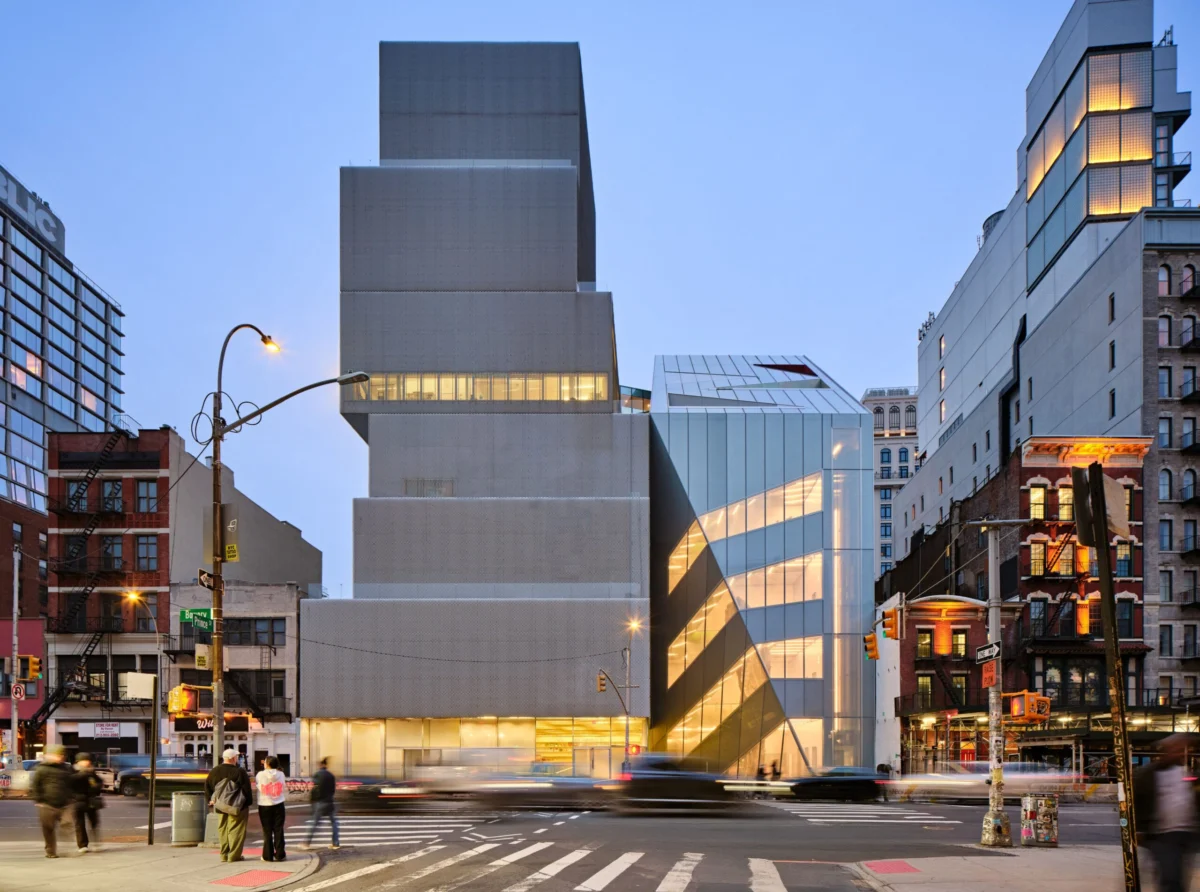
The New Museum of Contemporary Art has reached a pivotal milestone in its storied history with the completion of its highly anticipated building expansion on Manhattan’s Lower East Side. This architectural development, designed by the internationally acclaimed firm OMA, marks the culmination of a decades-long transformation of the institution from a niche experimental space into a cornerstone of the global contemporary art world. As the museum prepares to debut its new glass-clad addition, it also stands at the threshold of a significant leadership change, with longtime director Lisa Phillips set to retire in April. The expansion not only doubles the museum’s exhibition space but also serves as a physical manifestation of the institution’s enduring commitment to innovative, early-career artists—a mission that has remained constant since its founding in the late 1970s.
The Architectural Legacy of the Bowery Site
To understand the significance of the current expansion, one must look back to the museum’s 2007 relocation to the Bowery. Founded in 1977 by Marcia Tucker, the New Museum spent its early years in various locations, including a notable stint in SoHo. However, it was the move to 235 Bowery that redefined its identity. At the time, the Bowery was far from the gentrified cultural corridor it is today; it was a neighborhood characterized by industrial grit and a history as New York’s "skid row."
The museum’s choice of the Japanese architecture firm SANAA, led by Kazuyo Sejima and Ryue Nishizawa, was a bold move. At the time, SANAA was not yet the household name in architecture it would become after winning the Pritzker Prize in 2010. The firm’s design—a series of stacked, off-kilter stucco boxes wrapped in a galvanized zinc-plated steel mesh—was a radical departure from traditional museum architecture. It was designed to maximize a narrow footprint while responding to the height restrictions and industrial character of the neighborhood. The "dull gray" mesh exterior allowed the building to shimmer under certain lights while maintaining a rugged, almost utilitarian presence that mirrored the then-unpolished Bowery.
Despite the critical acclaim of the SANAA building, its limitations became apparent almost immediately upon its 2007 opening. With only 58,700 square feet of total space, the museum found itself constrained by its own success. The gallery floors, while aesthetically striking, were often overcrowded, and the lack of dedicated space for education, community programming, and circulation hampered the institution’s growth. Lisa Phillips, who took the helm as director in 1999, recognized early on that the museum’s ambitions would eventually outpace its physical boundaries.

A New Vision: The OMA Expansion
In 2016, the New Museum announced plans to expand into the adjacent 50-foot-wide lot at 231 Bowery, a property it had acquired nearly a decade earlier. For this next chapter, the museum turned to OMA (Office for Metropolitan Architecture), the firm co-founded by Rem Koolhaas. The project was led by Shohei Shigematsu, the partner-in-charge of OMA’s New York office, whose portfolio includes significant cultural projects such as the expansion of the Albright-Knox Art Gallery and the Sotheby’s headquarters.
Shigematsu’s challenge was to create a structure that complemented the iconic SANAA building without mimicking it. The result is a glass-covered tower that functions as a prismatic counterpoint to the original "stack of boxes." While the SANAA building is opaque and monolithic, the OMA addition is transparent and communicative. The new structure features an angled facade that pulls away from the original building, creating a sense of visual tension and dynamism.
A central feature of the OMA design is the inclusion of a complex switchback stairway and a soaring atrium. This architectural "magic trick," as described by Phillips, allows the building to house significant volume while appearing slender and light from the street. The addition adds approximately 40,000 square feet of space, including four floors of new gallery space that seamlessly connect to the existing SANAA galleries. These connections were achieved by strategically removing sections of the original building’s cinder-block side wall, allowing for a fluid transition between the old and the new.
Chronology of Institutional Growth
The expansion is the latest entry in a timeline of strategic growth that has seen the New Museum evolve from a small alternative space into a major international destination:
- 1977: Marcia Tucker founds the New Museum with a focus on living artists and work that has not yet gained mainstream acceptance.
- 1983: The museum moves to the Astor Wine & Spirits Building in SoHo.
- 1999: Lisa Phillips is appointed director, ushering in an era of unprecedented fundraising and expansion.
- 2002: SANAA is selected to design the museum’s first dedicated home on the Bowery.
- 2007: The SANAA-designed building opens to the public, winning numerous architectural awards.
- 2008: The museum acquires the adjacent lot at 231 Bowery for future expansion.
- 2016: OMA is officially announced as the architect for the expansion project.
- 2019: The museum launches a $89 million capital campaign to fund the expansion and increase its endowment.
- 2022: Construction begins on the OMA addition.
- 2024/2025: Completion of the expansion and the retirement of Lisa Phillips.
Technical Innovations and Serendipitous Design
The OMA addition is more than just an increase in square footage; it is a sophisticated exercise in urban engineering and lighting. The decision to use glass as a primary material was a response to the SANAA building’s limited natural light. In the new galleries, light is filtered through the glass skin, creating a bright, airy environment that contrasts with the more enclosed, white-cube feel of the original floors.

One of the most talked-about aspects of the new design is the "serendipitous" lighting effects mentioned by Phillips. Due to the complex geometry of the glass panels and the angles at which they meet, the building acts as a giant prism during the afternoon hours. On the fifth floor, this results in the refraction of light into vivid rainbows that dance across the gallery walls. While some critics and visitors have pointed to minor construction defects—inevitable in a building where dozens of reflective and transparent materials meet at acute, non-standard angles—the overall effect is one of joy and wonder.
The expansion also addresses practical needs that were previously overlooked. It includes a dedicated "New Inc" space—the museum’s cultural incubator—along with expanded classrooms, a new restaurant, and enhanced back-of-house facilities. This allows the museum to function not just as a gallery, but as a comprehensive cultural campus.
Financial and Strategic Implications
The expansion project was supported by a robust capital campaign that exceeded its initial targets, reflecting the strong support of the New Museum’s board and the broader philanthropic community. The project’s total cost, estimated at nearly $90 million, covers not only the construction but also an increase in the museum’s endowment to ensure long-term financial sustainability.
By doubling its gallery space, the New Museum is now better positioned to compete with other major New York institutions like the Whitney Museum of American Art and the Museum of Modern Art (MoMA). However, the New Museum maintains a distinct niche. While MoMA and the Whitney have vast historical collections to manage, the New Museum remains focused on the "new." The expanded footprint allows for more ambitious solo exhibitions and large-scale installations that were previously impossible to mount.
The expansion also has significant implications for the Lower East Side. Since 2007, the Bowery has undergone a rapid transformation, with luxury boutiques and high-end hotels replacing the industrial wholesalers that once lined the street. The New Museum’s growth has been a primary driver of this gentrification. The new OMA building, with its transparent facade, further integrates the museum into the streetscape, inviting passersby to witness the activity within and solidifying the area’s status as a premier arts district.

Official Responses and the Future of Leadership
As the building nears its public debut, the sentiment among the museum’s leadership is one of triumph mixed with transition. Lisa Phillips, who has led the institution through its most transformative quarter-century, views the expansion as her final major contribution to the New York art scene. "I’m proud that I’m leaving the museum with such a desirable campus," Phillips stated, noting that the building is being experienced "joyfully" by those who have had early access.
The search for Phillips’ successor is currently underway, with the board of trustees looking for a leader who can navigate the complexities of a much larger institution. The new director will inherit a state-of-the-art facility and a global reputation, but will also face the challenge of maintaining the museum’s "scrappy," experimental edge within a much more formal and expanded architectural framework.
Shohei Shigematsu of OMA expressed satisfaction with how the building balances its internal functions with its external presence. He noted that while the street view suggests a sculptural staircase or atrium, the "magic" lies in the large, functional gallery spaces tucked behind the glass. This duality—part public spectacle, part serious art space—is expected to be the hallmark of the New Museum’s next era.
Impact on the Contemporary Art Landscape
The completion of the New Museum expansion represents a significant moment for contemporary art in the United States. In an era where many institutions are struggling with declining attendance or financial instability, the New Museum’s successful growth is a testament to the enduring appeal of innovative and experimental art.
The seamless integration of the SANAA and OMA buildings provides a unique architectural case study in how to expand a "modern classic" without diminishing its original impact. The juxtaposition of the two buildings—one a stack of metal-clad boxes, the other a glass prism—serves as a metaphor for the museum itself: an institution that is constantly evolving, layering new ideas upon established foundations, and always looking toward the future of artistic expression.

As the doors open to the new OMA-designed galleries, the New Museum is poised to continue its mission on a grander scale, providing a platform for the next generation of artists to challenge, inspire, and redefine the boundaries of contemporary culture.