Johny Marice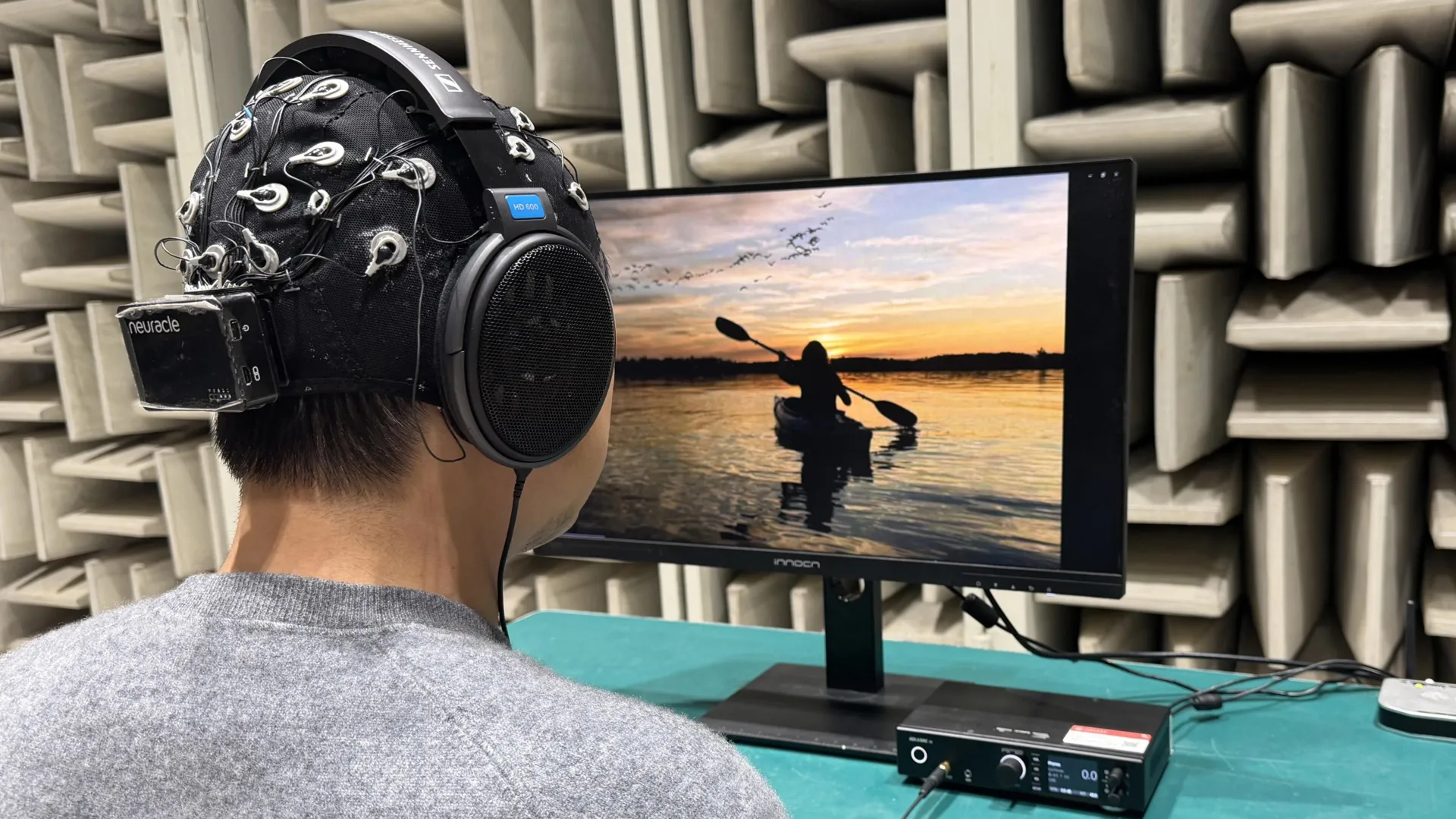
The age-old advice to close your eyes when trying to concentrate on a faint sound, long believed to enhance auditory perception by minimizing visual distractions, has been challenged by groundbreaking research. For generations, this intuitive strategy has been adopted by many, assuming that by shutting out the visual world, the brain could dedicate more processing power to deciphering subtle auditory cues. This common belief, however, often falters in environments saturated with background noise, where the intended boost in hearing sensitivity proves elusive. A recent study, published in the esteemed Journal of the Acoustical Society of America (JASA) by AIP Publishing, has rigorously tested this assumption, revealing a counterintuitive reality: in noisy conditions, closing your eyes may actually hinder your ability to hear.
Unraveling the Auditory-Visual Connection
Researchers at Shanghai Jiao Tong University embarked on a comprehensive investigation to dissect the intricate relationship between visual input and auditory detection. Their primary objective was to ascertain whether the instinctive act of closing one’s eyes genuinely augments hearing capabilities, particularly when faced with the pervasive challenge of background noise. The study’s findings challenge deeply ingrained notions and offer a fresh perspective on how our senses interact and influence each other.
The Experimental Design: A Multi-Sensory Gauntlet
To rigorously assess the impact of visual stimuli on auditory perception, the research team designed a series of carefully controlled experiments. Participants were tasked with a specific auditory challenge: to identify the precise moment a sound became just barely audible amidst a constant stream of background noise. This was achieved by having them listen to a range of sounds through high-fidelity headphones while a confounding ambient noise played simultaneously. Their crucial task involved adjusting the volume of the target sound until it reached this threshold of detectability.
The experimental protocol ingeniously incorporated four distinct visual conditions to isolate the effects of visual input:
- Eyes Closed: Participants performed the auditory detection task with their eyes completely shut, simulating the common intuitive approach.
- Eyes Open, Blank Screen: The participants repeated the task with their eyes open but focused on a completely blank, non-distracting screen. This condition served as a baseline for visual engagement without specific content.
- Eyes Open, Still Image: In this phase, participants viewed a static image that was thematically related to the sound they were hearing. For instance, if the sound was of a bird chirping, they might see a picture of a bird.
- Eyes Open, Matching Video: The most complex visual condition involved participants watching a video that precisely synchronized with the auditory experience. If the sound was of a flowing river, they would see a video of a river.
This systematic variation of visual conditions allowed the researchers to meticulously measure how different levels and types of visual engagement influenced the participants’ ability to discern faint sounds in a noisy environment.
The Surprising Results: Vision as an Auditory Ally
The experimental outcomes delivered a significant blow to the prevailing assumption that visual deprivation enhances hearing. Contrary to popular belief and the intuitive impulse, the study revealed that closing one’s eyes actively impaired the ability to detect faint sounds when background noise was present.
"We found that, contrary to popular belief, closing one’s eyes actually impairs the ability to detect these sounds," stated Yu Huang, a lead author of the study. "Conversely, seeing a dynamic video corresponding to the sound significantly improves hearing sensitivity."
The data clearly indicated that rather than providing the anticipated benefit, the act of closing one’s eyes made it more challenging for individuals to pick out subtle auditory signals in a cacophony of background noise. In stark contrast, when participants were presented with relevant visual input, especially a dynamic and congruent video, their auditory detection capabilities saw a marked improvement. This suggests that visual engagement, far from being a distraction, can act as a powerful facilitator for auditory processing.
Decoding the Neural Mechanisms: Over-Filtering and Neural Criticality
To delve deeper into the underlying neurological processes, the researchers employed electroencephalography (EEG) to monitor brain activity throughout the experiment. EEG is a non-invasive technique that measures electrical activity in the brain, providing insights into how different brain regions are activated and communicate.
The EEG data revealed a fascinating phenomenon. When participants closed their eyes, their brain activity shifted into a state characterized as neural criticality. This state, while potentially beneficial for certain types of information processing, leads to a heightened degree of filtering of incoming sensory information.
This enhanced filtering mechanism, however, proved to be a double-edged sword. While it might theoretically help to attenuate irrelevant background noise, it also, critically, suppressed the very target sounds that participants were trying to detect. The brain, in its attempt to create a more focused internal environment by closing off visual input, inadvertently became less sensitive to the faint auditory signals.
"In a noisy soundscape, the brain needs to actively separate the signal from the background," Huang explained. "We found that the internal focus promoted by eye closure actually works against you in this context, leading to over-filtering, whereas visual engagement helps anchor the auditory system to the external world."
This concept of "over-filtering" is crucial. In noisy environments, the brain’s natural tendency might be to amplify signals that are perceived as important and suppress those that are not. However, when visual input is entirely removed, the brain’s filtering system appears to become overly aggressive, potentially discarding faint auditory signals as noise, even when they are the intended focus. Conversely, the presence of relevant visual cues seems to provide an external anchor, helping the brain to more effectively distinguish between signal and noise and to prioritize the auditory information that is congruent with the visual experience.
The Nuance of Noise: When Closing Eyes Might Still Help
The researchers were careful to qualify their findings, emphasizing that the detrimental effect of closing one’s eyes is likely specific to noisy environments. In situations where background noise is minimal or absent, the traditional wisdom of closing one’s eyes to enhance focus on subtle sounds might still hold true. In quieter settings, the brain may not need to engage in the same level of active filtering, and the reduction of visual input could indeed allow for a more concentrated auditory experience.
However, the practical implications of this study are significant. In the context of everyday life, most environments are not silent. Commuting, working in an office, attending a social gathering, or even being at home often involve a substantial degree of ambient noise. In these common scenarios, the study suggests that keeping one’s eyes open and actively engaging with the visual environment is likely the more effective strategy for optimizing auditory perception. This could mean paying attention to visual cues in your surroundings or even consciously looking at the source of a sound if possible.
The Interplay of Senses: Future Frontiers in Research
The findings of this study open up a rich avenue for future research into the intricate and dynamic interplay between our senses, particularly vision and hearing. The research team at Shanghai Jiao Tong University has indicated plans to further explore these connections.
A key question on their agenda is to precisely delineate the source of the visual benefit. Is it simply the act of having visual input processed by the brain that aids hearing, or is it specifically the congruence between visual and auditory information that drives the enhancement?
"Specifically, we want to test incongruent pairings — for example, what happens if you hear a drum but see a bird?" Huang elaborated. "Does the visual boost come from simply having the eyes open and processing more visual information, or does the brain require the visual and audio information to match perfectly? Understanding this distinction will help us separate the general effects of attention from the specific benefits of multisensory integration."
This line of inquiry aims to differentiate between the general attentional benefits of engaging the visual system and the more profound advantages gained from multisensory integration, where the brain combines information from different senses to create a more robust and coherent perception of the world. If seeing a bird while hearing a drum sound does not provide the same auditory boost as seeing a bird while hearing a bird song, it would strongly suggest that the brain relies on a matching of sensory information for optimal processing.
Broader Implications and Real-World Applications
The implications of this research extend beyond academic curiosity. Understanding how visual engagement influences auditory perception could have significant applications in various fields:
- Education: For students, particularly those with learning difficulties, understanding how to optimize their sensory input for learning could be transformative. Educators might consider incorporating visual aids that directly correlate with auditory lessons.
- Assistive Technologies: For individuals with hearing impairments, this research could inform the development of more sophisticated assistive devices. For example, visual cues or augmented reality overlays could be integrated to help users better discern speech in noisy environments.
- Occupational Safety: In professions where clear auditory communication is critical for safety (e.g., air traffic control, emergency services), this research could lead to improved protocols and training for personnel to optimize their auditory focus.
- Everyday Life: On a personal level, the findings encourage a re-evaluation of ingrained habits. The next time you’re trying to catch a quiet word in a bustling restaurant, consider keeping your eyes open and perhaps looking in the general direction of the speaker, rather than closing them in a futile attempt to enhance your hearing.
The study, conducted over a specific period, likely involving recruitment of participants and data collection spanning several months, culminated in the publication of its findings in JASA, a leading journal in acoustics. The Acoustical Society of America, through its publishing arm AIP Publishing, ensures that such rigorous scientific work reaches the broader academic and scientific community, fostering further exploration and understanding.
In conclusion, while the intuitive urge to close our eyes when trying to hear better is understandable, scientific evidence now suggests that in the presence of background noise, this strategy is counterproductive. Instead, engaging with the visual world, especially with congruent visual information, appears to be a more effective pathway to enhanced auditory perception, highlighting the profound and often underestimated interconnectedness of our senses.