
 Reynand Wu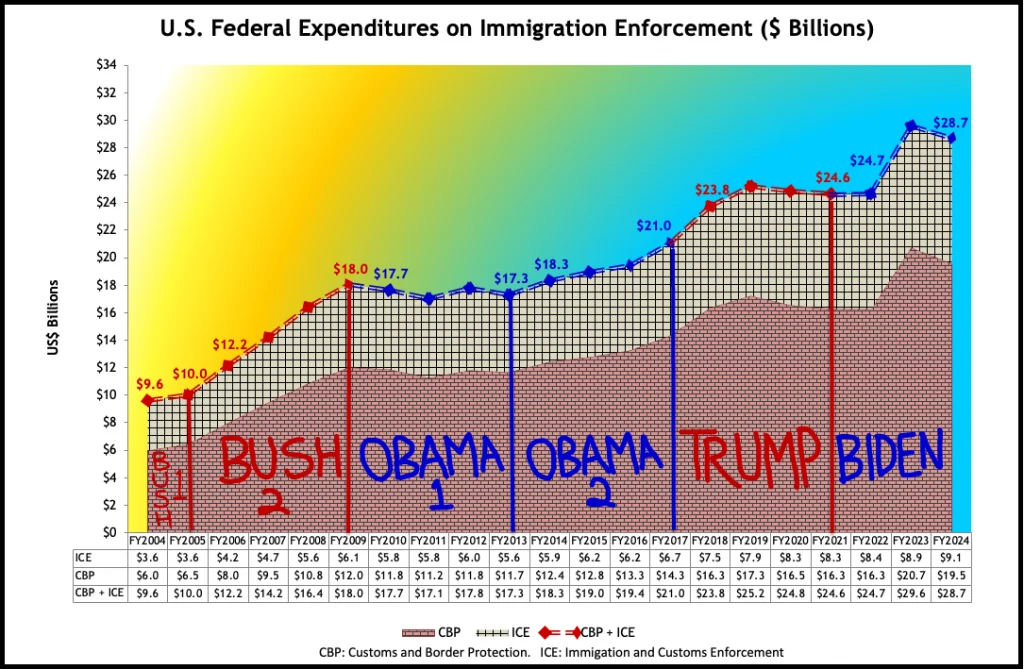
State borders, often perceived as natural and immutable lines on a map, are in reality dynamic constructs forged through political conflict, nationalist narratives, and complex economic systems. Crucially, they are also the product of substantial and continuous public financial investment. Far from being static demarcations, these borders perform vital social functions, differentiating between insiders and outsiders, maintaining distinct political systems, and constructing economic differences through varying trade relations, national currencies, and disparate value regimes. An examination of the United States’ approach to border management, particularly post-9/11, reveals a profound financial commitment to this infrastructure, demonstrating a bipartisan consensus on enforcement that often belies rhetorical differences in immigration policy. Federal expenditures on immigration enforcement have nearly tripled over the past two decades, underscoring the transformation of the border into a heavily funded security apparatus.
The Evolving Nature of State Borders and Their Functions
Historically, the drawing of state borders has frequently followed periods of conflict, war, and the assertion of national sovereignty, often reflecting arbitrary decisions or the outcomes of power struggles rather than inherent geographical or cultural divisions. These lines on a map, however, quickly accrue significant symbolic and functional weight. Beyond mere territorial separation, borders serve as critical instruments for state control, defining citizenship, regulating movement, and shaping national identities. They are crucial for maintaining the integrity of political systems, enabling governments to implement distinct laws, social policies, and governance structures within their designated territories. Economically, borders are fundamental to the operation of national economies, allowing states to control trade flows, impose tariffs, manage national currencies, and maintain unique regulatory and value regimes. This economic differentiation can lead to significant disparities in wealth, labor costs, and market access across contiguous regions, creating incentives for both legal and unauthorized cross-border movements.
Post-9/11: The Securitization of the US-Mexico Border
The events of September 11, 2001, marked a pivotal moment in the evolution of US border policy, fundamentally reshaping the national discourse around security and immigration. In the aftermath of the attacks, state officials strategically conflated the threat of anti-terrorism with the imperative of border regulation. This narrative shift led to the "securitization" of the US-Mexico border, reframing immigration as a matter of national security rather than primarily an economic or humanitarian issue. This recharacterization provided the impetus for a massive governmental restructuring and an unprecedented allocation of resources to border enforcement.
A direct consequence of this shift was the creation of the Department of Homeland Security (DHS) through the Homeland Security Act of 2002, signed into law by President George W. Bush. DHS consolidated 22 disparate federal agencies under a single umbrella, centralizing efforts related to border security, immigration enforcement, disaster response, and counter-terrorism. Within DHS, two key agencies emerged as central to immigration enforcement: Customs and Border Protection (CBP) and Immigration and Customs Enforcement (ICE). CBP, which proudly identifies itself as "one of the world’s largest law enforcement organizations," is tasked primarily with detecting and preventing the illegal entry of individuals and goods into the United States, aiming to "maintain borders that work." ICE, on the other hand, focuses on protecting America from "cross-border crime and illegal immigration that threaten national security and public safety," encompassing apprehension, detention, and deportation. Both agencies have seen their mandates and operational capacities dramatically expanded since their inception, reflecting the sustained national commitment to a fortified border.
A Chronology of Escalating Investment
The financial commitment to US immigration enforcement has grown substantially over the past two decades, illustrating a clear upward trajectory regardless of the political party in power.
- FY2004: Federal spending on immigration enforcement stood at approximately $9.6 billion. This period was still relatively early in the post-9/11 securitization push, with the newly formed DHS and its agencies beginning to ramp up operations.
- George W. Bush Administration (2001-2009): Following the creation of DHS, funding for border security and immigration enforcement saw significant increases. The rhetoric of national security and the "war on terror" provided a powerful justification for expanded budgets. By the end of Bush’s second term, annual spending had escalated considerably. His administration’s total contribution to immigration enforcement reached $178.9 billion over ten years, averaging $17.9 billion annually.
- Barack Obama Administration (2009-2017): Despite initial hopes among some for a more reform-oriented approach to immigration, the Obama administration continued the trend of increased enforcement funding. While engaging in rhetorical efforts to distinguish its approach from its predecessor, particularly regarding pathways to citizenship, the practical reality was a sustained and even expanded investment in border security technology, personnel, and detention infrastructure. The Obama years saw a total expenditure of $230.5 billion on immigration enforcement, averaging $21.0 billion annually, surpassing the average annual spending of the Bush administration. This period saw a peak in deportations, often earning Obama the moniker "deporter-in-chief" from critics.
- Donald Trump Administration (2017-2021): The Trump administration made border security a cornerstone of its political agenda, most notably with the promise to build a "big, beautiful wall" along the US-Mexico border. While highly visible and controversial, this push was built upon the existing foundation of an already heavily funded and militarized border apparatus. Spending continued to climb, with significant allocations towards wall construction, increased Border Patrol agents, and expanded detention facilities.
- Joe Biden Administration (2021-Present): Despite campaigning on a platform that promised a more humane approach to immigration, the Biden administration has, in practice, largely continued the trend of robust border enforcement funding. Faced with significant migrant surges and political pressure, the administration has maintained, and in some areas, increased, the operational capacity of CBP and ICE. A notable recent action, in October 2023, saw the administration waive no fewer than 26 federal regulations to construct additional border wall segments in Texas, a move that drew comparisons to the Trump administration’s policies and underscored the ongoing political imperative to demonstrate border control, particularly in advance of the 2024 presidential election.
- FY2024: The projected federal expenditure on immigration enforcement is $28.7 billion. This figure represents a nearly threefold increase from the FY2004 budget of $9.6 billion in unadjusted dollars. Even when adjusted for inflation to 2024 dollars, the increase is substantial, rising from approximately $17.5 billion to $28.7 billion, indicating a real and significant expansion of the border security budget.
The Staggering Financial Landscape of Enforcement
Over a period of 21 years, from FY2004 to FY2024, the United States has dedicated an astonishing cumulative total of $409.4 billion in public funds to immigration enforcement and border security. This monumental investment underscores the priority given to border control within the national budget. Breaking down these expenditures reveals further insights:
- Presidential Terms: Republican presidents accounted for $178.9 billion of this spending, averaging $17.9 billion annually. Democratic presidents, however, authorized $230.5 billion, averaging $21.0 billion annually. This data challenges the perception of a clear partisan divide in actual spending habits, indicating that both parties have overseen significant increases in enforcement budgets.
- Agency Allocation: Of the total, CBP has received approximately $275 billion, reflecting its primary role in physical border patrol, technology deployment, and initial processing. ICE has been allocated $134.4 billion, underscoring its expansive responsibilities in internal enforcement, detention, and deportation operations.
This colossal financial outlay supports a vast and complex infrastructure designed to manage, restrict, and deter cross-border movement. It funds tens of thousands of Border Patrol agents and ICE officers, their salaries, benefits, and equipment. It pays for an extensive network of surveillance technologies, including drones, ground sensors, biometric scanners, and advanced camera systems. It covers the construction and maintenance of physical barriers—walls, fences, and checkpoints—as well as the operation of a sprawling system of immigration detention centers across the country. Furthermore, these funds support the logistical apparatus for apprehending, processing, and deporting individuals, including transportation, legal services, and administrative costs. This comprehensive investment transforms the border from a simple line into a multifaceted, technologically advanced, and heavily militarized zone.
Official Responses and the Rhetoric-Reality Gap
Official statements from CBP and ICE consistently emphasize their missions as crucial for national security and public safety. CBP’s primary mission, as stated, is "to detect and prevent the illegal entry of individuals into the United States" and to "maintain borders that work." ICE’s mission is "to protect America from the cross-border crime and illegal immigration that threaten national security and public safety." These statements frame their activities as essential protective measures against existential threats, aligning with the post-9/11 securitization narrative.
However, the analysis of federal spending data reveals a striking divergence between the stated rhetorical positions of political parties and their actual policy implementations. While Democratic presidents and politicians often articulate a more pro-immigrant stance, advocating for pathways to citizenship, comprehensive immigration reform, and more humane treatment of migrants, their administrations have nonetheless overseen a greater average annual increase in border enforcement funding than their Republican counterparts. This suggests a powerful underlying consensus on the necessity of a robust enforcement apparatus, irrespective of partisan rhetoric.
This "partisan consensus" on immigration policy, despite public performances of disagreement, is rooted in complex political and economic realities. The original analysis suggests this phenomenon reflects "the fundamental contradictions of bourgeois liberal democracy," where the interests of ruling economic, political, and racial elites may supersede the stated will of the working populace. In this framework, politicians, regardless of party affiliation, may prioritize policies that maintain existing power structures and economic inequalities, including those facilitated by strict border controls that regulate labor flows and maintain distinct value regimes. The political pressure to appear "tough on the border," especially in an increasingly polarized political landscape, also plays a significant role, leading administrations to adopt or continue enforcement-heavy policies to avoid accusations of being weak on national security.
Broader Impact and Implications
The persistent and escalating financial investment in US border enforcement carries profound and far-reaching implications, extending beyond mere budgetary figures.
- Humanitarian Costs: The militarization of the border and the expansion of enforcement powers have severe humanitarian consequences. Increased border patrols and physical barriers often push migrants into more perilous routes, leading to a tragic rise in deaths due to exposure, dehydration, or injury in remote and dangerous terrain. The expanded detention system has also drawn widespread criticism for its conditions, impacting the physical and mental health of detainees, including families and children. Family separations, a policy that gained notoriety under the Trump administration but has roots in earlier enforcement practices, inflict deep psychological trauma.
- Economic Impact Beyond Spending: While the direct spending is immense, the broader economic impact is multifaceted. Border communities often become economically dependent on the enforcement infrastructure, with local economies benefiting from federal contracts for construction, supplies, and personnel housing. However, increased enforcement can also disrupt cross-border economies, affecting trade, tourism, and the availability of labor for sectors reliant on migrant workers. The costs associated with processing and deporting individuals also represent a significant drain on public resources that could otherwise be allocated to social services or infrastructure.
- Erosion of Civil Liberties: The expansion of enforcement agencies like CBP and ICE has also raised concerns about the erosion of civil liberties, particularly in border zones. These agencies often operate with broad powers, including the ability to conduct searches and question individuals without warrants within a certain distance from the border, impacting not only migrants but also citizens and legal residents. The increasing use of surveillance technologies can also have privacy implications for communities residing near the border.
- Political Inertia and the Future: The established momentum of border securitization, fueled by continuous bipartisan funding, creates significant political inertia. Shifting away from an enforcement-heavy paradigm towards more comprehensive and humane immigration policies becomes exceedingly difficult once such a vast and entrenched apparatus is in place. The political calculus, particularly in election cycles, often favors demonstrating strict border control over pursuing potentially unpopular reform efforts. This perpetuates a cycle where "anti-immigrant violence," as articulated in the original analysis, continues to fill the "gaping void left by the abandonment of any commitment to a progressive ideological agenda" within parts of the Democratic Party, leading to a de facto perpetuation of policies that prioritize enforcement over integration or systemic solutions.
In conclusion, the US border is not merely a geographical line but a colossal, continuously expanding, and heavily funded apparatus, costing hundreds of billions of dollars over the past two decades. This financialization of the border, driven by a post-9/11 security imperative and sustained by a bipartisan consensus on enforcement, reveals a complex interplay of political narratives, economic interests, and a deeply entrenched institutional structure. Understanding the financial investment in this system is critical to comprehending its profound societal, economic, and humanitarian implications, and to recognizing the significant challenges inherent in any attempt to reshape the future of US immigration policy.








