Layla Zulfa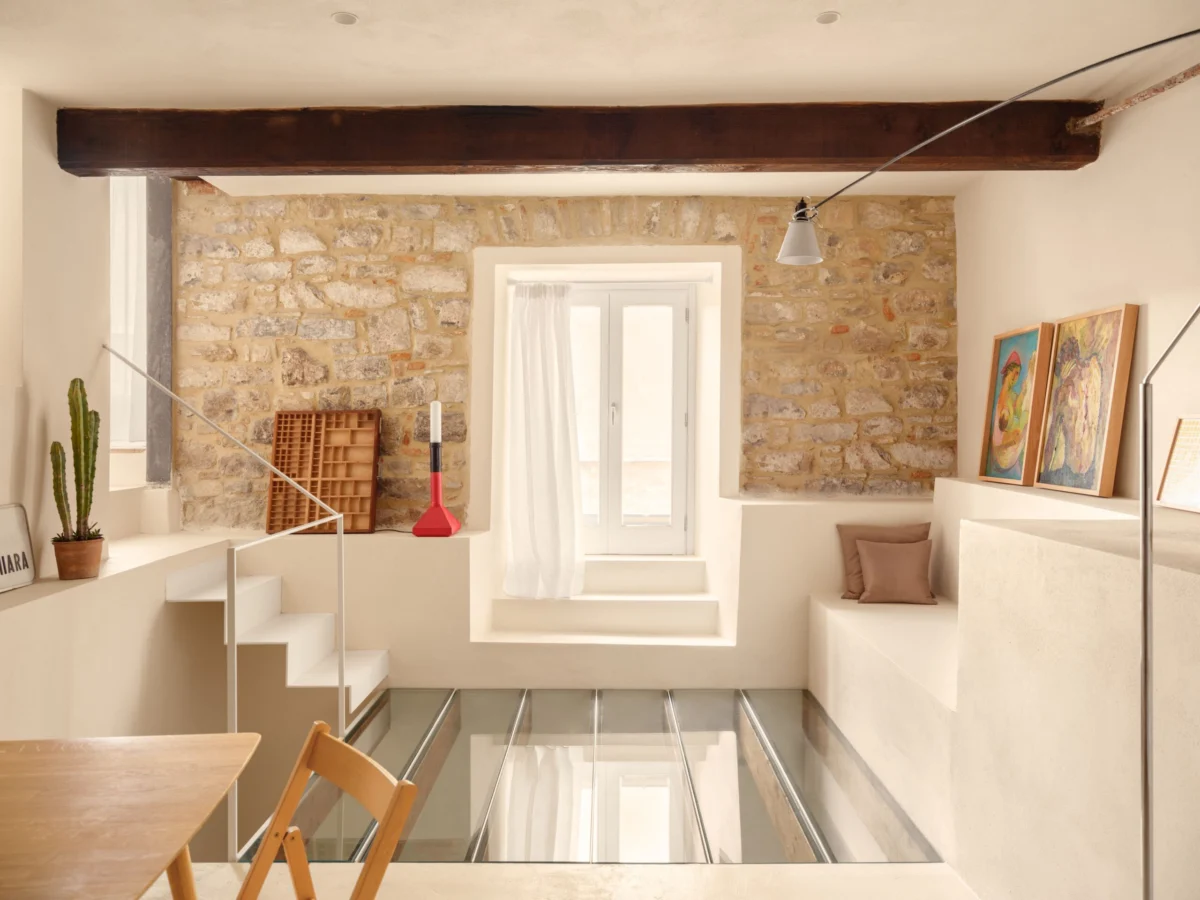
In the ancient maritime province of Liguria, specifically within the labyrinthine corridors of Imperia’s historic Parasio district, architect Davide Andracco has completed a complex renovation of a 592-square-foot residence. The project, which involved the conversion of a dilapidated 17th-century structure into a highly functional modern home, represents a significant case study in the adaptive reuse of historical urban fabric. Originally characterized by dampness, neglect, and structural decay, the property was initially viewed as an untenable prospect by most potential buyers. However, through a series of structural interventions and spatial reconfigurations, Andracco has successfully balanced the preservation of Ligurian architectural heritage with the demands of contemporary living for his client, a Swiss educator.
The renovation is notable not only for its aesthetic refinement but also for its technical navigation of strict local preservation laws. In many of Italy’s historic centers, external additions to residential buildings are prohibited, forcing architects to look inward and downward to expand living volumes. By identifying and repurposing forgotten structural voids, Andracco maximized the utility of a footprint that would otherwise be considered insufficient for a multi-functional residence.

Historical Context: The Parasio District of Imperia
To understand the constraints and significance of the project, one must look at the geography of Imperia. Formed in 1923 by the union of two historically rival towns, Porto Maurizio and Oneglia, Imperia remains a bastion of traditional Ligurian culture. The Parasio district, located in Porto Maurizio, serves as the city’s medieval heart. It is characterized by its "carruggi"—narrow, winding alleys designed centuries ago to provide shade and defense against maritime invaders.
The building in question dates back to the 1600s, an era when residential construction relied heavily on local stone, chestnut timber, and thick masonry walls designed to withstand the humid Mediterranean climate. Unlike the grand palazzos found in nearby Genoa or the buttery-toned villas of the Portofino coast, this structure was originally a modest dwelling. Over centuries, such buildings often underwent haphazard modifications, leading to the "labyrinthine" internal configurations common in the region. Before Andracco’s intervention, the property had fallen into a state of total abandonment, suffering from significant moisture ingress—a common ailment for stone structures built directly into the hillside.
A Chronology of Discovery and Intervention
The project began with a period of skepticism. When the client first visited the site, the interior was dark, damp, and seemingly claustrophobic. Andracco’s primary challenge was to convince the homeowner that the "hopeless ruin" possessed latent volume. The renovation timeline can be divided into three distinct phases: discovery, structural stabilization, and interior refinement.

During the initial demolition and clearing phase, the architectural team uncovered two major structural surprises that fundamentally altered the project’s trajectory. The first was a large, subterranean cistern located beneath the primary floor level. Historically, these waterproof tanks were essential for collecting rainwater in Ligurian coastal towns where freshwater springs were scarce. Because the cistern was no longer in use, Andracco realized it offered a rare opportunity to increase the home’s vertical volume without violating external height restrictions.
The second discovery occurred at the entrance. Upon investigating a sloped ceiling above the doorway, the team found a hidden void. This discovery allowed for the insertion of a lofted platform, which now serves as a sleeping area or workspace, effectively adding a "room" where none previously existed.
The Vertical Labyrinth: Navigating Six Levels in 592 Square Feet
The most striking feature of the completed home is its spatial complexity. In a space of just 592 square feet (approximately 55 square meters), Andracco has engineered six distinct levels. This verticality creates a residence that functions like a three-dimensional puzzle, or as the architect suggests, a small-scale version of an M.C. Escher drawing.

- Entry Level: The entrance sits slightly below street level, a common feature in historic Parasio.
- The Suspended Platform: From the entrance, a staircase leads to the newly discovered lofted area.
- The Living Area: A descent leads to the main social hub of the home.
- The Study (Former Cistern): The deepest part of the home, this cool, quiet space was reclaimed from the 17th-century water tank.
- The Sleeping Loft: An upper-tier area designed for rest.
- The Bathroom: The final level, reached via a turn from the sleeping area.
This "roller coaster" layout is connected by two primary staircases. One is a minimalist masonry structure, while the second is a bespoke metal installation crafted by Gre.Mo Carpenteria In Ferro. This metal staircase spans the void of the former cistern, providing a visual contrast between industrial modernity and ancient stone.
Materiality and Technical Specifications
The choice of materials was driven by a dual need for historical continuity and moisture management. Liguria’s coastal environment presents constant challenges regarding salt air and rising damp. To address these concerns, the client requested the installation of new internal wall partitions in several areas, particularly the bathroom. While Andracco originally intended to leave the 17th-century brickwork exposed throughout, he prioritized the homeowner’s concerns regarding longevity and climate control.
The living area retains its original structural columns and chestnut beams, which were treated and preserved. The sofa is not a freestanding piece of furniture but is "carved" out of a pre-existing masonry block, making it an integral part of the architecture. This use of "monastic" materials—stone, concrete, and wood—creates a uniform aesthetic that prevents the small, multi-level space from feeling cluttered.

Custom woodwork was a critical component of the project. Given the irregular angles and unique dimensions of the 17th-century shell, standard furniture was largely unusable. The kitchen and various storage units were custom-built by BF Mobili Arredamenti, ensuring that every square inch of the 592-square-foot footprint was utilized for storage or utility.
The Integration of Barite: Science and Folklore
One of the more unusual aspects of the renovation is the inclusion of Barite stones, which were shipped from Switzerland at the client’s request. Barite (barium sulfate) is a mineral known for its high density and its ability to absorb radiation. In industrial applications, it is frequently used in the construction of X-ray rooms and nuclear shielding.
The client’s motivation was twofold: a desire for protection against environmental radiation and a belief in the stone’s metaphysical properties. In various esoteric traditions, Barite is associated with the "third eye" and "crown chakra," believed to foster mental clarity and psychic ability. Andracco integrated these stones into a cemented strip located in front of the living room window. While invisible to the naked eye, the presence of the Barite serves as a symbolic and literal shield, contributing to the "refuge" atmosphere the client sought.

Broader Implications for Urban Preservation
The successful completion of this project highlights several trends in modern European architecture. First, it demonstrates the viability of "micro-living" in historical contexts. As urban populations grow and housing prices rise, the ability to transform "unusable" ruins into high-design residences is becoming increasingly valuable.
Second, the project underscores the importance of adaptive reuse in the fight against urban sprawl. By revitalizing a 400-year-old structure in the heart of Imperia, the architect and homeowner have contributed to the preservation of the Parasio district’s social and architectural fabric. This prevents the "museumification" of historic centers, where buildings are left empty and preserved only for their facades. Instead, this renovation proves that ancient structures can be updated to meet 21st-century standards of comfort and design without losing their historical soul.
Finally, the project serves as a testament to the role of natural light in small-space design. Despite the building’s original state as a damp and dark ruin, Andracco’s focus on light—amplified by the white partitions and the reflective qualities of the stone—has transformed the 592 square feet into a space that feels significantly larger than its physical dimensions.

As mass tourism continues to reshape much of the Italian Riviera, towns like Imperia and neighborhoods like Parasio offer a glimpse into a more authentic, slower-paced way of life. Projects like Andracco’s ensure that these historic centers remain lived-in, vibrant, and architecturally relevant for future generations. The transformation of a 17th-century cistern into a modern study is more than just a design "tweak"; it is a sophisticated dialogue between the past and the present.