
 Reynand Wu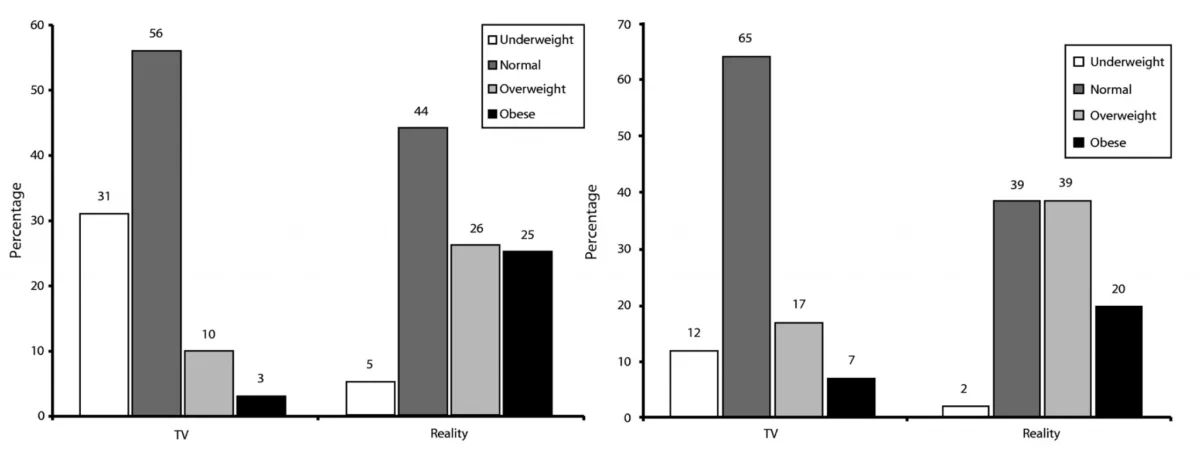
Television, as a primary vehicle for cultural storytelling, has long operated as an arbiter of social norms, dictating not only what stories are told but whose bodies are deemed worthy of occupying the screen. For decades, researchers have observed a consistent pattern: television content frequently distorts, mocks, and marginalizes individuals with larger body types. Rather than serving as fully realized characters, fat individuals are often reduced to two-dimensional caricatures, stripped of depth, agency, and meaningful narrative development. This systemic exclusion is not merely a creative choice but a reinforcement of narrow societal beauty standards that equate thinness with virtue and larger bodies with moral or aesthetic failure.
The discrepancy between the reality of human diversity and the curated world of television is stark. According to data cited by Brownell et al. (2003) comparing television representation to actual body mass index (BMI) distributions in the United States during the turn of the millennium, television characters were disproportionately thin. While the general population showed a significant presence of overweight and obese individuals, television screens remained heavily skewed toward slender silhouettes. This underrepresentation serves to solidify a "thin ideal," suggesting to the audience that beauty is a monolithic concept accessible only to those who fit a specific, limited physical profile.
The Anatomy of On-Screen Bias
The mechanism by which television enforces this bias is multifaceted, relying on a combination of verbal cues, character archetypes, and casting choices. A study conducted by Tzoutzou et al. (2021) highlighted the disparity in how characters are affirmed on-screen. In their analysis, the researchers found that 100% of the compliments regarding physical appearance directed toward female characters were reserved for those who were thin. Conversely, not a single positive message regarding appearance was extended to women of average or larger body types. This pattern was mirrored in the treatment of male characters, where positive reinforcement for those in larger bodies was virtually non-existent, occurring only once throughout the study’s sample.
This exclusionary environment is further compounded by the reliance on tropes. When fat characters do appear, they are frequently relegated to the periphery of the narrative. They often inhabit the roles of the "comic relief," the "sidekick," or, in more sinister portrayals, the antagonist. Research into comedy writing has revealed that fat women are significantly more likely to be the subject of a joke rather than the deliverer of one. In these instances, the humor is rarely directed with the character; instead, the character serves as the punchline, inviting the audience to laugh at their body rather than with their personality.
Historical Context and the Demonization of Size
The link between physical size and negative character traits has been a recurring theme in media history, particularly within children’s programming. Himes and Thompson’s research (2007) into popular children’s videos found that obesity was explicitly correlated with negative attributes—such as being unattractive, unfriendly, cruel, or evil—in 64% of the content analyzed.
This trope is deeply embedded in the collective cultural memory. Villains such as Ursula from Disney’s The Little Mermaid or the Queen of Hearts from Alice in Wonderland utilize physical markers of "fatness" to signal moral depravity. By connecting a larger body type with villainy, television and film creators create a subconscious association for younger audiences, suggesting that physical characteristics are outward manifestations of an internal, sinister nature. This process of demonization effectively strips these characters of their humanity, positioning them as cautionary tales rather than complex individuals.
Chronology of Media Research and Changing Standards
The conversation regarding body representation has evolved significantly over the past thirty years. During the 1990s and early 2000s, the focus of media research was primarily on the "thin ideal" and its contribution to the rise of disordered eating among young women. The landmark study by Fouts and Burggraf (1997) served as a turning point in the field, demonstrating that as little as 30 minutes of television exposure could significantly alter a young woman’s self-perception. This research established a causal link between media consumption and body dissatisfaction, noting that the consistent viewing of idealized, thin characters resulted in immediate, negative shifts in how viewers appraised their own bodies.
Throughout the 2010s, the discourse shifted toward the concept of "fatphobia" in media. With the rise of the body positivity movement, critics began to demand more nuanced portrayals. However, as noted in various analyses of the "Melissa McCarthy Effect," while certain actors gained mainstream success, the roles offered to them often continued to rely on the same outdated tropes of the "funny, fat best friend" or the "unlovable protagonist." While representation has increased numerically, the quality of these roles remains a point of contention for media sociologists.

The Psychological Impact on the Audience
The internalization of these televised standards has tangible, long-term psychological implications. When television consistently suggests that only thin bodies are deserving of romance, success, and positive affirmation, viewers who do not fit that standard may begin to internalize those messages as personal truths.
Research suggests that the impact of this media consumption extends beyond body image, influencing how individuals perceive their social standing. Studies have indicated that viewers may come to believe they are subject to the same sexist or discriminatory treatment observed on screen if they do not adhere to the body norms presented by the industry. This creates a cycle of anxiety, where the fear of being treated differently due to one’s body size leads to increased stress and lower self-esteem.
Furthermore, the desire to conform to these unrealistic standards is a primary driver of frequent dieting and disordered eating patterns. For many young women, the pressure to reach an unattainable ideal is intensified by the media’s constant reinforcement that "thinner is better." The mass media’s ability to define the parameters of attractiveness creates a standard that is often biologically incompatible with the diverse reality of the human population, leaving many feeling alienated from their own physical selves.
Implications for the Television Industry
The industry’s reliance on these patterns of marginalization presents a significant failure in inclusivity. Television serves as a powerful mirror for society, and when that mirror is distorted, it impacts the mental health and social development of the public. If the goal of television is to connect with a broad audience, it must recognize that the audience is inherently diverse.
Sociologists and media critics argue that the solution is not merely "more" representation, but "better" representation. This involves moving away from the "villain" and "sidekick" tropes and providing characters with larger bodies the same narrative weight, romantic agency, and emotional depth as their thinner counterparts.
The professional consensus among media scholars is that the responsibility lies with writers’ rooms and casting directors to challenge their own implicit biases. By prioritizing diversity in body type as a standard element of storytelling—rather than a "niche" topic—television could begin to dismantle the pervasive stigma surrounding fatness.
Conclusion
The data consistently demonstrates that television has a long-standing, well-documented issue with how it portrays and treats larger bodies. From the lack of positive verbal reinforcement to the frequent association of size with villainy, the medium has played a significant role in cementing a narrow, exclusionary definition of beauty. The consequences of these portrayals are not limited to the screen; they ripple outward, affecting the self-esteem, social perceptions, and mental health of the audience.
For television to truly evolve into a space that is inclusive and reflective of the human experience, it must abandon the outdated, biased frameworks that have defined its history. All bodies deserve to be seen as central to the narrative, and all viewers deserve to see themselves represented with dignity, complexity, and humanity. Until the industry addresses these structural biases, the screen will continue to reflect a distorted image of reality, one that leaves a significant portion of the population feeling marginalized and undervalued.







