
 Ana Megawati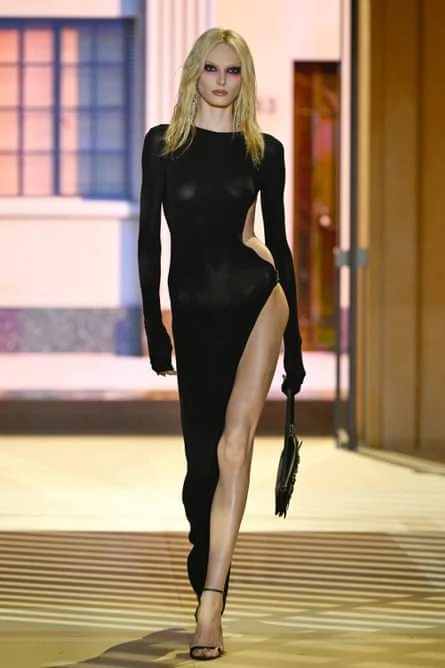
The intersection of commerce and haute couture took center stage during Milan Fashion Week on Friday, where creative director Demna presented his third collection for Gucci inside a meticulously constructed, convention-center replica of a flagship boutique. Surrounded by giant stone columns, faux-Paonazzo marble slabs, and plush velvet couches, an A-list audience that included Romeo Beckham, Bianca Jagger, Cardi B, and Edward Norton watched models navigate aisles lined with shelving units displaying archival and current pieces. While attentive sales assistants hovered nearby to answer inquiries, the immersive retail setup offered a purely aesthetic experience, stopping short of actual transactions much to the disappointment of several very important clients (VICs) hoping to engage in immediate retail therapy.
The high-concept staging serves as a physical manifestation of Demna’s evolving strategy to steer Gucci away from a tumultuous period of declining revenues and restore the Italian luxury titan to its historical prominence. As the crown jewel of parent company Kering—historically accounting for roughly half of the conglomerate’s total revenue—Gucci’s financial trajectory has been closely monitored by industry analysts and corporate executives alike. The latest showcase provides critical insights into the brand’s creative direction, consumer reception, and broader commercial viability as it attempts to cement a permanent rebound.
Background Context and Corporate Evolution
Gucci’s recent history has been defined by dramatic stylistic swings and corresponding financial volatility. Under the theatrical, maximalist romanticism of former creative director Alessandro Michele, the brand experienced an unprecedented boom, scaling new heights in global luxury market share and cultural relevance. However, by 2022, consumer fatigue and changing macroeconomic conditions began to impact growth, prompting Kering to engineer a sharp strategic pivot.
In an effort to modernize and capture a more restrained consumer base, the house installed Sabato de Sarno, whose minimalist vision represented an abrupt departure from Michele’s ornate aesthetic. The transition, however, failed to resonate with core luxury shoppers. Over a three-year period, Gucci’s revenue plummeted, nearly halving and sending shockwaves through Kering’s financial reports. The steep decline triggered urgent boardroom recalibrations, culminating in the departure of key executives and a mandate to completely recalibrate the brand’s identity.
In July of the previous year, Kering appointed Demna—the mononymic designer renowned for his decade-long tenure at Balenciaga, where he successfully transformed the house into an avant-garde commercial powerhouse—to spearhead Gucci’s rescue mission. Tasked with halting the downward sales spiral, Demna spent his first year in office conducting an exhaustive operational and creative audit.

Reflecting on his first twelve months at the helm, Demna noted that his initial period was strictly "dedicated to understanding and formulating what Gucci stands for." Describing Friday’s Milan presentation as his complete personal vision for the brand, the designer synthesized his extensive market research into a singular conclusion: Gucci is fundamentally about "luxury that wants to be seen."
Chronology of the Turnaround Strategy
The path to recovery has been gradual but shows measurable signs of stabilization. The timeline of Gucci’s recent structural and creative overhaul highlights the urgency of Kering’s leadership:
- Late 2022 – 2024: Sabato de Sarno’s minimalist collections lead to a steep and sustained drop in quarterly revenues, culminating in a nearly 50% reduction in brand sales over three years.
- July: Demna officially assumes the role of creative director at Gucci, initiating a 12-month internal review of the brand’s heritage, archives, and commercial footprint.
- February: Demna’s inaugural runway collections introduce early design shifts, notably leaning into muscular tailoring, skinny silhouettes, and urban streetwear elements.
- July: Kering reports a tentative return to growth in its quarterly financial filings, explicitly attributing the positive trajectory to the initial retail rollout of Demna’s early designs.
- September: During Milan Fashion Week, Demna stages his third major collection inside a life-sized boutique installation, introducing a comprehensive brand taxonomy divided into three distinct character archetypes.
Collection Analysis: Archetypes and Aesthetic Codes
Moving away from the experimental silhouettes of his previous runway outings, Demna’s latest collection established a clear, character-driven taxonomy designed to appeal to a broad, cross-generational demographic. The designer categorized his vision into three distinct archetypes: the rebellious aristocrat, the snob, and the eccentric.
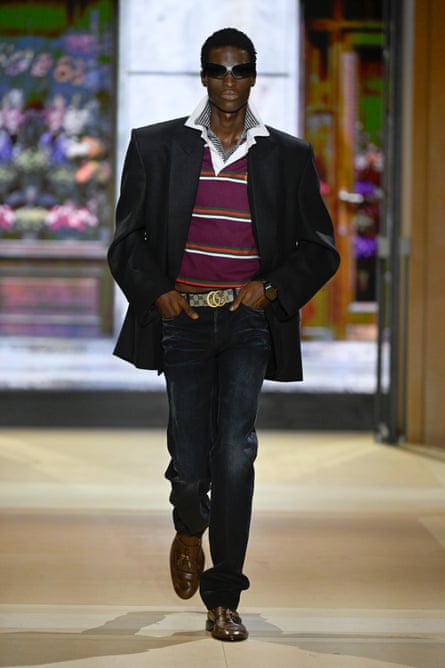
Menswear departures from previous seasons were immediate and pronounced. The muscle tees and skinny jeans seen on the February catwalk were replaced by voluminous, oversized tailoring, relaxed loafers, and tasselled slippers. Low-rise denim sat heavily on the hips, anchored by the brand’s signature triple horse-bit belts dangling low. Outerwear featured exaggerated, sharply peaked shoulders, while hoodies—a foundational signature from Demna’s Balenciaga era that he initially claimed he would avoid at Gucci—made a calculated and prominent reappearance.
For womenswear, the collection offered a rigorous "study of posh dress codes," blending British sartorial tropes with traditional Italian bourgeois references. Rugby tops and impeccably tailored skirt suits anchored the daytime looks. Subtle nods to Gucci’s equestrian heritage surfaced via spiky-heeled, stirrup-motif riding boots paired with clingy white jodhpurs.
Simultaneously, the collection tapped into modern internet culture, specifically acknowledging the TikTok-driven trend of "nonnamaxxing"—a playful celebration of classic Italian grandmother style. This was executed through fuzzy coats, elegant shawls, and wiggle pencil skirts. British sensibilities were equally present, manifested through pleated A-line skirts in traditional Scottish tartans and crisp Oxford shirting. Demna noted an intentional desire to reconnect the brand with its foundational origins, specifically referencing the Savoy hotel in London, where company founder Guccio Gucci worked as a luggage porter during the 1890s.
Furthermore, the collection paid fervent homage to the provocative, hyper-sensual Tom Ford era of the 1990s, which cemented Gucci’s status as a global powerhouse. Described by the designer as an exploration of "nocturnal glamour," the eveningwear segment featured bottom-grazing hemlines, backless silhouettes loosely secured by weighted hardware, and soaring metal-heeled stilettos. Standout moments included model Alex Consani walking the runway in a long black dress split from toe to bust, held together by a bedazzled G-logo clasp at the hip.
Statements, Official Responses, and Market Implications
The strategic pressure facing Demna and the broader executive team remains intense. Kering’s chief executive officer, Luca de Meo—who transitioned to the luxury conglomerate from the automotive sector last year—has been vocal about the strict parameters required for the brand’s long-term viability. De Meo has repeatedly emphasized that Gucci must remain "immediately recognisable and culturally pertinent" to reclaim its market dominance.
Industry analysts point out that while creative validation on the runway is a necessary first step, the ultimate metric of success will be retail conversion. Kering’s recent financial results indicate that wholesale and retail partners are responding favorably to the new merchandise, providing a vital cushion as the company attempts to rebuild its operating margins. However, sustaining this momentum requires converting runway buzz into tangible foot traffic and long-term customer loyalty.
The architectural conceit of Friday’s show—staging a runway inside an idealized, high-end storefront—serves as both a meta-commentary on the luxury retail experience and a direct challenge to the corporate hierarchy. By placing sales assistants on the floor among celebrities and editors, Demna underscored the commercial reality underpinning the artistic spectacle: fashion at this scale must ultimately sell clothes.
As Gucci navigates this critical chapter, the success of Demna’s vision will determine not only his own legacy within the house but also the financial health of Kering as it fights to regain its standing in a fiercely competitive global luxury market. If the brand successfully balances cultural relevance with commercial accessibility, corporate leadership anticipates the return of the long queues outside its boutiques that once defined its golden eras.









