Ana Megawati
Marks & Spencer made retail and fashion history by staging its very first catwalk show at London Fashion Week, presenting an accessible, high-street collection directly to a star-studded front row at the Design Museum. The high-profile event represented a strategic milestone for the heritage British retailer, which is currently ranked second in UK style perception behind Zara. Aiming to redefine how mainstream consumers interact with the bi-annual fashion showcase, the brand made all runway looks available for immediate purchase online and in stores. The debut arrives during a critical juncture for London Fashion Week, which has increasingly sought to reconnect with everyday consumers amid soaring luxury prices and broader economic pressures.
High-Street Ambitions Meet the Capital’s Premier Fashion Showcase
The debut took place before an exclusive audience of 310 guests, featuring a mix of cultural figures, athletes, and politicians, including Joan Collins, Kemi Badenoch, Ian Wright, and Jamie Carragher. The presence of such a diverse front row underscored the cultural crossover appeal that Marks & Spencer targeted with the collection.

The runway presentation served as a high-stakes gamble for both the retailer and the organisers of London Fashion Week. For M&S, the challenge lay in translating high-fashion aesthetics into practical, everyday wardrobes without alienating its core demographic of over 23 million customers, or conversely, being dismissed by industry purists. For the British Fashion Council, hosting a mass-market giant offered a vital opportunity to democratise an event that has frequently faced criticism for becoming detached from real-world financial realities during an ongoing cost-of-living crisis.
Maddy Evans, the womenswear director at Marks & Spencer, described the stylistic philosophy behind the showcase as "fashion with a small f, not a capital F." This design ethos prioritized wearable contemporary trends—such as sharp kilts, low-rise slouchy denim, and structured separates—over avant-garde concepts or impractical haute couture.
A Centenary of High-Street Evolution and Strategic Positioning
The timing of the London Fashion Week debut aligns with the centenary of fashion retailing at Marks & Spencer, providing a historical anchor for a collection that heavily references the brand’s extensive archives. Designers reinterpreted traditional silhouettes, introducing updated iterations of classic twinsets, such as cardigans layered over knitted camisoles, and sage-green lace lingerie sets that nod to the company’s long-standing manufacturing heritage.

The stylistic direction deliberately avoided chasing fleeting micro-trends, focusing instead on foundational wardrobe staples. The colour palette relied heavily on versatile neutrals accented by strategic pops of crimson red across both men’s and women’s lines. Menswear offerings leaned into contemporary utility, highlighted by classic grey office suits—modelled by musician and cultural figure Lennon Gallagher—alongside practical chore jackets.
Industry analysts note that the presentation reinforces M&S’s recent commercial turnaround in apparel. Buoyed by previous successes, including highly sought-after collaborations and viral accessories like suede loafers that drew comparisons to luxury houses, the retailer has solidified its market position. Evans noted that trailing only behind Zara in style perception aligns with corporate strategy. While Zara represents the fast-moving cutting edge of fashion, M&S aims to position itself as fashion accessible to the wider public.
Democratising the Runway: Pricing and Immediate Availability
A defining characteristic of the Marks & Spencer London Fashion Week debut was the immediate commercial availability of the garments. Breaking with traditional fashion week models—where showcased items typically remain unavailable to consumers for six months—every piece from the collection went on sale concurrently with the start of the runway show on Friday.
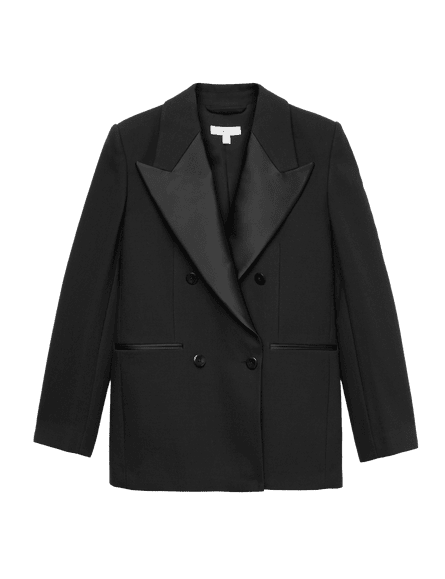
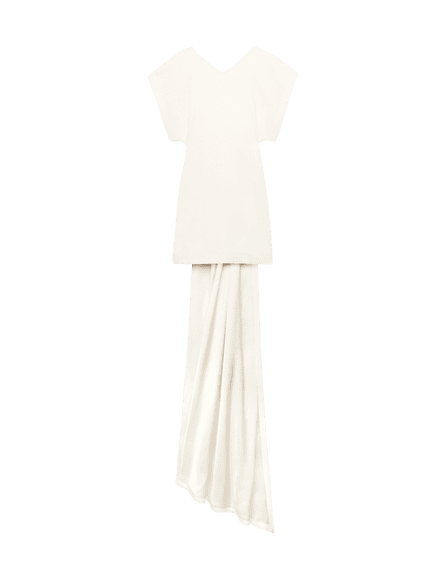
The pricing structure was deliberately engineered to challenge the exclusivity of the fashion calendar. Half of the entire collection was priced under £50, while the most expensive garment—a premium leather coat—retailed at £450. Key items highlighted by fashion editors included a double-breasted tuxedo jacket at £85, an ivory satin party dress with kimono sleeves and a train priced at £89, a gold sequin fringe skirt for £50, a red half-zip sweater at £41, and a vintage-style tobacco leather jacket with a borg collar for £250.
By removing the traditional waiting period between runway visibility and retail availability, M&S leveraged immediate consumer impulse purchasing. The strategy directly addresses long-standing complaints from fashion consumers who find runway trends financially unattainable or practically out of reach.
Industry Impact and the Broader London Fashion Week Schedule
The inclusion of Marks & Spencer forms part of a broader revitalisation of the London Fashion Week schedule. Alongside the high-street giant’s debut, the season has benefited from the homecoming of major luxury houses, including Alexander McQueen returning to show in London rather than Paris, and designer Christopher Kane making a widely anticipated return to the catwalk following his appointment at Mulberry.
These high-profile additions have injected renewed momentum into the British capital’s fashion ecosystem. While independent and emerging designers continue to form the creative core of London Fashion Week, the integration of mass-market commercial powerhouses like M&S provides crucial economic stability and media visibility.
Following the conclusion of the runway presentation, guests gathered for an elevated interpretation of the quintessential British high-street experience, partaking in smoked salmon finger sandwiches and champagne served on silver trays, effectively bridging the gap between democratic comfort and runway glamour.
Market Implications and Future Outlook
The commercial success of the M&S London Fashion Week showcase offers significant implications for the UK retail sector. As household budgets remain constrained by inflationary pressures, traditional department stores and high-street retailers face mounting pressure to demonstrate value without sacrificing trend relevance.

By successfully merging accessibility with the cultural cachet of London Fashion Week, M&S has established a new benchmark for how legacy brands can market apparel to a broad demographic. The use of models spanning a wide range of ages and body types further reinforced the brand’s stated objective to reflect its vast consumer base authentically.
Whether other high-street competitors will follow M&S onto the official fashion week schedule remains to be seen. However, the overwhelmingly positive reception from both the celebrity front row and industry critics suggests that accessible, wearable fashion holds a viable and profitable place on the global runway calendar.