Prabowo Widodo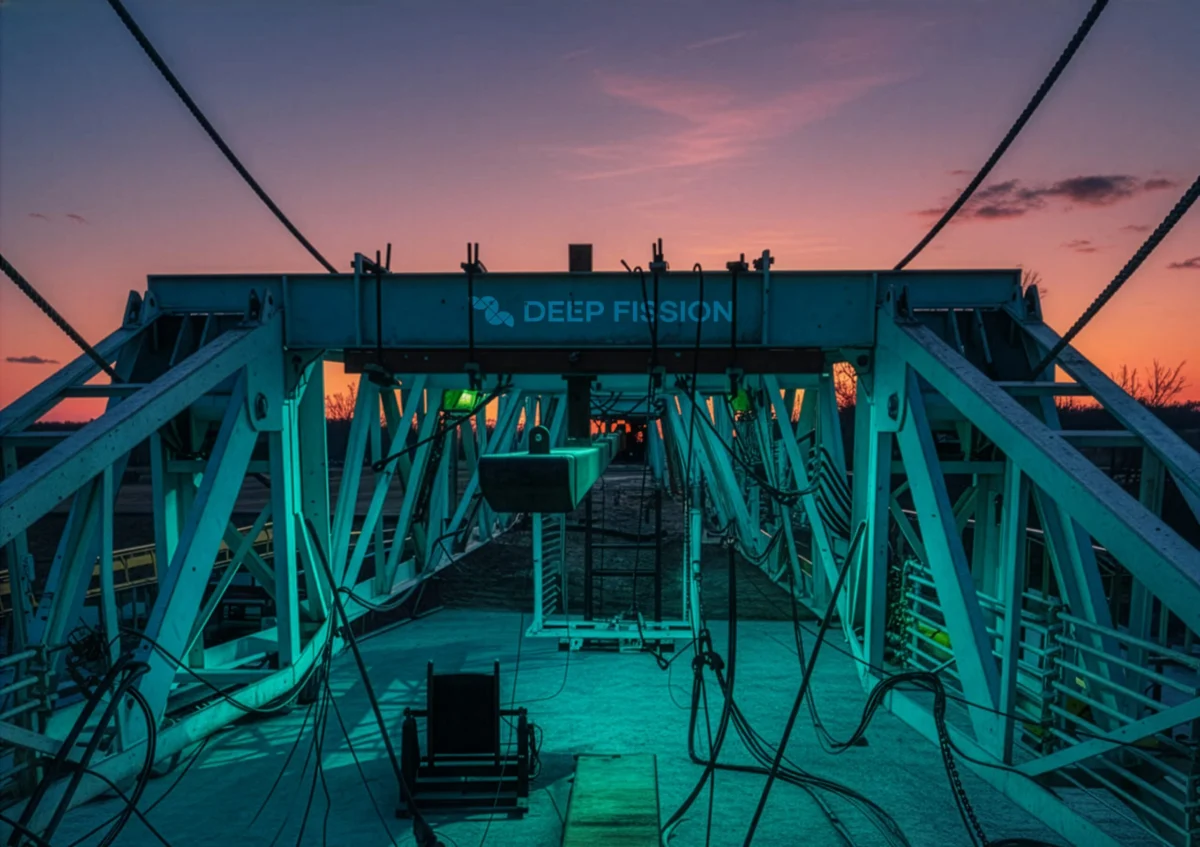
A peculiar sense of déjà vu has permeated the financial markets this week as nuclear startup Deep Fission announced its intention to go public on the Nasdaq exchange. The company, aiming to raise significant capital to fund the development of subterranean nuclear reactors designed to power the burgeoning demand from AI data centers, is embarking on this public offering barely a year after a previous, yet ultimately aborted, attempt to enter the public sphere. This unusual double bid for public market validation raises critical questions about the company’s trajectory, its financial health, and the broader investor appetite for nascent, high-risk energy technologies.
The Curious Case of a Double Public Offering
Last September, Deep Fission made headlines by announcing it had gone public through a reverse merger with Surfside Acquisition, a Delaware-based shell company. This mechanism, often associated with Special Purpose Acquisition Companies (SPACs), allows a private entity to quickly become publicly traded by acquiring an existing listed company. The transaction reportedly included a concurrent private placement that raised $30 million at a share price of $3. However, the anticipated public trading on the OTCQB, a marketplace for developing companies, never materialized. Searches for Deep Fission on the OTCQB yield no results, and the company’s own S-1 filing for its current Nasdaq bid explicitly denies that its stock has ever been publicly traded. This effectively renders the prior "public listing" a paper exercise, public in name only, leaving investors who participated in the private placement in an ambiguous position.
Now, Deep Fission is pursuing a more traditional Initial Public Offering (IPO) on Nasdaq, aiming to raise $157 million at a share price between $24 and $26. This offering would value the company at up to $1.66 billion, a staggering figure for a company that, according to market observers, was reportedly struggling to secure a $15 million funding round just one year prior. The shift in valuation and listing strategy, despite an arguably bleaker operational outlook, has prompted scrutiny from analysts and potential investors alike.
A Deep Dive into Deep Fission’s Financial Landscape
The recent S-1 filing, submitted to the Securities and Exchange Commission (SEC) on May 20, paints a more challenging financial picture compared to its December predecessor. A persistent "going concern" warning underscores the precariousness of Deep Fission’s financial position, indicating that without the successful completion of this IPO, the company faces a substantial risk of exhausting its capital within the next 12 months.
Indeed, the startup’s financial health has deteriorated demonstrably in recent months. The accumulated deficit ballooned from $56.2 million in December to $88.1 million by March. Furthermore, in the six weeks leading up to the filing, the company’s cash and cash equivalents declined by approximately $6.4 million, representing a substantial burn rate of about 7%. This rapid consumption of capital highlights the immense financial demands of developing complex nuclear technology and the critical need for a successful IPO to sustain operations.
The company did secure an $80 million equity investment prior to the current IPO attempt, a significant sum that included $20 million from Blue Owl, a prominent data center developer. Blue Owl also signed a non-binding Memorandum of Understanding (MOU) for future power plants, signaling potential strategic alignment. However, even this substantial injection of capital was insufficient to alleviate the "going concern" warning, suggesting that Deep Fission’s projected expenses and capital requirements remain exceptionally high, or that the investment terms did not fully address its immediate liquidity challenges.
Technological Ambitions Meet Ground-Level Realities
Deep Fission’s core mission revolves around developing small, subterranean nuclear reactors to provide clean, reliable power for the energy-intensive operations of AI data centers. The escalating demand for artificial intelligence processing has created an unprecedented need for electricity, with projections indicating that data center energy consumption could double or even triple in the coming years, potentially accounting for a significant percentage of global electricity usage. This context makes Deep Fission’s offering highly relevant, as nuclear power, particularly advanced fission technologies, is seen by many as a carbon-free, baseload solution capable of meeting such vast energy demands.
However, the path from concept to commercial operation for nuclear technology is notoriously long, capital-intensive, and fraught with regulatory and technical hurdles. The company’s latest S-1 reflects a slip in its development timeline. Previously, Deep Fission had targeted achieving "criticality"—the point at which a nuclear chain reaction becomes self-sustaining—by July 2026. This specific estimate has now been removed from the current filing, replaced with an unspecified timeline. Such delays in critical milestones are common in complex engineering projects but are a red flag for investors monitoring progress and assessing risk.
A key focus for Deep Fission now is drilling, perhaps a tacit acknowledgment of the significant challenges involved in creating the necessary infrastructure for subterranean reactors. In March, the company commenced drilling its first of three test wells, aiming to collect data from depths of up to 6,000 feet. This initial test well has an eight-inch diameter, a size significantly smaller than what would be required for commercial-scale reactors.
The transition from test wells to commercial deployment presents substantial engineering hurdles. Deep Fission estimates it will require boreholes ranging from 30 to 50 inches in diameter and extending a mile deep. To put this into perspective, even at the lower end of this range, these boreholes would be considerably larger than those typically used in the conventional oil and gas industry, where standard production wells rarely exceed 12-17 inches in diameter for the main wellbore. Drilling such wide and deep holes poses immense technical challenges, including managing rock stability, maintaining bore integrity, and developing specialized drilling equipment. The sheer scale and complexity of these operations have direct cost implications, potentially running into tens of millions of dollars per commercial borehole, depending on geological conditions. Until Deep Fission can definitively prove its capability to drill these large-diameter boreholes efficiently and cost-effectively, the final design of its reactors, which must integrate seamlessly into these subterranean structures, cannot be finalized.
Regulatory Landscape and Industry Comparisons
Beyond the technical and financial challenges, the regulatory environment for nuclear power is among the most stringent in the world. In the United States, the Nuclear Regulatory Commission (NRC) oversees all aspects of nuclear facility licensing, from design approval to construction and operation. The process is exhaustive, lengthy, and expensive, often taking a decade or more for advanced reactor designs.
Deep Fission’s relative position in this regulatory journey stands in stark contrast to some of its more established peers. For example, nuclear fission startup X-energy recently completed a successful, upsized IPO, with its stock performing strongly on its first day of trading. However, X-energy is in a significantly different stage of development; it is already generating revenue and is considerably farther along in the NRC’s licensing process for its Xe-100 small modular reactor. NuScale Power, another SMR developer, has also made significant strides, with its reactor design already certified by the NRC, a monumental achievement that de-risks a substantial portion of its commercialization pathway.
The comparison with companies like X-energy and NuScale serves as a crucial reminder for investors: in a sector where enthusiasm for groundbreaking technology can often outpace tangible progress, valuation and developmental milestones are not synonymous. Deep Fission’s current stage, still grappling with fundamental drilling mechanics and an undefined reactor timeline, places it far behind companies that are either revenue-generating or possess advanced regulatory approvals.
Market Dynamics and Investor Sentiment
The broader market context for nuclear energy has seen a significant shift in recent years. Driven by climate change concerns, energy security imperatives, and the escalating demand for reliable baseload power, particularly from industries like AI, there is renewed interest and investor excitement in advanced nuclear fission technologies. The success of X-energy’s IPO last month is a testament to this "fission fever."
However, this enthusiasm must be tempered with rigorous due diligence, especially for early-stage companies in capital-intensive sectors. The historical precedent of the SPAC boom and bust, where many companies went public with inflated valuations and unproven business models, serves as a cautionary tale. Deep Fission’s prior "public in name only" listing, combined with its current financial and technical situation, may cause some investors to approach this new IPO with heightened skepticism.
The $80 million investment, including from a strategic partner like Blue Owl, is a positive signal, suggesting a potential future off-take agreement for Deep Fission’s power. Blue Owl’s interest underscores the acute need for reliable, scalable energy solutions for data centers. However, the non-binding nature of the MOU means there is no firm commitment, and the ultimate success hinges on Deep Fission’s ability to deliver a commercially viable product on a reasonable timeline.
Implications and Outlook
The outcome of Deep Fission’s Nasdaq IPO will have significant implications, not just for the company itself, but potentially for the broader advanced nuclear sector. For Deep Fission, a failed IPO would almost certainly trigger the "going concern" warning, potentially leading to severe financial distress or even cessation of operations within the next year. A successful IPO, conversely, would provide a vital capital infusion, allowing the company to continue its ambitious drilling and reactor development efforts.
For the advanced nuclear industry, Deep Fission’s journey could serve as a litmus test. A successful public offering, despite the challenges, might further fuel investor confidence in innovative nuclear solutions. Conversely, if the offering struggles or the company faces continued setbacks post-IPO, it could introduce a note of caution, prompting more stringent scrutiny of other early-stage nuclear ventures.
Ultimately, while the vision of subterranean nuclear reactors powering the future of AI is compelling and timely, Deep Fission’s current IPO attempt appears to be driven less by demonstrable technological or commercial breakthroughs and more by an urgent need for capital and an opportunistic play on the prevailing investor excitement for fission power. The critical factors that will determine its long-term viability—successful drilling at scale, timely reactor development, and rigorous NRC approval—remain significant hurdles that lie far in the future. For investors, the decision will weigh the immense potential of the technology against the substantial financial risks, developmental delays, and a less-than-clear path to commercialization.