Jono Maryono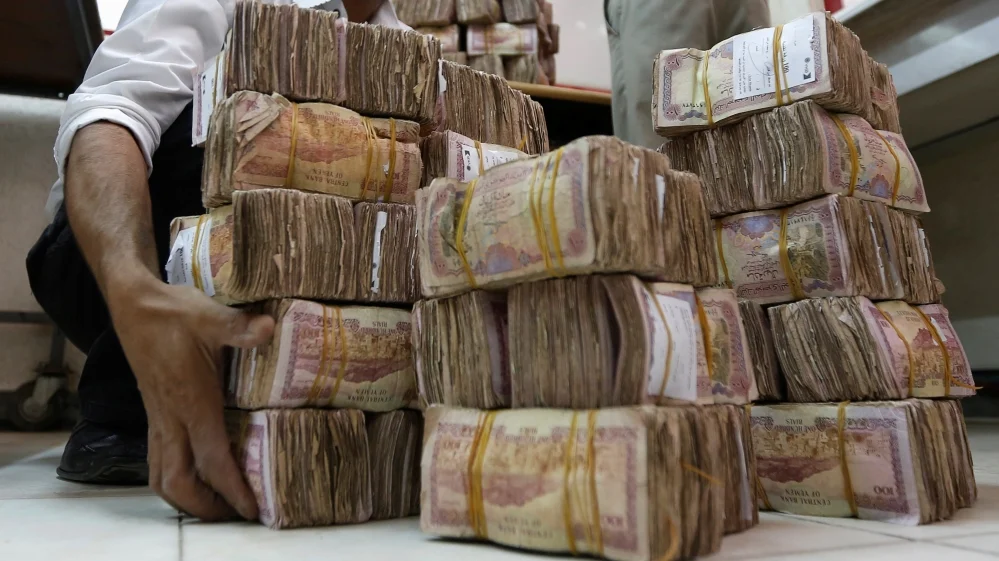
Mukalla, Yemen – The Yemeni government’s decisive actions to arrest the sharp devaluation of the national currency have, paradoxically, plunged the country into a crippling liquidity crunch, leaving citizens and businesses struggling to access even basic cash. While the measures implemented by the Central Bank of Yemen (CBY) in Aden have successfully curbed the Yemeni riyal’s precipitous fall against the US dollar, they have inadvertently choked the flow of physical currency, creating a parallel crisis that threatens to unravel any economic gains.
Months ago, the Yemeni riyal was trading at approximately 2,900 to the US dollar, a figure that underscored the nation’s profound economic instability. The CBY’s intervention, which included shutting down unauthorized exchange firms accused of currency speculation, centralizing internal remittance systems under a regulated framework, and establishing a committee to manage imports and provide traders with hard currency, brought the exchange rate down to a more stable figure of around 1,500 riyals to the dollar. This initial stabilization was met with cautious optimism, offering a glimmer of hope in a nation long beleaguered by conflict and economic collapse. However, this fragile recovery has been overshadowed by a severe shortage of Yemeni riyals in circulation, a problem that has escalated to unprecedented levels across government-controlled territories.
The Unforeseen Consequences of Currency Control
The immediate aftermath of the CBY’s directives has been a stark contradiction: while the riyal’s value has stabilized on paper, the physical availability of cash has evaporated. Residents in major cities such as Aden, Taiz, and Mukalla report an acute scarcity of Yemeni riyals. Banks and exchange firms, citing a crippling lack of physical cash, are reportedly refusing to convert foreign currencies like the US dollar and Saudi riyal, or are imposing stringent daily limits, sometimes as low as 50 Saudi riyals per person. This situation has left many Yemenis unable to access their savings, paralyzing daily transactions, stifling small businesses, and fostering a burgeoning black market where unofficial exchange rates are increasingly unfavorable to the customer.
Mohammed Omer, a small grocery shop owner in Mukalla, recounted his frustrating attempts to exchange a few hundred Saudi riyals received from customers. "I’ve gone from one exchange to another, and they refuse to exchange more than 50 riyals," Omer stated, his voice tinged with exasperation. "It’s a waste of time and effort – I’ve had to close my shop." His plight is emblematic of countless others who are finding their livelihoods threatened by the inability to access or utilize their own money.
A Decade of Economic Devastation
Yemen’s current economic predicament is inextricably linked to over a decade of devastating conflict. The war, pitting the Saudi-backed government against the Iran-aligned Houthi movement, has not only resulted in immense human suffering, with thousands killed and millions displaced, but has also systematically targeted the nation’s economic infrastructure and revenue streams. Both warring factions have been severely constrained by a lack of financial resources, struggling to meet fundamental obligations such as paying public sector salaries and funding essential services in the territories under their control.
The economic meltdown has been exacerbated by a fractured financial system, with parallel institutions and currencies operating in different regions. The CBY’s move to centralize control was an attempt to assert authority and bring order to a chaotic financial landscape. However, the rapid implementation and the sheer scale of the liquidity shortage suggest that the mechanisms for ensuring adequate cash circulation were either insufficient or were outpaced by the swiftness of the regulatory changes.
Official Acknowledgment and Proposed Solutions
In response to the growing public outcry and the evident economic paralysis, the Central Bank in Aden acknowledged the cash shortage during a board meeting in March. Officials stated that they had approved several "short- and long-term" measures to address the problem, though specifics were not disclosed. The CBY emphasized its commitment to pursuing "conservative precautionary policies" aimed at stabilizing the riyal and mitigating inflationary pressures. However, the effectiveness and timeline of these proposed solutions remain to be seen, as the liquidity crisis continues to deepen.
Meanwhile, the impact on government employees is particularly harsh. Many have reported receiving their salaries in low-denomination banknotes, primarily 100 and 200 riyal notes. This forces them to carry their wages in large, cumbersome bundles, and many merchants are refusing to accept such quantities of low-value currency. Munif Ali, a government employee in Lahj, took to social media platform Facebook to voice his frustration, posting a video of himself surrounded by stacks of small-denomination notes. "Merchants are refusing to recognize this," he lamented, calling for legal action against those who reject legally issued currency.
The Disproportionate Impact on Vulnerable Populations
The current liquidity crisis disproportionately affects those who rely on savings in hard currency, such as individuals who have accumulated wealth in Saudi riyals, Yemeni expatriates sending remittances home, and soldiers paid in foreign currency. These groups find themselves unable to convert their funds into usable Yemeni riyals, leaving them vulnerable to economic shocks and unable to meet immediate needs.
For instance, Saleh Omer, a resident of the Dawan district in Hadramout, recounted his struggle to exchange a remittance of 1,300 Saudi riyals. The exchange firm that facilitated the transfer refused to convert it into Yemeni riyals due to a lack of cash, advising him to seek local shops. Even then, after extensive pleading, a shopkeeper agreed to exchange only 500 Saudi riyals at a rate of 400 Yemeni riyals to the Saudi riyal, significantly below the official rate of approximately 410:1. Converting the remaining 800 Saudi riyals would require further days of effort, highlighting the immense difficulty faced by ordinary citizens in accessing their own money.
Navigating the Crisis: Workarounds and Stratification
In the absence of accessible formal channels, Yemenis have devised various coping mechanisms. Some rely on the goodwill of trusted shopkeepers for deferred payments, while others engage in informal exchanges at grocery stores and supermarkets, often accepting less favorable rates. The introduction of online money transfer services by some banks and exchange firms has provided a lifeline for a segment of the population, but these solutions are often inaccessible in rural areas with limited internet connectivity.
The social stratification within Yemen has also become more pronounced in navigating this crisis. Individuals with strong personal connections within the banking and exchange sectors are better positioned to access cash. Khaled Omer, a travel agency owner in Mukalla, explained his reliance on a trusted contact at a local exchange firm to obtain Yemeni riyals for payroll and essential expenses. "Exchange companies say they are facing a liquidity crunch," he observed, underscoring the widespread nature of the problem.
The ripple effects extend to critical sectors like healthcare. Reports have emerged of patients being denied medication as health facilities refuse to accept payments in Saudi riyals, with exchange firms unwilling or unable to convert them. Hesham al-Samaan in Taiz shared his ordeal when a local hospital refused to accept Saudi riyals for a relative’s treatment, forcing him to desperately search for someone willing to exchange the currency. His public appeal on Facebook, questioning the government’s role in protecting its citizens from such exploitation, resonated with many who shared similar experiences of being denied essential services due to the lack of local currency.
An Unforeseen Advantage for Importers
While the cash shortage has crippled many, it has inadvertently presented an opportunity for some traders, particularly those importing goods from Saudi Arabia. The increased availability of Saudi riyals at discounted rates has become a boon for these businesses. A clothing trader in Mukalla, speaking on condition of anonymity, admitted to accepting payments in both Yemeni and Saudi riyals to attract customers and secure the foreign currency necessary for his operations. "As a businessman who sells goods in Yemeni riyals, I benefit from the cash shortage," he stated. "Exchange companies that need local currency I hold sell me Saudi riyals at lower rates." This dynamic highlights the complex and often contradictory economic realities in Yemen, where one segment of the population’s hardship can translate into another’s gain.
The current liquidity crisis, a direct consequence of well-intentioned but potentially inadequately planned currency stabilization measures, underscores the fragile nature of Yemen’s economy. The government faces the daunting task of not only maintaining the riyal’s stability but also ensuring that the necessary liquidity is available to prevent the economy from grinding to a complete halt. Without a swift and effective resolution to the cash shortage, the gains made in stabilizing the currency risk being overshadowed by widespread economic hardship and social unrest. The path forward will require a delicate balancing act, addressing the immediate cash crunch while ensuring the long-term viability and accessibility of the Yemeni financial system.