
 Jono Maryono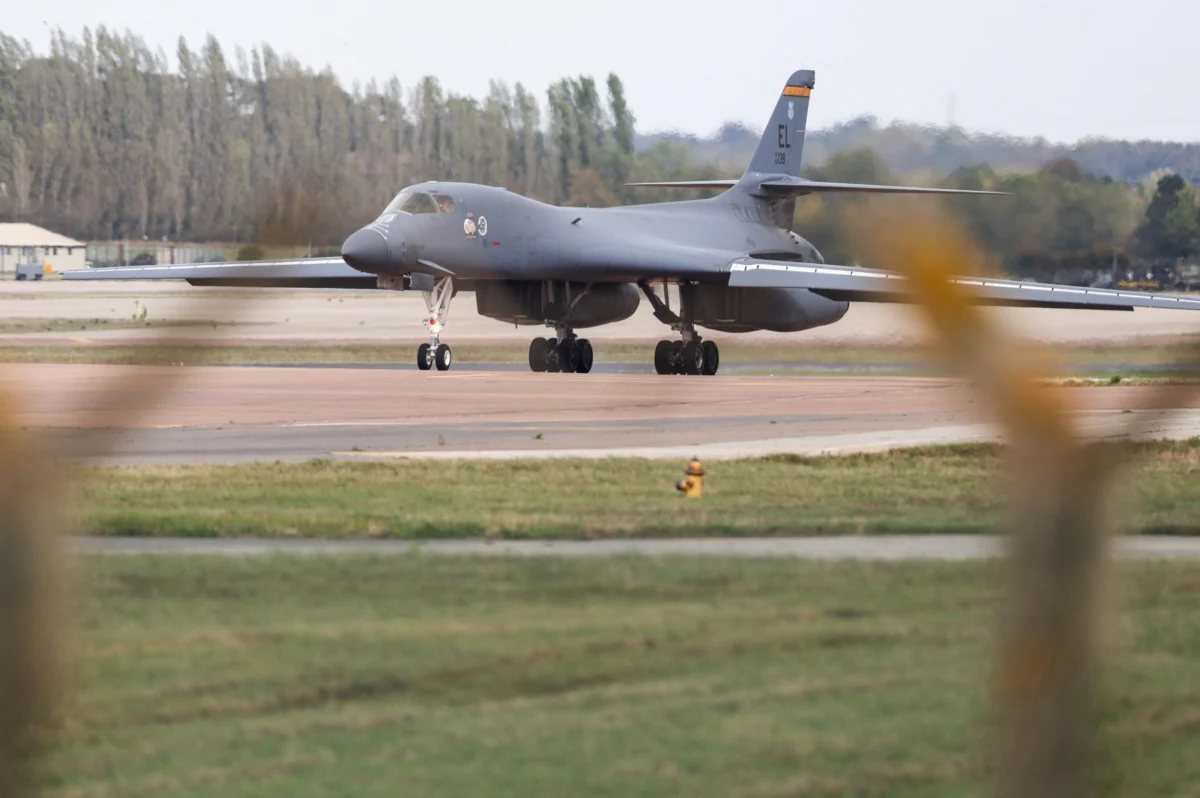
The departure of a dozen U.S. Air Force B-1B Lancer strategic bombers from Royal Air Force (RAF) Fairford in Gloucestershire, England, marks a sudden and significant shift in Western military posture across Europe. Over the course of Sunday, the heavy aircraft lifted off from the sprawling western England facility and headed west toward the United States, bringing an abrupt halt to the base’s role as the primary European forward operating hub for ongoing U.S. military operations targeting Iran.
RAF Fairford, situated approximately 160 kilometers (100 miles) west of London, holds a unique and critical status within global military infrastructure. It serves as the United States Air Force’s sole permanent European airfield specifically designated and equipped for heavy bomber operations. The facility provides Washington with a strategic geographic bridge across the Atlantic, significantly cutting down transit times and operational complexities for missions directed toward the Middle East and Eastern Europe. However, the sudden relocation of the fleet underscores the fragile intersection of geopolitical conflict, local security vulnerabilities, and force-protection protocols.
The withdrawal follows a tense fortnight marked by high-profile counterterrorism arrests in the United Kingdom, intensifying diplomatic friction between London and Tehran, and shifting explanations from senior Western officials regarding the precise motivation behind the redeployment. While the aircraft have only been moved back to domestic bases—where the vast majority of the U.S. strategic bomber fleet is permanently stationed—the timing of the flight operations has ignited an intense international debate over force survivability and the reach of foreign intelligence operations on allied soil.
A Chronology of Escalation and Security Breaches
To understand the sudden exodus from RAF Fairford, analysts must examine a rapidly developing timeline that intertwined local law enforcement actions with high-stakes international diplomacy.

The sequence of events began to accelerate in late September against the backdrop of an ongoing air campaign against Iranian targets, which commenced in late February. On September 27, British counterterrorism police executed a series of coordinated raids, arresting five men on suspicion of plotting to plant explosives near the perimeter of the Fairford installation. Subsequent searches of vehicles belonging to the suspects yielded quantities of petrol, though investigators confirmed that no active explosive devices were recovered during the initial operations. Despite the absence of immediate bomb-making materials, British authorities maintained that the individuals posed a credible threat and placed them under intensive investigation. The suspects were subsequently released on bail the following day as forensic inquiries continued.
The security apparatus in the UK was jolted again on October 2, when police operating in London detained a 25-year-old British-Iranian dual national. The individual was taken into custody on fresh suspicions of plotting an attack targeting the airbase. This arrest deepened anxieties regarding potential insider threats or coordinated sabotage operations directed by hostile state actors against Western military assets. Like the previous suspects, the young dual national was released on bail on October 3, though he remains the subject of an active and expansive national security probe.
The political fallout was swift. British Prime Minister Andy Burnham publicly suggested that the Iranian state had "played a part" in orchestrating the foiled plots, though he declined to elaborate on classified intelligence findings. Tehran forcefully denied any involvement, condemning the allegations as entirely baseless fabrications designed to manufacture hostile sentiment. In a traditional diplomatic protest, the Iranian government summoned the British ambassador in Tehran to formally register its displeasure over the arrests and the public accusations levied by British officials.
By Sunday, the operational calculus in Washington shifted. Faced with mounting intelligence assessments regarding potential threats to the facility, the decision was made to evacuate the B-1B fleet, clearing the tarmac at Fairford and diffusing a potential security flashpoint on British territory.
Divergent Official Narratives from Washington
The explanations offered by senior U.S. leadership regarding the bomber relocation highlighted differing internal assessments of the threat environment, creating a brief period of public confusion.

U.S. President Donald Trump addressed reporters at the White House on Monday, explicitly linking the aircraft movement to external security threats. "There were some threats, and we believe they were linked to Iran," President Trump stated. "So we moved them around a little bit, not very far." The acknowledgment of a direct threat profile stood in contrast to standard military messaging, which often minimizes operational disruptions to project strength and stability.
Hours prior to the president’s remarks, U.S. Secretary of State Marco Rubio sought to downplay the connection between the police arrests and the tactical redeployment of the bombers. Speaking to the press, Rubio characterized the flight home as a routine matter, asserting that it was "not unusual to see rotations happen" within the global bomber task force framework. He further expressed absolute confidence in the robust security protocols governing U.S. military installations hosted by international allies.
Despite Secretary Rubio’s efforts to frame the move as business-as-usual, defense analysts widely agree that relocating an entire wing of strategic assets directly in response to local arrests represents an extraordinary precautionary measure, signaling a high level of concern over asymmetric or terrorist threats to high-value military hardware.
Inside the U.S. Heavy Bomber Fleet: Capabilities and Constraints
The departure from Fairford places renewed focus on the unique capabilities, maintenance demands, and strategic roles of the heavy bomber fleet operated by the United States Air Force. The service currently relies on three active aircraft types, with a fourth advanced platform progressing through the final stages of development and flight testing.
The B-52 Stratofortress remains the patriarch of the fleet. Entering service during the Cold War, the active B-52H models currently deployed were constructed in the early 1960s. Boasting an impressive wingspan of 56 meters (185 feet), the Stratofortress is the largest bomber in the U.S. inventory. It possesses a massive payload capacity of approximately 31 tonnes, capable of hauling an extensive array of conventional ordnance, precision-guided cruise missiles, and strategic nuclear weapons. B-52s have been a frequent sight at RAF Fairford throughout various rotational deployments, serving as the workhorse for long-range conventional deterrence and strike missions.

The aircraft that actually departed Fairford this weekend were the B-1B Lancers. Introduced to the operational inventory in the mid-1980s, the Lancer is distinguished by its variable-sweep wings, which sweep back to enable supersonic flight speeds reaching up to 1.2 times the speed of sound. While the B-1B was stripped of its nuclear mission under strategic arms reduction treaties, it carries the heaviest conventional payload of any aircraft in the U.S. stable, hauling roughly 34 tonnes of internal and external munitions. Its combination of speed, low-altitude flight capabilities, and immense ordnance capacity made it a central asset in the recent air campaigns.
The third pillar of the force is the B-2 Spirit, an advanced flying-wing stealth bomber designed specifically to penetrate sophisticated, layered integrated air defense networks. With a production run capped at just 20 aircraft—leaving 19 currently operational—the B-2 is among the most exclusive and costly military aircraft ever built. It is capable of delivering both conventional and thermonuclear weapons, including the colossal 13,600-kilogram (30,000-pound) GBU-57 Massive Ordnance Penetrator, colloquially known as the "bunker buster." These specialized munitions were famously utilized by B-2s launched from continental U.S. bases during precision strikes on heavily fortified Iranian nuclear infrastructure in June 2025.
Looking toward the future, the U.S. Air Force is actively preparing for generational fleet modernization. The B-21 Raider, a next-generation stealth bomber designed with advanced digital architectures and reduced maintenance footprints, is currently undergoing rigorous flight testing. Program officials confirm the aircraft remains firmly on track for initial operational delivery in 2027. Over the next fifteen years, the service intends to systematically retire the aging B-1B and B-2 fleets, transitioning toward a streamlined, highly capable future force structure composed exclusively of B-21 Raiders and heavily modernized, upgraded B-52 Stratofortresses.
Global Logistics and the Architecture of Bomber Deployments
The operational footprint of the U.S. strategic bomber force is underpinned by a complex global logistical network. Permanently, all U.S. heavy bombers are based within the continental United States, housed across five primary installations: Barksdale Air Force Base in Louisiana, Minot Air Force Base in North Dakota, Whiteman Air Force Base in Missouri, Dyess Air Force Base in Texas, and Ellsworth Air Force Base in South Dakota.
These domestic hubs feature exceptionally long and wide runways—typically exceeding 10,000 feet (3,048 meters)—comparable in scale to the largest international civil aviation hubs. However, military planners note that runway length is rarely the primary limiting factor for global bomber operations. Instead, deployment locations are dictated by stringent security infrastructure, specialized weapons storage facilities capable of housing sensitive munitions, and extensive technical maintenance support footprints.

When executing operations abroad, the U.S. Air Force frequently utilizes forward operating locations and rotational deployments to project power and reassure regional allies. Alongside RAF Fairford in Europe, key overseas nodes include Andersen Air Force Base on the U.S. territory of Guam in the Western Pacific and the strategically vital joint U.S.-British naval and air support facility on the island of Diego Garcia in the Indian Ocean.
In addition to permanent forward bases, the Air Force routinely dispatches smaller task force elements to allied nations for brief operational windows under the rubric of "Bomber Task Force" deployments. Recent months have seen B-52s operating out of Morón Air Base in Spain, B-1Bs stationed at Ørland Main Air Station in Norway and Misawa Air Base in Japan, and B-52 detachments deployed to Tindal in northern Australia.
When forward basing options are restricted or rendered politically or operationally unviable—as demonstrated by the sudden clearing of RAF Fairford—the U.S. military retains the capability to execute global strike missions directly from the continental United States. This capability, however, relies entirely on extensive aerial refueling support. During the height of the conflict with Iran, intercontinental bomber missions launched from domestic bases routinely exceeded 30 hours round-trip. To sustain these grueling sorties, each three-bomber formation required dedicated support from six to nine aerial refueling tanker aircraft to rendezvous along transoceanic flight paths, illustrating the vast logistical coordination required to maintain global strategic reach independent of European infrastructure.
Strategic Implications of the Fairford Withdrawal
The removal of the B-1B fleet from Gloucestershire carries immediate and long-term implications for European defense architecture and Western coalition operations.
In the short term, the absence of heavy bombers at RAF Fairford degrades the immediate responsiveness of U.S. power projection capabilities in the European and Middle Eastern theaters. While missions can still be launched from North American sanctuaries or alternative overseas hubs like Diego Garcia, the elimination of a prime forward-staging post in Western Europe increases transit times and reliance on complex tanker air bridges. This operational friction could complicate rapid-response tasking should regional hostilities flare up unexpectedly.

From a counterterrorism and internal security perspective, the incident exposes vulnerabilities regarding the protection of high-value military installations located within densely populated allied nations. The ability of alleged conspirators to surveil or attempt sabotage near a vital NATO-aligned airbase highlights the ongoing threat posed by asymmetric actors, proxy networks, and insider infiltration. Host nations like the United Kingdom now face intensified pressure from Washington to enhance perimeter security, tighten intelligence sharing regarding dual-national threats, and aggressively neutralize hostile intelligence operations operating within domestic borders.
Ultimately, the sudden departure of the B-1B Lancers serves as a stark reminder that modern strategic warfare is not solely determined by raw kinetic capabilities—such as Mach-1.2 speeds, massive explosive payloads, and stealth technology—but remains deeply vulnerable to the persistent, low-tech challenges of local security, counterintelligence vigilance, and the complex diplomatic equations binding international military alliances.









