
 Jono Maryono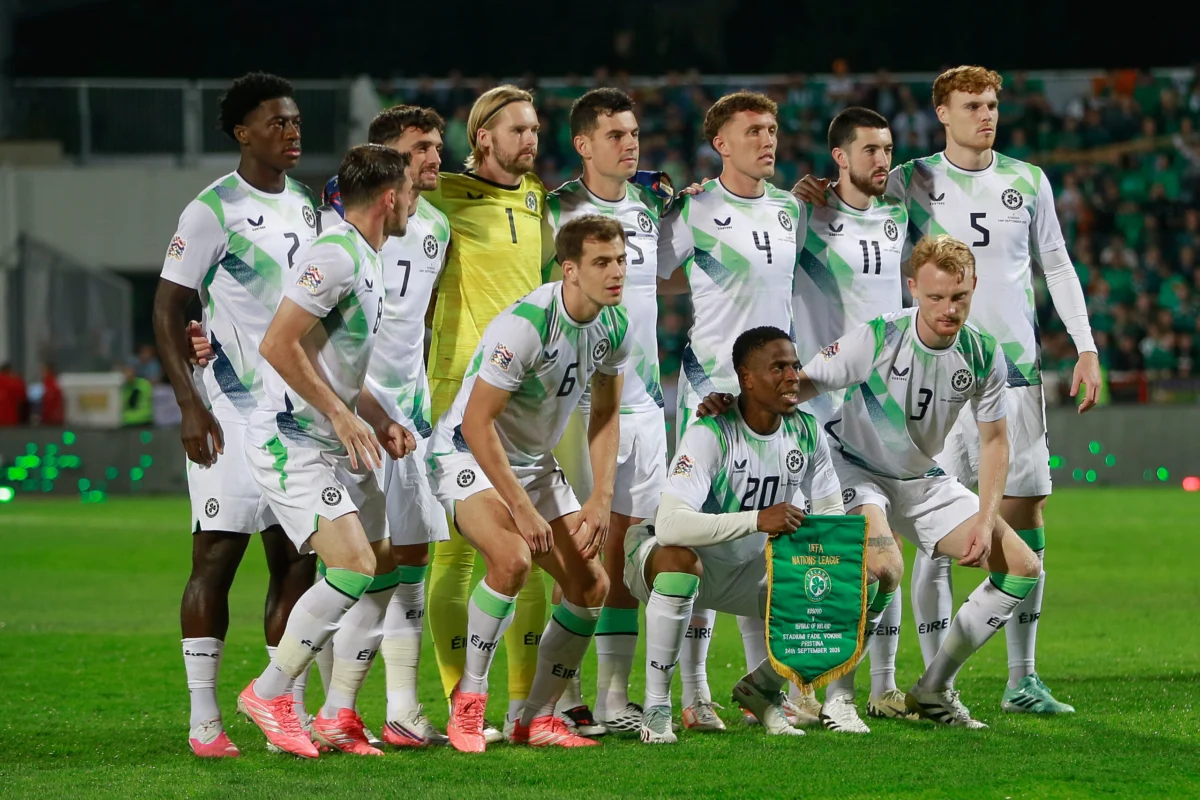
Preparations for Ireland’s upcoming UEFA Nations League fixtures against Israel have plunged into disarray, as mounting domestic and international pressure, coupled with reported player dissent, threatens to derail the matches entirely. Scheduled to face Israel in Debrecen, Hungary, on Sunday before hosting the return fixture in Bačka Topola, Serbia, on October 4, the Football Association of Ireland (FAI) finds itself at the center of a severe ethical, sporting, and political storm.
The crisis escalated dramatically on Saturday when media personnel stationed in Hungary were left waiting indefinitely ahead of a scheduled pre-match news conference. Informed only 15 minutes before the planned start time that proceedings would be delayed until after the team’s training session, journalists faced further disruptions. According to reports from Irish broadcaster RTÉ, the squad remained confined to their hotel more than two hours past the scheduled commencement of training. Sources within the camp indicated that a faction of the playing squad had expressed strong reservations about fulfilling the fixtures, raising the distinct possibility of a collective boycott rooted in conscience.
The unfolding developments highlight a profound friction between governing body directives, player autonomy, and public sentiment in Ireland, where solidarity with the Palestinian population remains deeply embedded in the social and political fabric.
Chronology of a Mounting Crisis
The friction surrounding these fixtures is not a sudden development but the culmination of months of geopolitical tension, sporting diplomacy, and domestic activism.
Back in November, the FAI initially adopted a principled stance by formally petitioning UEFA to suspend Israel from international competition, citing the humanitarian crisis in Gaza. However, European football’s governing body rejected the appeal, leaving national associations with a binary choice: fulfill scheduled matches or face severe sporting and financial sanctions.
As the match dates approached, public opposition intensified. Last week, demonstrators gathered outside the Irish team hotel in Dublin, urging players to take a stand. Concurrently, the SIPTU trade union erected a prominent billboard in central Dublin near the River Liffey. Displaying an image of a blood-stained football, the installation carried the unambiguous messages: “Go with your conscience!” and “Don’t play with genocide.”
By Thursday, following a 1-0 defeat to Kosovo, player discomfort spilled into the public domain. Midfielder Jason Knight acknowledged the unenviable position of the squad, explicitly stating that he believed the matches should not proceed.
The rhetoric reached a fever pitch when Ireland manager Heimir Hallgrímsson attempted to navigate the controversy by stating, “We’re not playing with genocide, we’re playing against genocide. We’re playing against Israel, we’re not playing with Israel.” The remarks provoked an immediate and furious backlash from the Israel Football Association (IFA), which condemned the Icelandic coach’s comments as a display of “stupidity, ignorance, and hypocrisy.”
Saturday’s dramatic delays in Hungary suggest that these tensions have permeated the dressing room, threatening team cohesion as players weigh their professional obligations against personal and public ethics.
Domestic Pressure and the Voices of Dissent
The FAI’s decision to proceed with the fixtures has drawn sharp rebukes from various sectors of Irish society, bridging sports, labor unions, and civil society.
More than 160 prominent Irish athletes and sports figures signed an open letter imploring the FAI to reconsider its compliance with UEFA’s mandate. The signatories argued that sport cannot remain entirely divorced from humanitarian crises of this magnitude, particularly when national bodies have previously demonstrated a willingness to sanction states for geopolitical transgressions—precedents established notably in the swift exclusion of Russian teams following the invasion of Ukraine in 2022.
Former Ireland manager Brian Kerr articulated the depth of public alienation during a media appearance, asserting that the FAI had “lost the respect of the Irish people.”
“The Irish people and the soccer-going public don’t want the games to be played,” Kerr stated. “I think they’ve made their opinions clear over the last year. The FAI back in November actually went to UEFA and requested that Israel be put out of the tournament on principle. And yet they went against that principle.”
The sense of contradiction highlighted by critics forms the core of the domestic outcry. For many supporters and observers, the FAI’s initial instinct to lobby UEFA was the correct moral path, making their subsequent compliance difficult to reconcile for a public deeply attuned to Palestinian advocacy.
The UEFA Dilemma and Strategic Implications
At the heart of the FAI’s official stance is the threat of severe regulatory penalties. UEFA maintains strict protocols regarding political interference and fixture fulfillment. A unilateral boycott by Ireland could trigger cascading consequences, including heavy financial fines, the forfeiture of matches resulting in automatic 3-0 losses, and potential expulsion from future European competitions.
Of particular concern to the Irish association is the nation’s joint hosting status for the UEFA European Championship in 2028, a landmark tournament shared with England, Scotland, Wales, and Northern Ireland. FAI administrators have privately and publicly emphasized that risking the country’s standing within European football governance could jeopardize long-term infrastructural development, funding, and prestige associated with EURO 2028.
Yet, this adherence to realpolitik has created an internal crisis. RTÉ reporter Tony O’Donoghue highlighted the delicate balance within the squad, noting the collective ethos fostered by the coaching staff.
“If they stay to their stated ambition that they have to be all in it together, if one or more want to be out, maybe they will all be out,” O’Donoghue told RTÉ Radio 1, pointing to the risk of a complete squad walkout if individual players refuse to take the field.
Broader Precedents in International Sport
The situation facing the Republic of Ireland and Israel is part of a broader, increasingly complex intersection of geopolitics and international athletics. In recent years, international sports bodies have faced intense scrutiny regarding consistency in applying sanctions.
The prompt suspension of Russian and Belarusian athletes and teams by numerous international federations—including FIFA, UEFA, and the International Olympic Committee—following the outbreak of war in Ukraine established a modern benchmark for how sports organizations can respond to state aggression. Activists and critics frequently cite these swift measures when questioning why similar actions have not been uniformly applied in other geopolitical conflicts, leading to accusations of double standards within global sports administration.
Conversely, sports governing bodies consistently defend their frameworks by arguing that sports should remain a neutral platform, and that national associations should not be penalized for the actions of their sovereign governments. This ideological fault line leaves athletes, coaches, and administrators caught in the middle, forced to navigate moral dilemmas on global stages where there are rarely satisfactory resolutions.
Outlook as Matchday Approaches
As Sunday’s fixture approaches, the immediate priority for the FAI management team is stabilizing the camp and ensuring a functioning team takes the pitch in Debrecen. However, the events of the past week have already inflicted reputational damage and laid bare the deep fractures between institutional governance and public conscience in Irish football.
Even if the matches proceed as scheduled, the discussions triggered by the boycott movement extend far beyond the 90 minutes in Hungary and the subsequent fixture in Serbia. The episode serves as a watershed moment for Irish sport, illustrating the profound challenges that arise when global politics inevitably breach the boundaries of the playing field.









