Jono Maryono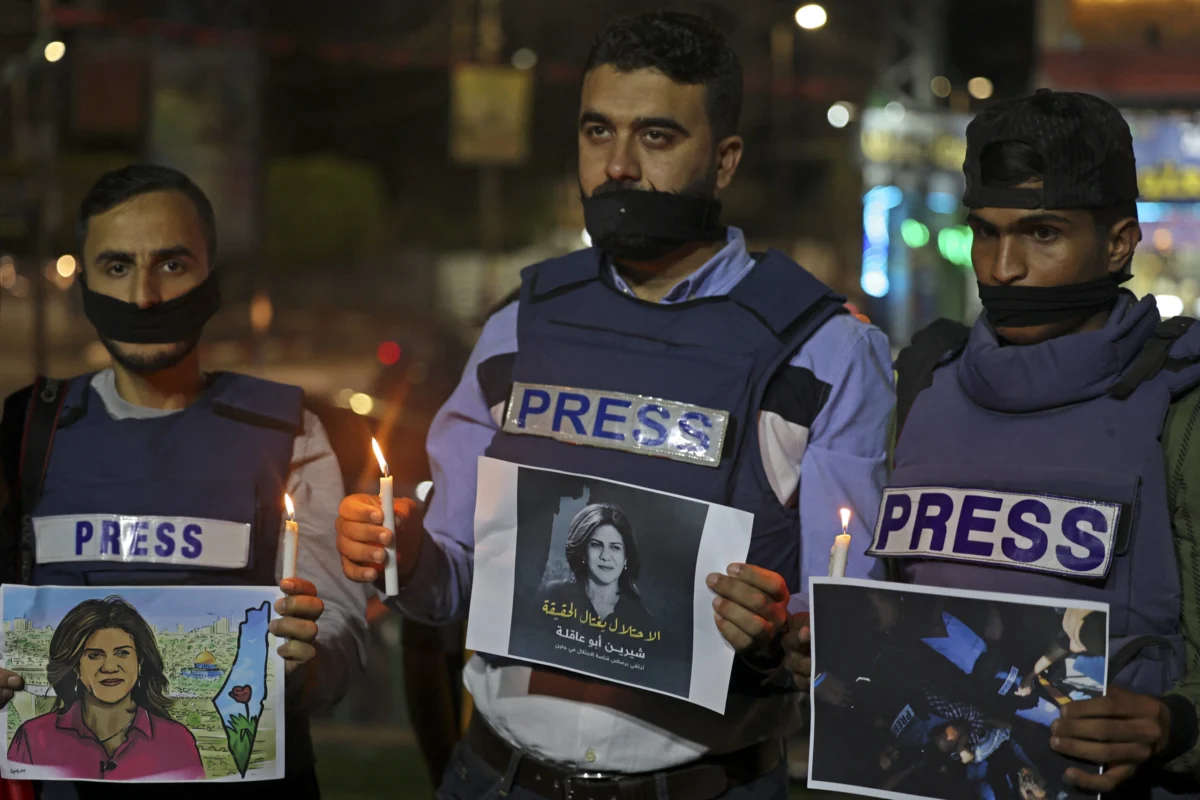
Four years after the fatal shooting of Shireen Abu Akleh, the veteran Al Jazeera correspondent whose voice resonated across the Arab world, the quest for justice remains unfulfilled, casting a long shadow over press freedom and accountability in the occupied Palestinian territories. The circumstances surrounding her death, and the subsequent lack of tangible repercussions for those responsible, have fueled a climate of impunity that Palestinian journalists and human rights advocates argue has emboldened further attacks on the press.
The tragic events of May 11, 2022, unfolded with brutal clarity. As Israeli forces conducted a raid in the Jenin refugee camp, veteran Al Jazeera correspondent Shireen Abu Akleh and her colleague, Palestinian journalist Ali al-Samoudi, were covering the operation. Both were wearing clearly marked press vests. According to al-Samoudi, who spoke to Al Jazeera, they were positioned in a street where there were no Palestinian fighters, no clashes, and no stone-throwers. They were also at a considerable distance from Palestinian civilians.
“We were alone. We were looking at the Israeli army to get close to them to find a safe spot for coverage,” al-Samoudi recounted. It was then that the first shots rang out. Al-Samoudi, who was at the forefront, turned to warn Abu Akleh. “I was telling her, ‘Let’s go back; it looks like they’re shooting towards us.’ As soon as I finished my sentence, I felt like something struck me. I put my hand on my back and found blood.” He believes the bullet that struck him in the back was intended for his chest, indicating a deliberate targeting.
Abu Akleh’s final words, he recalled, were a concerned utterance: “Ali got injured.” As al-Samoudi retreated, bleeding heavily, Abu Akleh moved to take cover behind a wall. He did not witness the second shot that claimed her life, as he was focused on reaching a hospital. He managed to get into a civilian car and was driven to Ibn Sina hospital, approximately 500 meters away. It was there, while medics were tending to his bullet wound, that the body of his colleague arrived. The trauma of the moment was palpable. “I managed to look and see Shireen lying next to me. I couldn’t believe the situation. I started screaming, and I tried to get to her. They didn’t let me,” al-Samoudi said. His experience in the field, however, left him with no doubt: “I knew from my experience in field work that it was clear that she had been killed.”
Abu Akleh, a dual US-Palestinian citizen, was a towering figure in Middle Eastern journalism, renowned for her decades of fearless reporting from the Palestinian territories. Her killing, described by Al Jazeera as an "assassination in cold blood," sent shockwaves through the international community and the journalism profession.
A Pattern of Unaccountability
The years following Abu Akleh’s death have been marked by a distressing lack of accountability. Despite numerous eyewitness accounts, independent investigations by media organizations, and even initial acknowledgments from Israeli officials that there was a "high possibility" of accidental fire by Israeli forces, no arrests have been made, and no charges have been filed. This absence of justice, advocates argue, has created a dangerous precedent.
“The absence of accountability, the absence of justice, the absence of the law and the failure to prosecute the perpetrators of the crime of assassination of Shireen led to these miseries that we are witnessing and the systemic and widespread killing of journalists,” al-Samoudi stated. He added, with palpable frustration, "Now Israel – with the utmost ease – says it is executing journalists."
Indeed, press freedom organizations have documented a grim trend: since the killing of Abu Akleh, Israel has been implicated in the deaths of hundreds of journalists and numerous US citizens in Gaza, Lebanon, and the West Bank. The Committee to Protect Journalists (CPJ) has identified Israel as the leading killer of journalists globally in recent years. This statistic, juxtaposed with the lack of consequences for Abu Akleh’s killing, paints a stark picture of the challenges faced by those reporting from the region.
The US Role and the Burden of Responsibility
As an American citizen, Shireen Abu Akleh’s death placed a particular onus on the United States to pursue justice. Washington’s long-standing, multifaceted relationship with Israel, including billions of dollars in annual military aid and diplomatic support, means it possesses significant leverage. Yet, critics contend that the US has failed to wield this influence effectively.

“If the US had imposed the appropriate measures and sanctions against Israel over the killing of Shireen, it may have saved hundreds of Palestinian journalists and civilians,” al-Samoudi asserted, calling on US officials to "wake up" and confront Israeli abuses. He lamented the "bias" and "support for Israel" as violations of fundamental human rights.
James Zogby, president of the Arab American Institute, echoed this sentiment. “The US is the only power that could play a role here. It has levers it chooses not to use,” he told Al Jazeera. While Israeli officials confirmed in late 2022 that the US had opened an investigation into the shooting, the probe has yielded no public reports or criminal charges. Al-Samoudi, one of the few eyewitnesses, reported being interviewed by US officials only once, with no subsequent follow-up. The Department of Justice, which oversees the FBI, did not respond to Al Jazeera’s request for comment by the time of publication.
The administration of former President Joe Biden did not confirm the FBI probe and, at times, appeared to adopt the Israeli narrative that the killing of Abu Akleh was accidental, a stance widely criticized by human rights groups and the journalistic community. Martin Roux, head of the crisis desk at Reporters Without Borders (RSF), observed that Abu Akleh’s killing sent a clear message: "Israel would be free to terrorize Palestinian journalists without consequence." He added, "This was part of a long series of targeted killings of Palestinian reporters by the Israeli army. Unfortunately, we see not only a lack of accountability and justice but a lack of pressure from Israel’s allies such as the United States.”
The Day of the Shooting: A Detailed Account
Al-Samoudi remains resolute in his conviction that he and Abu Akleh were deliberately targeted. On the morning of May 11, 2022, they arrived at the western edge of the Jenin refugee camp, where Israeli military forces were conducting a raid. Accompanied by other reporters, they were clearly identifiable in their press gear.
“We entered the street. There were no [Palestinian] fighters. There were no clashes of any kind near us. There weren’t even any stone throwers. We were also far from Palestinian civilians who were behind us,” al-Samoudi stated. He elaborated on their positioning: “As journalists, we were alone. We were looking at the Israeli army to get close to them to find a safe spot for coverage.”
The first shot struck al-Samoudi in the back. As he turned to alert Abu Akleh, he felt the impact. “I was telling her, ‘Let’s go back; it looks like they’re shooting towards us.’ As soon as I finished my sentence, I felt like something struck me. I put my hand on my back and found blood,” he recounted. He believes the soldiers likely intended to shoot him in the chest.
Abu Akleh was reportedly shot in the neck in a small, exposed area between her helmet and protective jacket. Al-Samoudi stressed that there was no warning from Israeli forces. “If they had told us to leave, we would have left,” he insisted. He characterized the shooting as a "targeted attack" rather than an accident or coincidence.
The timing of Abu Akleh’s killing coincided with a period of heightened Israeli military operations in the West Bank. Under the government of then-Prime Minister Naftali Bennett, there was a push to project an image of unwavering toughness against Palestinians, particularly amid criticism from the right wing of the political spectrum. The year 2022 was declared the deadliest year for Palestinians in the West Bank in 16 years, prior to the escalation of conflict in October 2023.
Al-Samoudi posited that Abu Akleh’s killing was a deliberate act aimed at silencing Al Jazeera’s coverage of Israeli assaults, particularly in Jenin. “They didn’t want us to be there. There was an Israeli plan to commit more crimes against Palestinians,” he said. “They didn’t want any eyewitnesses. They didn’t want any documentation. They didn’t want anyone to expose these Israeli abuses.”
Obfuscation and Delayed Justice
Following the shooting, then-Israeli Prime Minister Naftali Bennett initially claimed that Abu Akleh was shot by Palestinian fighters, sharing a video of clashes occurring some distance from the actual incident. When this narrative faltered, Israel announced an investigation. In September 2022, the Israeli military concluded there was a "high possibility" that Abu Akleh was "accidentally hit" by Israeli fire, a conclusion that starkly contrasted with eyewitness testimonies and findings from numerous independent media investigations.

"Israel’s response to her killing set a template of denying, lying and obfuscating," James Zogby observed. "First they say they didn’t do it. Then they say that somebody else did it. And finally, they say that they’ll look into it. It’s a way to avoid accountability that Israel has used as a tried-and-true practice for all sorts of crimes. And because it worked, it creates a sense of impunity. Israel believes they can get away with it.”
Zogby further criticized the US for seemingly adopting Israel’s strategy. "Part of the process of obfuscation came from the US. They started an investigation and four years later there are still no answers. It is a means of shielding Israel through delay.”
The pattern of delayed or absent accountability extends to other cases involving US citizens killed by Israeli forces or settlers. In one instance, US Ambassador Mike Huckabee called for an aggressive investigation into the killing of 20-year-old American citizen Sayfollah Musallet, who was beaten to death by settlers in the West Bank. However, ten months later, no criminal charges have been filed. Omar Shakir, executive director at DAWN, noted that his organization has documented at least 14 US citizens killed by Israeli forces or settlers since 2003, with no perpetrators held accountable. "When the United States failed to impose consequences on Israel for the killing of Shireen Abu Akleh, it sent a clear message: American lives do not matter when Israel kills them," Shakir stated. "That climate of impunity has had deadly consequences."
The Continuing Coverage
In the wake of Abu Akleh’s death, Israel has become the world’s leading killer of journalists, according to press freedom advocates. The Israeli military has, in several instances, documented and disseminated footage of journalist assassinations, often baselessly claiming the deceased were members of armed groups. Several Al Jazeera journalists, including Ismail al-Ghoul and Anas al-Sharif, have been killed in Israeli attacks in Gaza.
In the West Bank, press freedom is under constant strain. Ali al-Samoudi himself was released in early 2024 after a year of Israeli administrative detention, during which he reportedly endured abuse and significant weight loss. Journalists in the West Bank also face the escalating threat of violent settlers, often operating with perceived impunity and backed by the Israeli military. Assaults, movement restrictions, and brutal attacks have become increasingly common.
Furthermore, the trend of detaining journalists without charge, a practice to which al-Samoudi has been subjected, persists. According to the Palestinian Prisoners Society, more than 40 Palestinian journalists remain imprisoned by Israel.
Despite these formidable challenges, the spirit of journalism endures. “They want to stop us from doing our work, especially that we are the friends and colleagues of Shireen. We have said, and we will continue to say, ‘the coverage continues.’ Shireen Abu Akleh’s voice will not be silenced,” al-Samoudi declared.
He spoke with profound admiration for Abu Akleh, emphasizing her enduring legacy. “Shireen represented a comprehensive school in journalism, in humanity, in morality, in superior ideals. She was committed to fulfilling her mission with professionalism. Her coverage of the news was not ordinary or traditional,” he said. “She was able to analyze, describe and report on any situation with sophistication, which granted her an elevated status that allowed her to get closer to the people and earn the respect of everyone. Generations will learn from her. Shireen Abu Akleh is the Palestinian flame that will never be extinguished.” Her story, and the ongoing struggle for accountability in her name, continues to illuminate the critical role of independent journalism in bearing witness to truth, even in the face of overwhelming adversity.