Layla Zulfa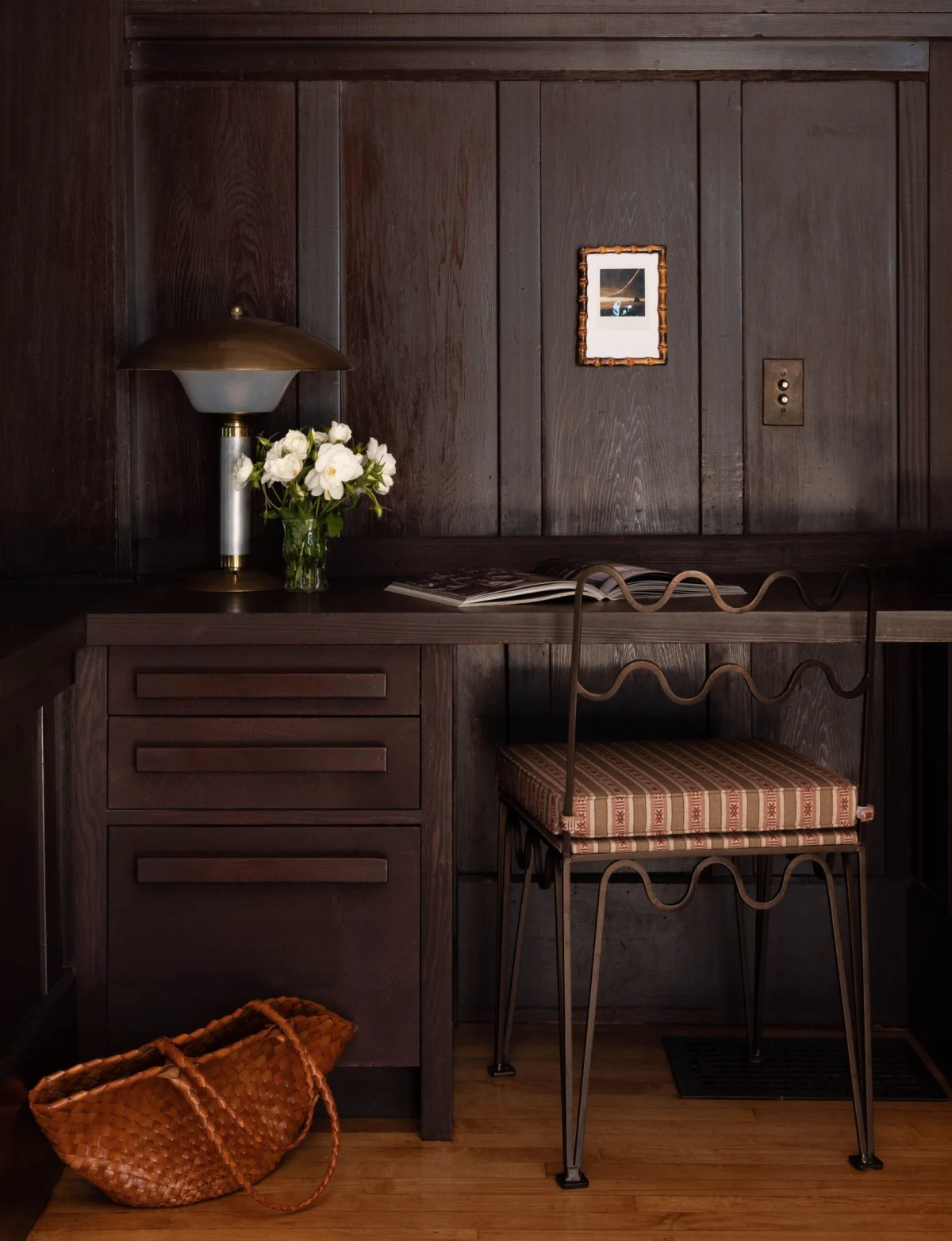
The Evolution of the Undulating Silhouette
The design of the Méandre collection is deeply rooted in the mid-century French decorative arts, specifically drawing inspiration from the work of Jean Royère (1902–1981). Royère was a seminal figure in 20th-century design, celebrated for his ability to merge traditional craftsmanship with biomorphic, playful shapes that defied the rigid functionalism of his contemporaries. His "Liane" wall lamps and "Ours Polaire" (Polar Bear) sofas utilized organic curves to create a sense of movement and comfort.
The Méandre by Design Frères—a Los Angeles-based design house and showroom known for its custom furniture and curation of European-inspired pieces—acts as a contemporary homage to this Royère-esque sensibility. The collection features hand-forged iron frames that twist into repetitive, rhythmic waves, providing a delicate yet industrial framework for various seating options. This historical lineage provides the piece with a level of "design gravitas" that distinguishes it from the mass-produced, brightly colored "squiggle" decor that flooded the market in the early 2020s.

Chronology of Recent Market Resurgence
The timeline of the Méandre’s recent ubiquity can be traced through several high-profile interior design projects featured in major publications between 2023 and 2024.
- Late 2023: The Austin Midcentury Revival. Designer Fern Santini integrated the Méandre chair into the primary bathroom of an Austin, Texas, home. Positioned amidst Parisian-inspired elements like brass hardware and herringbone flooring, the chair served to soften the hard surfaces of the marble and tile, demonstrating its utility in transitionary spaces.
- Early 2024: The Brooklyn Art Deco Apartment. Designer and resident Justin DiPiero utilized the Méandre chair in his 1939 pre-war Brooklyn residence. DiPiero’s use of the chair highlighted its ability to bridge the gap between historic Art Deco architecture and modern, "whimsical" furniture.
- Mid-2024: The Berkeley Craftsman. Designer Heidi Caillier featured the Méandre chair in a dark corner of a quintessential Berkeley craftsman home. By adding a bespoke Namay Samay textile seat, Caillier illustrated the piece’s versatility, proving it could harmonize with British-influenced, textured interiors rather than just minimalist or ultra-modern spaces.
- Late 2024: The Dordogne Cháteau. Designer Brandon Quattrone paired Méandre counter stools with a Shaker-style island in a renovated 14th-century French kitchen. This placement underscored the chair’s ability to act as a playful counterpoint to austere, historical architecture.
Supporting Data and Market Trends
The persistence of the Méandre chair aligns with broader furniture industry data indicating a sustained shift toward "curvilinear" and "organic" forms. According to a 2023 trend report from 1stDibs, an online marketplace for high-end furniture, consumer interest in 20th-century French design remains in the top percentile of search queries. Specifically, wrought iron furniture and pieces inspired by the "Jean Royère style" have seen a consistent year-over-year increase in valuation.
Current market listings for the Méandre collection reflect this high-end positioning. A set of three Méandre counter stools by Design Frères is currently valued at approximately $8,250 on secondary markets, while a pair of similar wrought iron and shearling chairs can command upwards of $7,800. This pricing structure places the squiggle aesthetic firmly within the luxury "investment piece" category, distancing it from the "fast furniture" versions of the trend that were predicted to die out in 2021.

Industry analysts suggest that the "friendly" nature of the curve is a psychological response to the post-pandemic domestic environment. Research in neuro-aesthetics suggests that human beings have a natural preference for curved lines over sharp angles, as curves are perceived as safer and more inviting. This "softening" of the home has become a primary objective for interior designers tasked with creating spaces that feel lived-in and approachable.
Perspectives from the Design Community
For practitioners like Justin DiPiero, the appeal of the Méandre lies in its ability to provide visual relief within a room. DiPiero noted that the chair’s "curved forms and simple, striking silhouette" were essential for softening the more angular, geometric pieces in his living room, such as a European oak console and a mid-century surfboard coffee table. By pairing the iron curves with soft textures like boucle, designers create a balanced sensory experience.
Heidi Caillier’s application of the chair in the Berkeley project highlights another strategic use: providing "levity" to dark or heavy architectural corners. In traditional Craftsman homes, where dark wood and heavy moldings can sometimes feel oppressive, the undulating ironwork of the Méandre provides a sense of transparency and lightness. This "airy" quality allows the chair to occupy space without visually cluttering the room, a critical factor in smaller urban dwellings.

In the case of the Dordogne cháteau, designers Brandon Quattrone and Isadora Lim used the stools to inject a sense of "play" into a kitchen that dates back to 1350. The contrast between the 700-year-old stone and the modern, wavy ironwork serves to "de-formalize" the space, making a historic monument feel like a contemporary home.
Broader Implications for Interior Design
The enduring popularity of the Méandre chair signifies a broader movement away from the sterile, rigid minimalism that defined the 2010s. We are currently witnessing a "New Post-Modernism," where designers feel free to mix historical references, artisanal craftsmanship, and playful geometries. The squiggle is no longer just a social media trend; it has been codified into the vocabulary of modern luxury.
This shift has also influenced more accessible market tiers. Brands such as Lulu and Georgia, through collaborations with designers like Sarah Sherman Samuel, have introduced "Ripple" and "Wavy" collections that mirror the Méandre’s silhouette at more accessible price points (typically ranging from $900 to $1,500). Similarly, artisanal platforms like Etsy and Artemest have seen a surge in "handcrafted iron" furniture that emphasizes the "human touch"—the slight imperfections in the forged metal that suggest the piece was made by an individual rather than a machine.

Conclusion and Future Outlook
As the interior design industry moves into 2025, the "Story Behind the Squiggle" is one of maturation. The Méandre chair by Design Frères has proven that a well-executed design, rooted in historical context and artisanal quality, can survive the volatility of internet-driven trend cycles. Its ability to serve as a "softening agent" in various architectural styles—from the rigid lines of Mid-century Modernism to the ornate details of French Cháteaux—ensures its place in the designer’s toolkit for the foreseeable future.
The broader implication for homeowners and collectors is a move toward "friendly" furniture that prioritizes comfort, movement, and visual interest over clinical perfection. Whether through high-end investment pieces like the Méandre or through more accessible "ripple" accents, the undulating line has firmly established itself as a staple of the modern home, proving that some trends don’t die—they simply evolve into classics.