
 Jono Maryono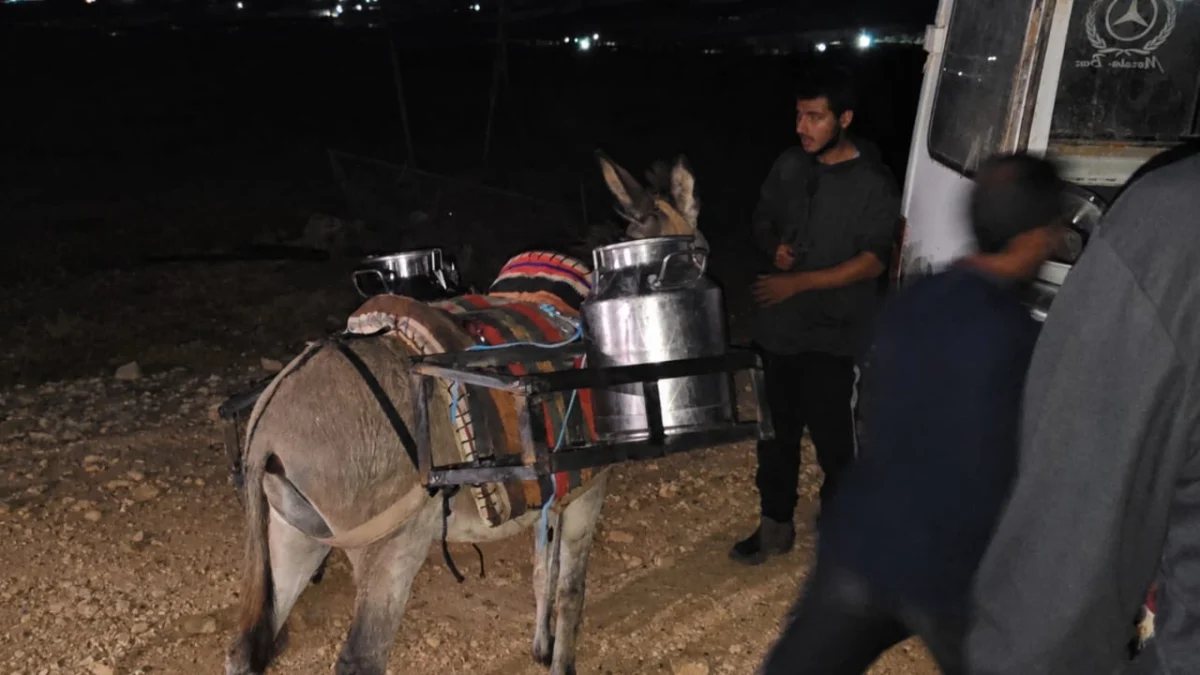
The vulnerable Bedouin herding community of Ras al-Ahmar in the occupied West Bank Jordan Valley is currently enduring a comprehensive, multi-week military siege that has cut off basic necessities, restricted human and animal movement, and brought livelihoods to the brink of collapse. For more than two weeks, Israeli forces have enforced severe access restrictions around the 300-person village, compounding an escalation of settler violence, land seizures, and infrastructure destruction that human rights monitors describe as part of a broader, systemic displacement campaign.
The 50 families living in Ras al-Ahmar, who have relied primarily on livestock and pastoralism since the 1970s, find themselves effectively isolated. Saeed Ayed, a local resident whose name has been changed for security reasons, paints a grim picture of daily survival under the current closure. With all vehicular entry points sealed, livestock are starving and suffering from parched conditions. The community, which manages a herd of some 15,000 animals, has been unable to secure water or essential fodder through standard supply chains.
To bypass military checkpoints and newly established barriers, residents have resorted to clandestine nocturnal operations. Under the cover of darkness, villagers transport scarce water supplies, milk, and fodder using pack donkeys, attempting to evade detection by patrolling Israeli soldiers and nearby settlers. Yet these desperate measures fall far short of community needs. Ayed reported that no water had successfully entered the village for three consecutive days after military forces sealed off secondary access paths. Without immediate intervention, local leaders warn of catastrophic losses to the livestock population, which forms the bedrock of the community’s economic survival.
Chronology of Escalation and Infrastructure Construction
The current blockade is not an isolated event but the acute phase of a long-term territorial strategy. The roots of the present crisis extend back several months, coinciding with the aggressive expansion of a military barrier project known officially by the Israeli military as "Crimson Thread."
Stretching approximately 20 kilometers (12 miles) through the northern Jordan Valley with a width of up to 50 meters (165 feet), the barrier project has steadily transformed the landscape since early 2025. The construction phase has involved extensive earth-moving operations, including the excavation of deep trenches, the raising of high dirt embankments, and the creation of dedicated military patrol roads.
According to data compiled by Kerem Navot, an organization monitoring Israeli land policies in the West Bank, the military barrier project has resulted in the seizure of nearly 115 hectares of land, approximately 85 percent of which is privately owned by Palestinians. The construction process has severely damaged critical local infrastructure, including agricultural wells, rural water networks, and greenhouses.
The timeline of the current crisis intensified sharply in mid-September, when access roads leading directly to Ras al-Ahmar were physically blocked. On Sunday, amid the ongoing closure, Israeli forces confiscated a tractor belonging to the joint village council of Ras al-Ahmar and Atuf, detaining its driver while he was attempting to deliver emergency animal fodder and water. Consequently, 51 schoolchildren from the village have been completely cut off from educational facilities for two weeks, unable to commute because vehicles cannot reach the area.
Humanitarian Impacts and Institutional Responses
The humanitarian toll of the siege extends far beyond economic disruption, directly threatening public health and safety. The most acute challenge is the severe restriction on emergency medical access, a vulnerability that poses life-threatening risks to elderly residents and vulnerable demographics. Furthermore, livestock health has deteriorated significantly; contagious diseases are spreading rapidly among newborn animals, and with veterinary teams barred from entering the area, preventable animal deaths are mounting.
Abdullah Bisharat, head of the Ras al-Ahmar and Atuf village council, emphasized the helplessness of the civilian population under the current conditions. Despite repeated appeals to international human rights organizations, no outside entity has successfully negotiated a breach of the military blockade. Bisharat noted that the hundreds of individuals affected are predominantly women, children, and the elderly.

The United Nations Office for the Coordination of Humanitarian Affairs (OCHA) has repeatedly identified West Bank Bedouin and herding communities as among the most vulnerable to forced displacement. OCHA statistics underscore a dramatic acceleration of displacement trends across the occupied territory. Since January 2023, at least 130 Palestinian communities have experienced full or partial displacement. Of those, 48 communities have been completely depopulated, with 12 communities displaced between January and August alone. Data for 2026 indicates that more than 2,500 Palestinians have been displaced due to a combination of settler violence and heightened access restrictions, contributing to a total of over 6,400 displaced individuals since late 2023.
The Broader Context: Settler Violence and Land Expropriation
Human rights defenders and Palestinian analysts view the blockade of Ras al-Ahmar as part of an orchestrated pressure campaign designed to compel indigenous herders to abandon their ancestral lands. Hassan Mleihat, chairman of the al-Baydar Organization for Defense of Bedouin Rights, stated that settler attacks have intensified significantly since February, driven by an explicit objective to seize control of strategic Jordan Valley territories.
According to Mleihat, the tactics employed against Ras al-Ahmar and neighboring hamlets include coordinated livestock theft, physical assaults on residents, vandalism of dwellings, and the systematic destruction of property. "We have faced livestock theft, attacks on our dwellings, beatings of residents, and vandalism of our homes," Saeed Ayed recounted. "This was happening almost daily, yet we refused to leave. Now, they are completely besieging us to force us out."
Mleihat contextualized the infrastructure projects currently altering the Jordan Valley landscape, arguing that the military road construction and land closures serve a dual geopolitical function. By framing these actions under security pretexts, authorities are effectively isolating Palestinian communities into fragmented geographical enclaves, shrinking their physical footprint to marginal pockets of land.
Socio-Political Implications and Strategic Shifts
As the Israeli political landscape prepares for upcoming national elections scheduled for October 27, analysts suggest that the developments on the ground in the West Bank are establishing a permanent new reality that will outlast any prospective change in government.
Adel Shadid, an expert on Israeli affairs, noted that the current operational environment reflects an unprecedented degree of military and administrative control over the West Bank. Rather than existing as a cohesive territory, Palestinian areas are increasingly reduced to small, isolated enclaves completely bounded by Israeli-controlled security, military, and economic infrastructures.
Shadid points to a broader ideological and perceptual shift within Israeli state policy regarding the West Bank. Settlements are increasingly normalized as an intrinsic part of the region’s permanent fabric rather than a temporary occupation. Concurrently, the foundational narrative regarding the territory has shifted away from viewing it as disputed land toward a framework where Jewish security and habitation are prioritized unconditionally.
Within this framework, the operational mandate of Israeli security forces in the West Bank has visibly evolved. Observers note that military and police units are deployed primarily to protect settler populations against perceived local threats, while largely ignoring or facilitating aggressive acts committed by settlers against Palestinian communities and agricultural assets. Under this logic, even basic environmental features—such as agricultural trees—are occasionally classified as security liabilities, leading to their removal without administrative or legal hindrance.
Ultimately, analysts like Shadid argue that the systemic measures facing communities like Ras al-Ahmar—ranging from military blockades and barrier construction to unchecked settler expansion—are designed to be irreversible. By systematically dismantling the infrastructure of rural Palestinian life and imposing insurmountable daily hardships, these policies are actively reshaping the demographic and geographic future of the West Bank, ensuring that the effects of the current crisis will endure long after the immediate political cycle concludes.









