Jono Maryono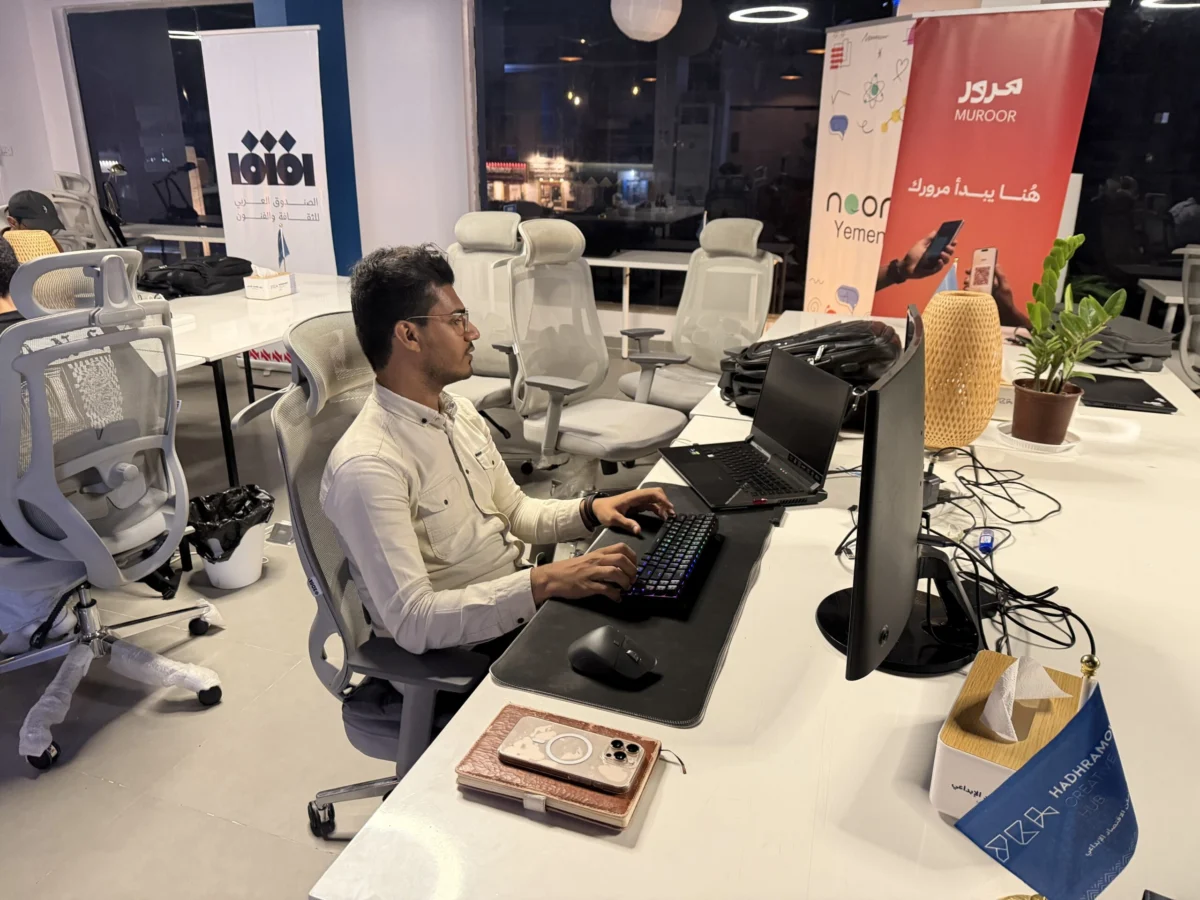
At the Mukalla Creative Hub, a modern oasis of productivity in Yemen’s coastal city, a palpable buzz of digital innovation fills the air. Men in casual attire focus intently on laptop screens, while others collaborate over desks, their faces illuminated by the glow of monitors. Nearby, women occupy ergonomic chairs, engaged in writing or browsing on their phones. The hub, designed with a sleek, cafe-style aesthetic, boasts comfortable seating arrangements, a welcoming counter at the entrance, and rows of computers, but its true allure lies beyond its stylish facade. What draws entrepreneurs, remote freelancers, and students to this space is not merely the comfortable ambiance or the reliable electricity, but a more fundamental, transformative element: fast, dependable Starlink satellite internet.
This critical infrastructure, powered by four Starlink devices, delivers speeds ranging from 100 to 150 Mbps, ensuring users remain constantly connected. For individuals like Hamzah Bakhdar, a digital freelancer who utilizes the hub, this consistent connectivity is a lifeline. In a nation ravaged by years of protracted conflict, which has decimated telecommunications infrastructure, eroded salaries, and isolated remote regions, Starlink is fostering a nascent but burgeoning digital workforce. Designers, developers, educators, and freelancers are now able to secure international clients, earning significantly more than the struggling Yemeni economy can offer.
The conflict in Yemen, which erupted in late 2014 between the Houthi rebels and the internationally recognized government, has had a devastating impact on the country’s infrastructure, including its telecommunications networks. This has been further exacerbated by the deliberate disruption of internet services. Buried land cables have been cut, plunging entire regions into digital darkness. The Houthi rebels, who control the capital Sanaa and significant portions of the country, exert considerable influence over Yemen’s major internet providers. This control has been wielded to block websites deemed sympathetic to their adversaries, including crucial platforms relied upon by tech professionals and remote workers. The arrival of Starlink satellite internet offers a vital alternative, enabling individuals to circumvent the Houthi grip on telecommunications and maintain online access, even in geographically remote areas.
Mohammed Helmi, a video editor and motion graphics designer, exemplifies the transformative power of this technology. He currently manages projects for clients in Yemen, Saudi Arabia, and the United States. Previously, intermittent internet connectivity and the depletion of mobile data allowances frequently led to dropped connections and missed deadlines, severely hampering his workflow. "In the past, when I downloaded files to my laptop, it would stop as soon as my data ran out," Helmi recounted to Al Jazeera at the cafe. "I had to buy another gigabyte and start the download all over again. Because of this, I often had to turn down projects." The reliable, high-speed internet provided by Starlink at the Mukalla Creative Hub has liberated him from these constraints, allowing him to meet international client expectations and secure more lucrative opportunities.

The Strategic Control of Internet Access
Starlink, a service provided by Elon Musk’s SpaceX, operates by connecting a ground-based dish to a constellation of low-Earth orbit satellites. While other satellite internet providers exist and new ones are entering the market, Starlink holds the distinction of being the only low-Earth orbit satellite internet service legally sanctioned for use in Yemen. This authorization was granted following an agreement between the internationally recognized government and SpaceX in September 2024.
However, the accessibility of Starlink remains a significant challenge for the vast majority of Yemenis. The initial kit cost of approximately $500 is prohibitively expensive in one of the world’s poorest nations, where over 80 percent of the population lives below the poverty line. Consequently, owning a Starlink dish remains an aspirational goal for many Yemenis desperate for reliable internet access.
University students, such as Mariam, a student at Hadramout University, find even purchasing internet vouchers from local resellers of Starlink access to be beyond their financial means, let alone acquiring a device outright. "People are using vouchers because they cannot afford Starlink devices, whose prices are very high," Mariam, who opted to be identified by her first name only, shared with Al Jazeera.
The Houthi authorities have responded with overt hostility to Starlink’s introduction into Yemen. They have initiated a campaign to dissuade the public from using the service, threatening legal repercussions for anyone found possessing the equipment. The group has publicly accused Starlink of acting as a "US espionage agent" and has characterized it as "a major threat to national security." Security analysts have voiced concerns that data transmitted over Starlink’s network could potentially be leveraged for "intelligence gathering and economic exploitation." Furthermore, there are international apprehensions regarding the concentration of satellite internet services and infrastructure within Starlink’s purview, particularly given Elon Musk’s increasing association with far-right movements in the United States and Europe.
Bridging the Gap: Connecting Yemen’s Remote Regions
Despite the Houthi’s threats and the substantial cost of the devices relative to Yemeni incomes, Starlink has gradually expanded its reach across the country, penetrating areas that have long been digitally isolated. Omer Banabelah, a mobile app developer, described how, prior to Starlink’s arrival, visiting his ancestral village in the countryside of Hadramout meant complete disconnection from the digital sphere. He was unable to make phone calls, let alone access the internet, leading to anxiety about clients potentially moving on due to unanswered messages. With Starlink now available in rural parts of the province, Banabelah no longer fears losing work due to his travel. "I can reply to their messages anytime, from anywhere," he stated. "Work that takes 10 minutes with Starlink could take an entire day without it."

Yemeni teachers, who have long grappled with meager and often delayed salaries, have also significantly benefited from the proliferation of Starlink. The service has empowered them to deliver uninterrupted online classes, thereby generating much-needed supplementary income. Raja al-Dubae, a school director in Taiz, informed Al Jazeera that her institution began offering online classes in 2023, utilizing the Yemeni curriculum, for Yemeni students residing in the United Arab Emirates, Saudi Arabia, Egypt, and China. Initially, the program served 50 students, with teachers connecting through local network infrastructure. However, during peak hours in the densely populated city, internet traffic would surge, causing connections to collapse and forcing teachers to abandon classes mid-session.
"Teachers were often disconnected from their students, and by the time the internet stabilised, the next class had already begun, leaving them frustrated and unable to finish their lessons," al-Dubae recounted. She admitted to initially dismissing her nephew’s suggestion to purchase Starlink due to the significant upfront investment. However, she now expresses regret for the delay. Since the installation of the service, student enrollment has surged to over 200, revenue streams have expanded, and teachers have begun to receive more competitive additional pay. "With Starlink, the internet is very fast and reaches every corner of the school," she emphasized. "Teachers no longer disconnect from their students. I never imagined it would make such a difference. Videos load quickly, we no longer turn away new applicants, and our reputation for fast internet has spread."
For Yemenis who have experienced the benefits of Starlink’s high-speed internet, including enhanced earning potential and expanded business opportunities, the prospect of returning to the slow and unreliable service of local networks is deeply concerning. "Go back to the headache of local networks? Perish the thought. We hope the service will continue to improve," al-Dubae declared, dismissing the notion of reverting to previous internet providers. Helmi echoed this sentiment, stating, "If Starlink were cut off, I would be devastated and forced back into the local market, which cannot cover my expenses or living costs." He paused, a smile flickering across his face as he contemplated the hypothetical scenario. "I would need to take on three or four jobs just to match what I earn from a single project from abroad." The narrative of Starlink in Yemen is one of resilience, innovation, and the relentless pursuit of digital connectivity in the face of immense adversity.