Jono Maryono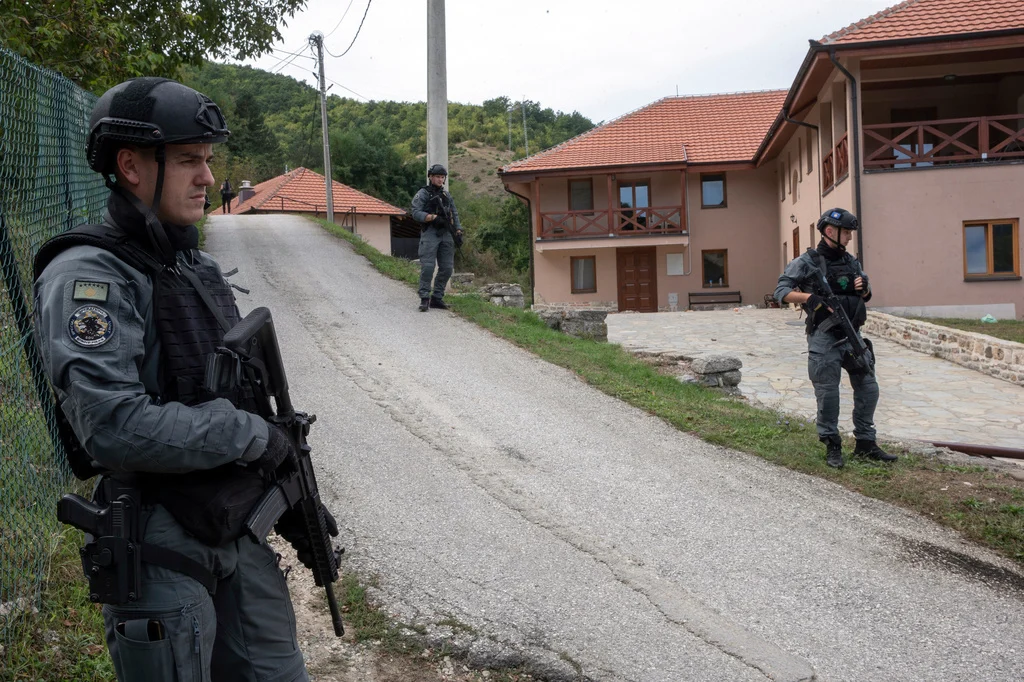
A court in Kosovo has convicted three ethnic Serbs on terrorism charges for their role in a deadly secession attempt near the country’s northern border in 2023, handing down life sentences to two defendants and a 30-year prison term to a third. The Basic Court in Pristina sentenced Blagoje Spasojevic and Vladimir Tolic to life in prison and Dusan Maksimovic to a 30-year jail term on Friday. The convictions stem from the armed incident in the village of Banjska, which resulted in a violent clash with Kosovo police that claimed the lives of one police officer and three of the attackers.
The Banjska Attack: A Violent Bid for Secession
The court’s verdict underscores the gravity of the September 24, 2023, incident, which significantly escalated ethnic tensions in Kosovo and drew international condemnation. According to the prosecution and the court’s findings, the perpetrators, armed with heavy weaponry, meticulously planned and executed an operation aimed at destabilizing Kosovo and potentially annexing its northern, predominantly Serb-inhabited region, to Serbia. Judge Ngadhnjim Arrni articulated the court’s rationale, stating, "Through this well-organised plan, and through the use of violence with heavy weaponry, they attempted to cut the northern part of Kosovo, namely the municipalities inhabited predominantly by Serbs, and to attach this part of the territory to Serbia."
The attack began when a convoy of armed individuals, reportedly numbering around 30, blocked a bridge on the road leading to Banjska Monastery. They subsequently engaged Kosovo police forces, initiating a prolonged shootout that lasted for hours. The casualties included police officer Afrim Bunjaku, who was killed in the initial confrontation, and three of the assailants who were also killed during the exchange of fire. Several other individuals were apprehended by Kosovo authorities.
Defendants’ Pleas and Court’s Findings
During the trial, the defendants maintained their innocence regarding direct involvement in killings. Blagoje Spasojevic, one of the convicted men, told the court, "I am not a terrorist. This (incident) was my biggest mistake in life… but I did not kill anyone." His statement highlights the complex narratives surrounding the event, with defendants potentially distancing themselves from the violence while acknowledging their participation in the broader operation.
The court’s sentencing reflects its assessment of the defendants’ involvement in a coordinated terrorist act aimed at undermining Kosovo’s territorial integrity. The evidence presented likely detailed the logistical preparations, weaponry, and the strategic objectives of the group. The severity of the sentences – life imprisonment for Spasojevic and Tolic, and a substantial 30-year term for Maksimovic – signals the judicial system’s strong stance against such acts of violence and separatism.
Milan Radoicic: The Mastermind?
A key figure identified in connection with the Banjska attack is Kosovo Serb businessman and politician Milan Radoicic. Radoicic, who resides in Serbia and maintains close ties to Serbia’s ruling populist party and President Aleksandar Vucic, publicly admitted to leading and organizing the assault after his identity was confirmed by Kosovo security officials through drone footage. This admission placed a significant focus on Serbia’s alleged role and Radoicic’s influence within the Serb community in Kosovo.
Radoicic is among a larger group of 45 individuals initially charged in connection with the armed incident, which stands as the most significant violent episode in Kosovo since its declaration of independence from Serbia in 2008. The trial that concluded on Friday involved only those three defendants who were in custody, indicating that the legal proceedings for others charged are either ongoing or have yet to commence.
Kosovo-Serbia Accusations and Denials
The Banjska attack immediately triggered a strong reaction from Kosovo, which accused Serbia of orchestrating the violence. Kosovo’s government has consistently pointed to evidence suggesting state backing for the attackers, citing the sophistication of the operation and the weaponry employed. However, Serbia, which lost control over Kosovo after NATO bombing in 1999 and does not recognize Pristina’s institutions, has vehemently denied these allegations. Belgrade maintains that the men acted independently, a narrative that Kosovo and its international allies largely reject.
This ongoing dispute over responsibility and state involvement remains a central point of contention in the broader Kosovo-Serbia dialogue, mediated by the European Union. The Banjska incident has further complicated efforts to normalize relations between the two entities, increasing mistrust and raising the stakes for regional stability.
The North of Kosovo: A Hotbed of Tensions
The situation in northern Kosovo, where approximately 50,000 Serbs reside, has historically been a focal point of ethnic division and political instability. This community largely rejects Pristina’s institutions, viewing Belgrade as their legitimate capital and governmental authority. The region has witnessed recurrent clashes between Kosovo police and ethnic Serbs, as well as occasional confrontations with international peacekeepers.
The 1998-99 war in Kosovo, which resulted in over 10,000 fatalities, was a direct consequence of the rebellion launched by ethnic Albanian separatists against Serbian rule. The legacy of this conflict continues to shape the political landscape and the deeply entrenched divisions between the ethnic Albanian majority and the Serb minority. The Banjska attack, therefore, did not occur in a vacuum but rather within a context of long-standing grievances and unresolved issues stemming from the war and Kosovo’s subsequent declaration of independence.
Broader Implications and International Reactions
The Banjska attack and the subsequent court ruling have significant implications for regional security and the ongoing efforts to achieve a comprehensive normalization of relations between Kosovo and Serbia. The verdicts serve as a strong assertion of Kosovo’s sovereignty and its determination to prosecute those involved in acts deemed to be terrorism.
Internationally, the incident prompted calls for restraint from both sides and for a thorough investigation. The European Union, the United States, and other key international actors have emphasized the need for accountability and for a de-escalation of tensions. However, the divergent narratives presented by Kosovo and Serbia, coupled with the deeply rooted historical animosities, present a formidable challenge to achieving lasting peace and stability in the Western Balkans.
The trial of Spasojevic, Tolic, and Maksimovic represents a crucial step in Kosovo’s judicial process concerning the Banjska attack. While these convictions address the immediate perpetrators and organizers within Kosovo’s jurisdiction, the broader question of Serbia’s alleged involvement and the role of figures like Milan Radoicic will likely continue to be a subject of intense political scrutiny and international diplomatic engagement. The sentences passed are a clear message from Kosovo’s judiciary regarding the boundaries of acceptable political action and the severe consequences of attempting to destabilize the country through violent means. The long-term impact of this verdict will also be measured by its effect on deterring future incidents and fostering a more stable environment in the ethnically divided north of Kosovo.