Layla Zulfa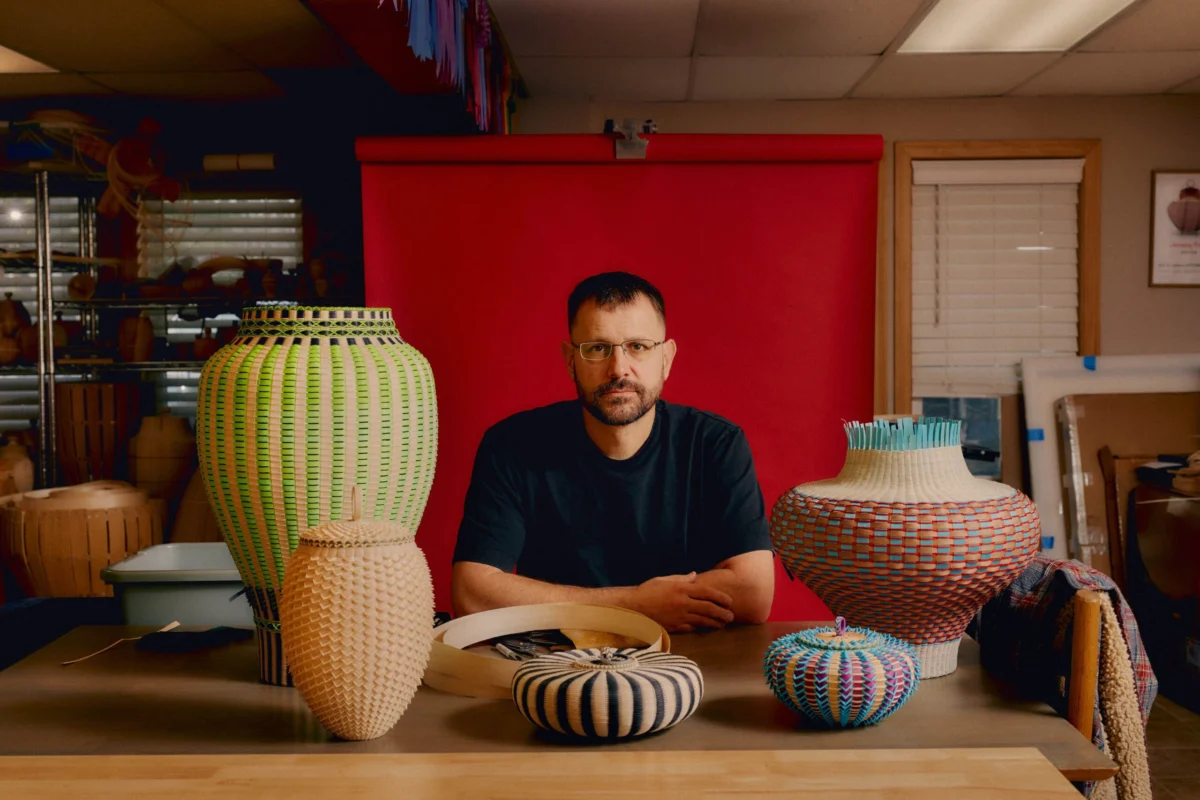
In the rural town of Eddington, Maine, where the population hovers just above 2,200, Jeremy Frey sits in his studio, meticulously transforming the raw materials of the North American wilderness into world-class fine art. As he prepares for his landmark solo exhibition at the Karma gallery in New York City, the rhythm of his work reflects a profound intersection of ancient heritage and modern innovation. Frey, a member of the Passamaquoddy Tribe and a 2025 MacArthur Fellow, is currently finalizing a collection of approximately 15 pieces that challenge the traditional boundaries of basketry. Among these is a monumental vessel standing nearly 24 inches tall, a project requiring more than a month of intensive manual labor. His process, which involves the use of tweezers to manipulate jet-black dyed ash wood over vibrant lime-green strips, serves as a bridge between the seventh-generation traditions of his ancestors and the high-stakes world of Manhattan’s contemporary art scene.
The Convergence of Tradition and Modernity
Jeremy Frey’s rise to prominence within the global art community is rooted in his identity as a Wabanaki person. The Wabanaki Confederacy, which includes the Passamaquoddy, Penobscot, Maliseet, Micmac, and Abenaki tribes, has practiced the art of ash and sweetgrass basketry for millennia. However, Frey’s work is distinguished by a refusal to remain tethered solely to the past. While he utilizes the same materials as his predecessors—primarily the brown ash tree (Fraxinus nigra)—his application of color, complexity of weave, and structural geometry elevate the medium into the realm of abstract sculpture.

The upcoming exhibition at Karma gallery signifies a pivotal moment for Frey. By presenting his work in a space known for showcasing avant-garde and contemporary masters, Frey is effectively dismantling the "craft" label that has historically marginalized Indigenous artisans. His pieces, which often feature fluctuating dimensions and "vision-bending" patterns reminiscent of Op Art pioneers like Victor Vasarely and Bridget Riley, function as optical illusions. The intricate "point weaves" create a sense of movement, making the static wooden vessels appear to pulse or vibrate when viewed from different angles.
A Chronology of Wabanaki Basketry and Frey’s Career
The evolution of Wabanaki basketry can be categorized into three distinct eras, each defined by the economic and social conditions of the time. Understanding this timeline is essential to appreciating Frey’s specific contributions to the field.
- The Utilitarian Era (Pre-Contact to 19th Century): Historically, Wabanaki baskets were rugged, functional tools designed for heavy labor. These included pack baskets for carrying supplies, fish traps, and storage containers. They were built for durability rather than aesthetic flourish, using thick strips of ash.
- The "Fancy Basket" Era (Mid-19th Century to Late 20th Century): As European settlers established resort communities along the Maine coast, Wabanaki weavers adapted their skills to meet the demands of the burgeoning tourism industry. This period saw the rise of "fancy baskets"—smaller, more decorative items like sewing kits, glove boxes, and wall pockets. While these were artistic, they were often sold for minimal prices at local markets, and the weavers remained largely anonymous to the broader art world.
- The Fine Art Era (Late 20th Century to Present): Led by innovators like Frey and his mentor, the late Sylvia Gabriel, basketry began to be recognized as a formal art medium. This era is characterized by signed works, museum acquisitions, and a focus on technical virtuosity.
Frey’s personal timeline mirrors this cultural shift. Raised on the Passamaquoddy Indian Township Reservation, he initially explored his creativity through drawing, painting, and toy-making. It was not until his young adulthood, after returning to the reservation following a period of personal transition, that he began learning the craft from his mother. Under the guidance of Sylvia Gabriel, a revered elder known for her complex point weaves, Frey discovered a passion for the physical and mental rigors of weaving. He soon sought out his uncle to learn the grueling process of harvesting and processing ash, a foundational skill that allows him total control over his medium from forest to finished product.

Technical Mastery and Material Innovation
The creation of a Jeremy Frey basket is a feat of engineering as much as artistry. The process begins in the Maine woods, where Frey selects specific ash trees. The harvesting involves cutting the timber, hauling it to the studio, and hand-pounding the logs with the back of an axe to separate the growth rings into thin, flexible strips. These strips are then sliced into various widths, sometimes as thin as a thread, and dyed to create the high-contrast palettes that have become his trademark.
While traditional baskets rely heavily on ash and sweetgrass, Frey incorporates a diverse array of materials to enhance texture and visual depth:
- Cedar and Birch Bark: Used for structural integrity and earthy contrast.
- Spruce Root: Often used for binding and intricate lashing.
- Porcupine Quills: Utilized for decorative embellishments on lids and bases.
- Copper and Bronze: His most recent innovations, which represent a shift toward permanence and scale.
In his current work for the Karma show, Frey is experimenting with bronze casting. By translating the delicate, woven textures of ash into bronze, he is creating sculptures that can exist outdoors and be scaled to architectural proportions. This transition addresses both the physical limitations of wood and the conceptual desire to "immortalize" the forms he creates.

Environmental Context and the Emerald Ash Borer Crisis
The urgency underlying Frey’s current practice is driven by a looming ecological catastrophe. The emerald ash borer (EAB), an invasive wood-boring beetle from Asia, has decimated ash populations across North America since its discovery in Michigan in 2002. The beetle arrived in Maine in 2018, posing an existential threat to the brown ash tree, which is the lifeblood of Wabanaki basketry.
Data from the Maine Department of Agriculture, Conservation, and Forestry indicates that the EAB is now present in multiple counties, with the potential to kill 99% of the state’s ash trees over the coming decades. For Frey, every tree he harvests is a race against time. "Every tree I take is immortalized," he notes, acknowledging that the very material that defines his culture is on the brink of disappearance.
The loss of the ash tree is not merely an economic or artistic concern; it is a spiritual one. According to Passamaquoddy legend, the cultural hero Glooskap created the first people by shooting an arrow into a brown ash tree, from which the Wabanaki emerged. The potential extinction of the tree challenges the continuity of the culture itself. In response, Frey has begun weaving with copper strips—a material that mimics the flexibility of ash but offers a "future-proof" alternative should the natural resource become unavailable.

Market Impact and Institutional Recognition
The transition of Frey’s work from reservation markets to institutions like the Metropolitan Museum of Art (The Met) and the Smithsonian American Art Museum has significant implications for the valuation of Indigenous art. Historically, Native American "crafts" were relegated to ethnographic collections rather than fine art galleries. Frey’s success, bolstered by the $800,000 "Genius Grant" from the MacArthur Foundation, has helped correct this imbalance.
The MacArthur Fellowship is awarded to individuals who show "exceptional creativity" and "promise for important future advances." In Frey’s case, the foundation highlighted his ability to "revitalize and subvert" traditional forms. This recognition has a "halo effect" on the entire Wabanaki weaving community, driving up market prices and encouraging a new generation of weavers to view the craft as a viable and prestigious career path.
Analysis of Broader Implications
Jeremy Frey’s career serves as a case study in the resilience of Indigenous culture in the face of environmental and colonial pressures. His work at Karma gallery is more than an art show; it is a statement on sovereignty and the right of Indigenous artists to define their own trajectories.

By incorporating non-traditional materials like bronze and copper, Frey is not abandoning his heritage but is instead ensuring its survival. If the ash trees vanish, the knowledge of the weave—the geometry, the tension, and the storytelling—must reside in other materials. This adaptability has always been a hallmark of Wabanaki culture.
Furthermore, Frey’s presence in the New York art market challenges the "static" view of Indigenous art. Collectors and curators are increasingly recognizing that "traditional" does not mean "unchanging." Frey’s ability to draw from seven generations of knowledge while simultaneously engaging with contemporary aesthetic movements like Op Art and Minimalism proves that Indigenous art is a living, breathing, and evolving force.
As the doors open at Karma, the art world will witness the culmination of decades of labor, centuries of tradition, and a forward-looking vision that refuses to be eclipsed by ecological hardship. Jeremy Frey’s baskets are no longer just containers; they are vessels for a culture’s history and a testament to an artist’s refusal to let that history fade. Through his hands, the humble ash tree is transformed into an enduring legacy, captured in wood, copper, and bronze for generations to come.